







Question: Please, answer all the 4 following questions: 1. Using the definition of E, show that E in equation (2) is equivalent to E in equation
Please, answer all the 4 following questions:
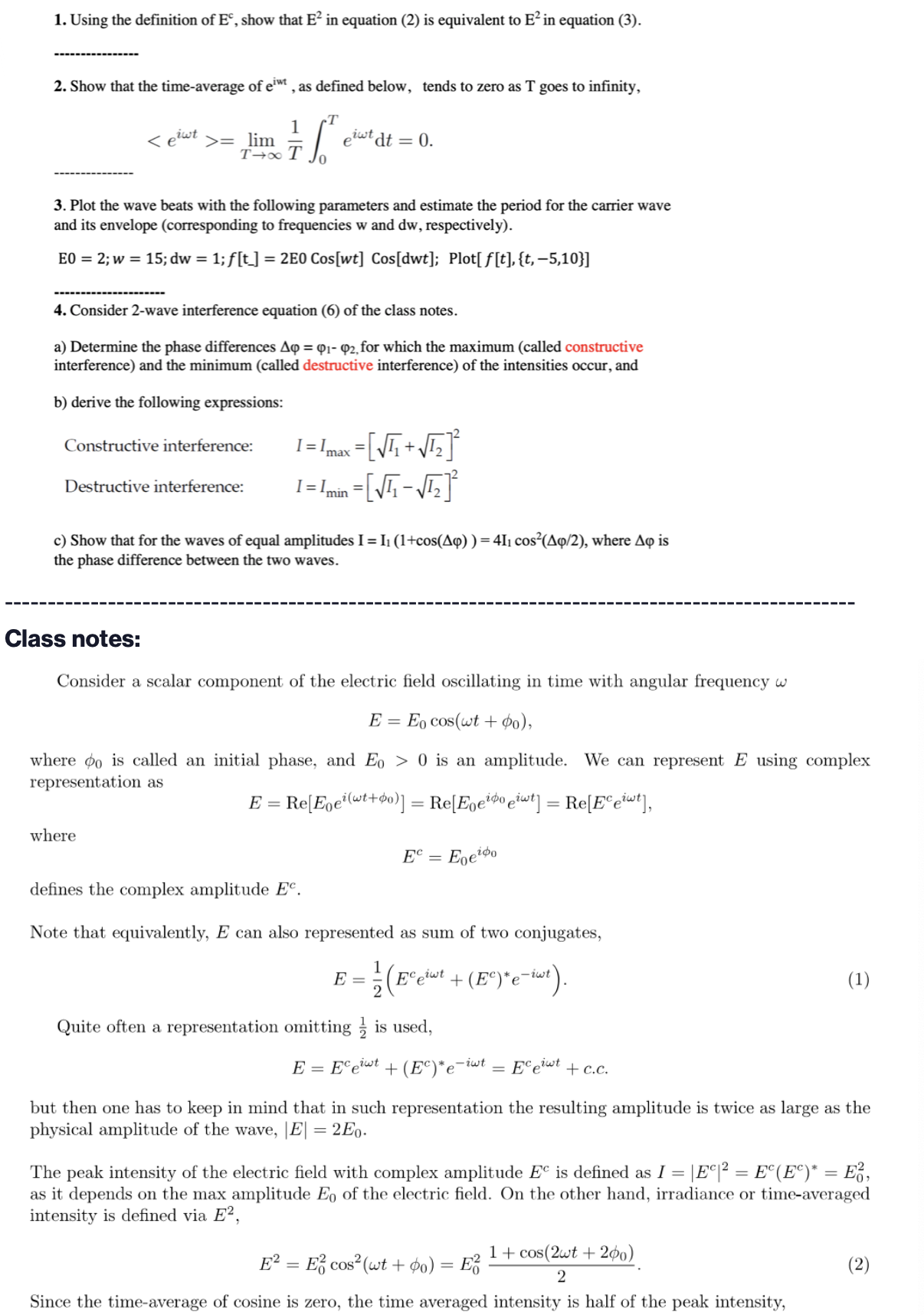
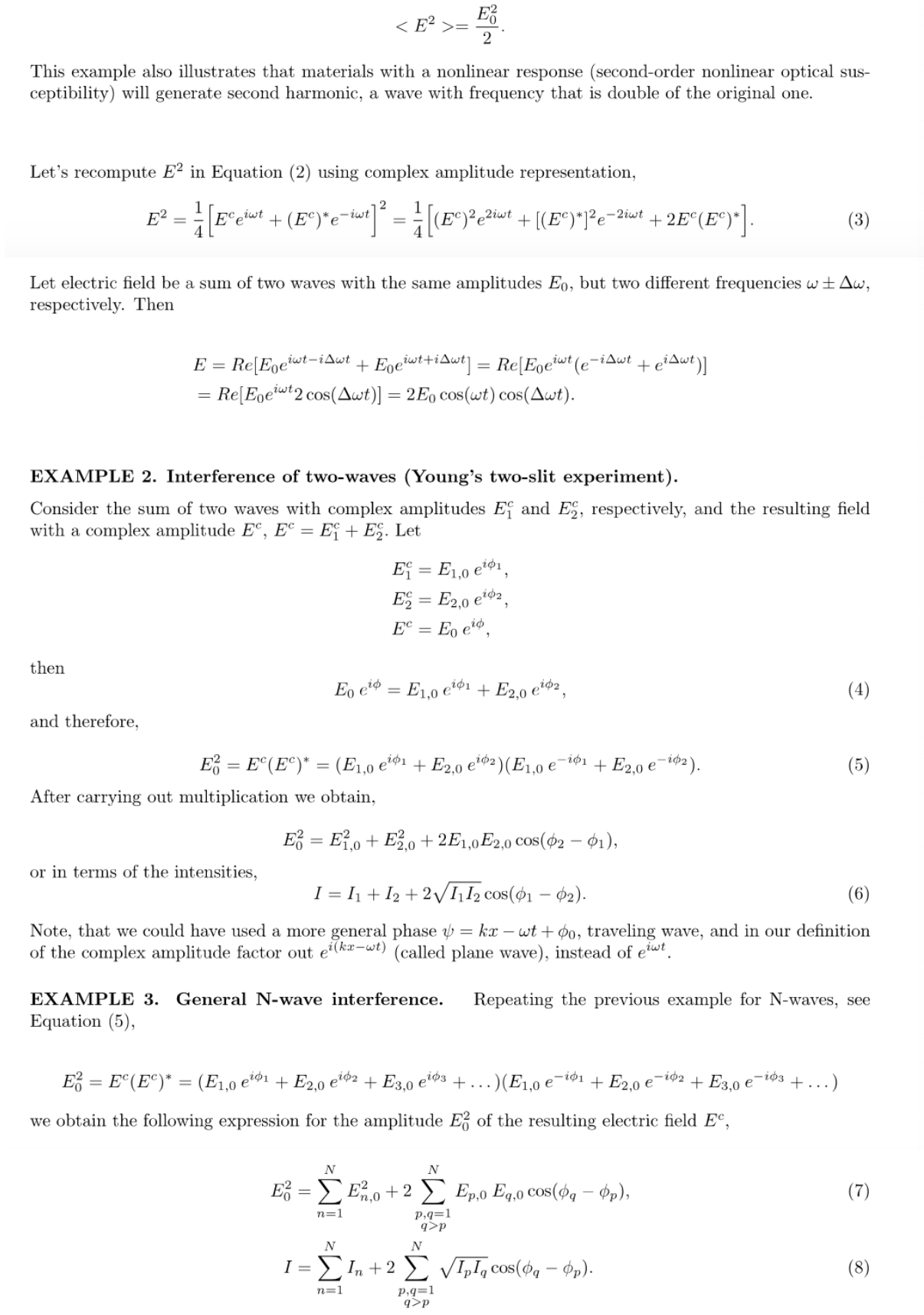
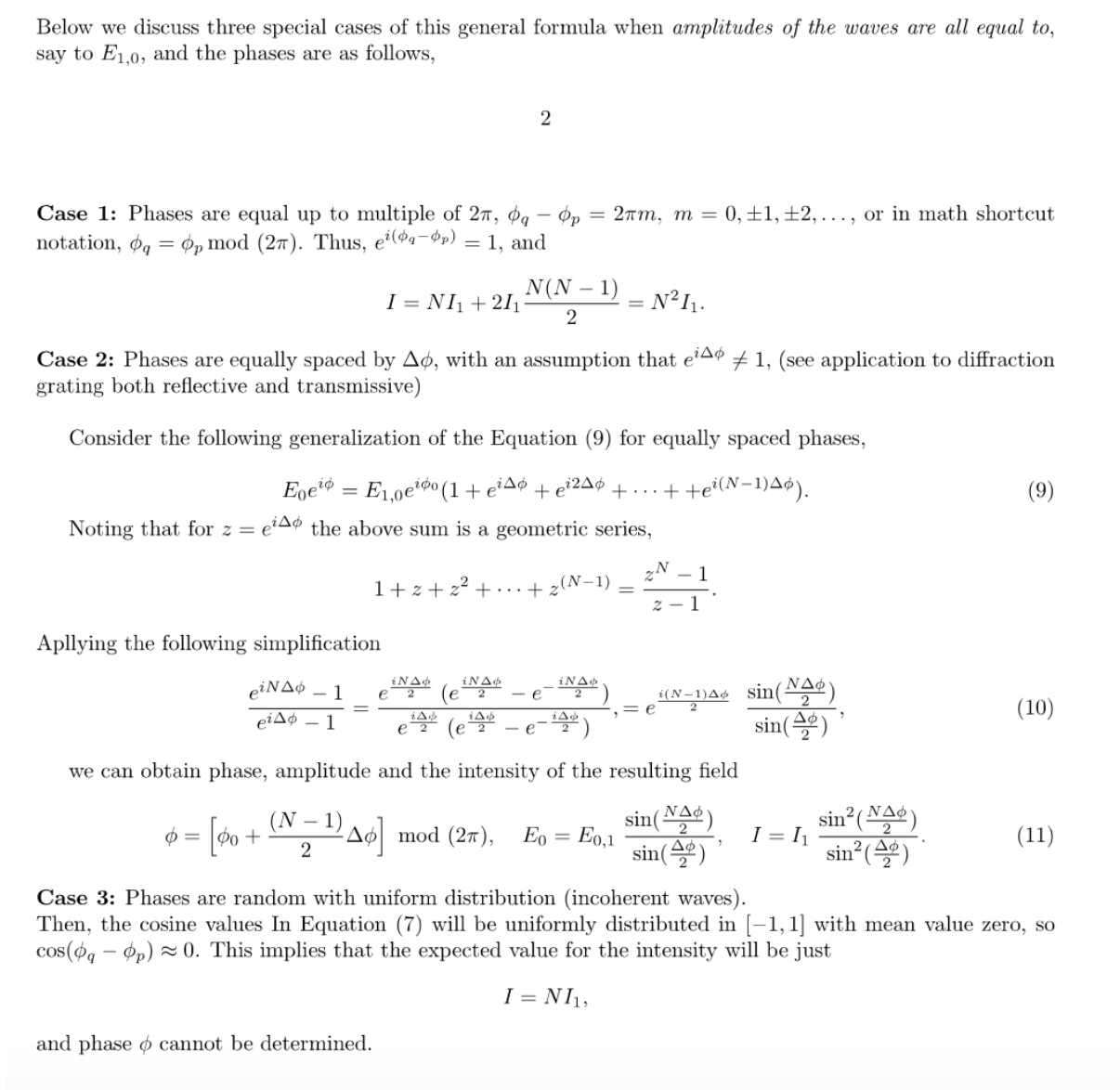
1. Using the definition of E, show that E in equation (2) is equivalent to E in equation (3). 2. Show that the time-average of e" , as defined below, tends to zero as T goes to infinity, = lim 3. Plot the wave beats with the following parameters and estimate the period for the carrier wave and its envelope (corresponding to frequencies w and dw, respectively). EO = 2; w = 15; dw = 1; f[t_] = 250 Cos[wt] Cos[dwt]; Plot[ f [t], {t, -5,10)] 4. Consider 2-wave interference equation (6) of the class notes. a) Determine the phase differences Ap = Q1- 02, for which the maximum (called constructive interference) and the minimum (called destructive interference) of the intensities occur, and b) derive the following expressions: Constructive interference: I = Imax = [VI + 12] Destructive interference: 1 = 1min =[VG - V12] c) Show that for the waves of equal amplitudes I = I1 (1+cos(Aq) ) = 411 cos?(AQ/2), where Ap is the phase difference between the two waves. Class notes: Consider a scalar component of the electric field oscillating in time with angular frequency w E = Eo cos(wt + do), where do is called an initial phase, and Eo > 0 is an amplitude. We can represent E using complex representation as E = Re[Foei (wt+40)] = Re[Foedo eiwt] = Re[Eceiwt], where EC = Foedo defines the complex amplitude Ec. Note that equivalently, E can also represented as sum of two conjugates, E = (Ecent + ( EC)+ e-int ). (1) Quite often a representation omitting = is used, E = Eceint + ( E ).e -int = Eceint + c.c. but then one has to keep in mind that in such representation the resulting amplitude is twice as large as the physical amplitude of the wave, | E| = 2Eo. The peak intensity of the electric field with complex amplitude Ec is defined as I = [ Ec|2 = E(EC)* = E;, as it depends on the max amplitude Eo of the electric field. On the other hand, irradiance or time-averaged intensity is defined via E2, E2 = E cos?(wt + po) = E2 1 + cos(2wt + 20) 2 (2) Since the time-average of cosine is zero, the time averaged intensity is half of the peak intensity,= Eo 2 This example also illustrates that materials with a nonlinear response (second-order nonlinear optical sus- ceptibility) will generate second harmonic, a wave with frequency that is double of the original one. Let's recompute E2 in Equation (2) using complex amplitude representation, E2 = _ JEcent + ( Egg-e- int ] ? = = [(Eggzeziwt + [ ( EC ) +Re - zit + 2EC (EC )*). (3) Let electric field be a sum of two waves with the same amplitudes Eo, but two different frequencies w + Aw, respectively. Then E = Re[ Foeiwt-ibut + Fociwttiwt] = RelEvent(e-iwt + eidwt) ] = Re[Foeiwt2 cos(Awt)] = 2E. cos(wt) cos( Awt). EXAMPLE 2. Interference of two-waves (Young's two-slit experiment). Consider the sum of two waves with complex amplitudes Ef and E2, respectively, and the resulting field with a complex amplitude Ec, Ec = Ef + ES. Let Ef = E1,0 el$1, ES = E2,0 el$2, EC = Eo eid then Eo eid = E10 eidl + Ez,0 eidz, (4) and therefore, E. = EC(EC)* = (E1,0 el$1 + E2,0 el$2)(E10 e-161 + Ez,0 e-162). (5) After carrying out multiplication we obtain, Ex = Exo + Ego + 2E1,0E2,0 cos($2 - $1), or in terms of the intensities, I = h +12+2VI1 12 cos($1 - $2). (6) Note, that we could have used a more general phase v = kx - wt + do, traveling wave, and in our definition of the complex amplitude factor out er(ka-wt) (called plane wave), instead of elwt. Equation (5), EXAMPLE 3. General N-wave interference. Repeating the previous example for N-waves, see E. = E(EC)* = (E1,0 elo1 + E2,0 el$2 + E3,0 eles + ... )( E1,0 e-191 + E2,0 e-192 + E3,0 e-ios +... ) we obtain the following expression for the amplitude E? of the resulting electric field Ec, E. = Eno + 2 > Ep.0 Ego cos($, - $p), (7) n=1 p,q=1 q>p I = >In+2 E VIplacos(da - $p). (8) n=1 P,q=1 1>pBelow we discuss three special cases of this general formula when amplitudes of the waves are all equal to, sag.r to Em, and the phases are as follows, Case 1: Phases are equal up to multiple of 211', 969. 412,, = 2am, m = 0, i1, i2, . . . , or in math shortcut notation, 45', = (pp mod (211'). Thus, 6\"\"pr = 1, and N(N 1) I=NI1+2I1 =N2I1. Case 2: Phases are equally spaced by Aq, with an assumption that em\"; 35 1, (see application to di'raction grating both reective and transmissive) Consider the following generalization of the Equation (9) for equally spaced phases, Noting that for z = 6\"" the above sum is a geometric series, 1+z+22+---+z(N'1)= Apllying the following simplication eiNAi' 1 ee (93$;lg e') iv215M. Sin(%'2) = E m = reg) '10) we can obtain phase, amplitude and the intensity of the resulting eld (N 1) smt%) 519%?) = + A mod 21:, :19 , I=I. 11 l 2 c'l'l ( ) E\" "'1 sin(%') 1 sin2(%%) ( ) Case 3: Phases are random with uniform distribution (incoherent waves) Then, the cosine values In Equation (7) will be uniformly distributed in [1, 1] with mean value zero, so cos(q 96p) a 0. This implies that the expected value for the intensity will he just I=er, and phase (3') cannot be determined
Step by Step Solution
There are 3 Steps involved in it

Get step-by-step solutions from verified subject matter experts
 Study Help