







Question: Please answer this question and i will give thumbs up. Thank you so much QUESTION: Hamid inherited $50,000.00 when his brother passed away. As he
Please answer this question and i will give thumbs up. Thank you so much

QUESTION:
Hamid inherited $50,000.00 when his brother passed away. As he and his wife Barbara were fairly ignorant about investments, they reached out to their life insurance agent, Mr. In the Know, who had previously sold them life insurance and RRSP policies for London Life Insurance. They met with Mr. In the Know in January 2021 and discussed various options. Ultimately, they decided to follow Mr. In the Knows advice and they invested the full $50,000.00 in ABC Capital Corporation for a 90 day term. They were told that they would receive an 8% return on their investment. When the ninety day term was over, they received a cheque from ABC Capital Corporation, which included the appropriate amount of interest, but the cheque bounced. To date, they have not received their initial deposit back or the interest owing on the deposit. They are now suing London Life, claiming that London Life is responsible for the funds owed to them.
Assumption:
You may make the assumption that Mr. In the Know has a similar relationship to the relationship that Mr. Demmers had with Manulife Financial.
Who will win this case?
PLEASE ANSWER ASAP PLEASE AND THANK YOU SO MUCH FOR YOUR HELP..
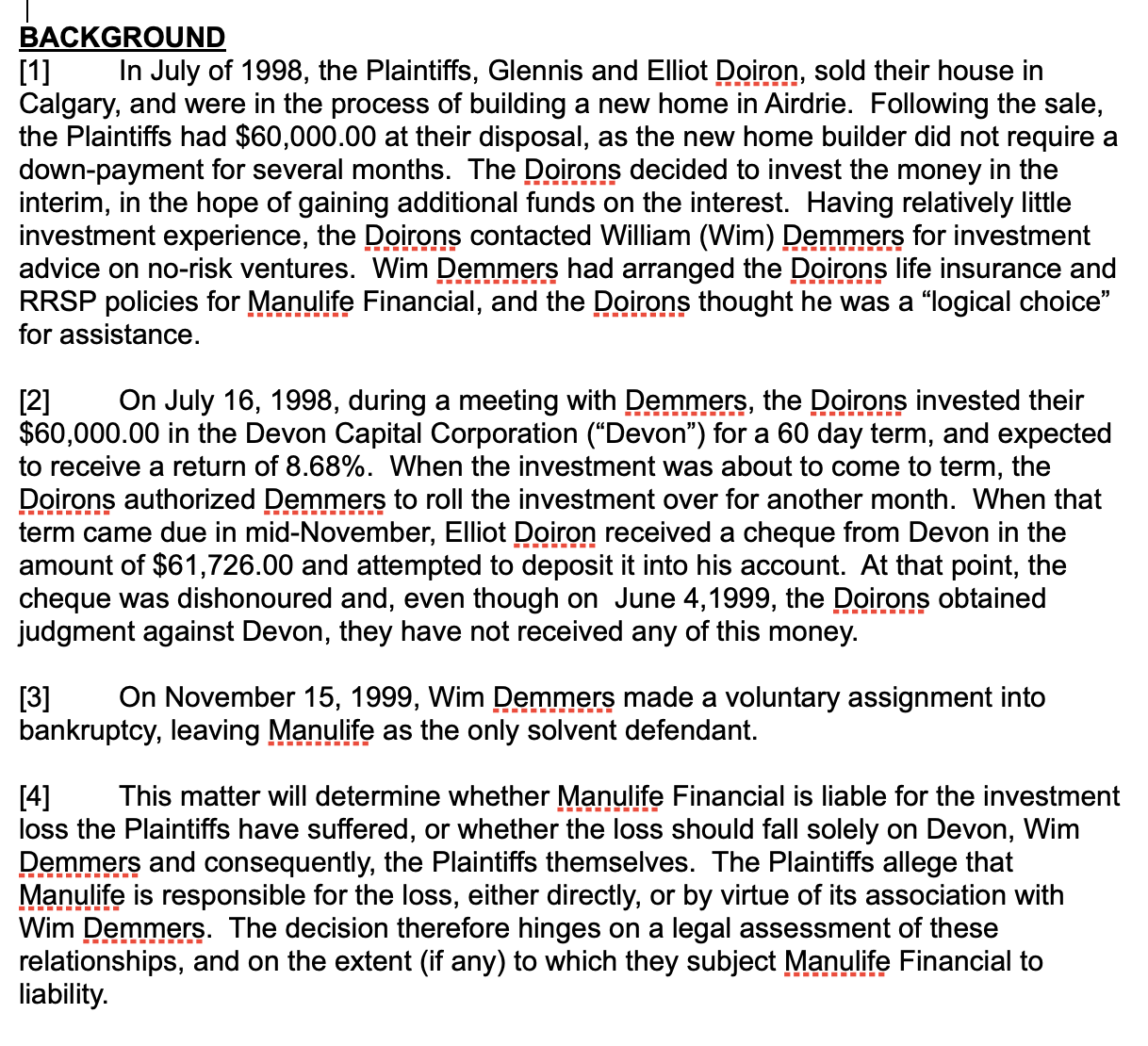
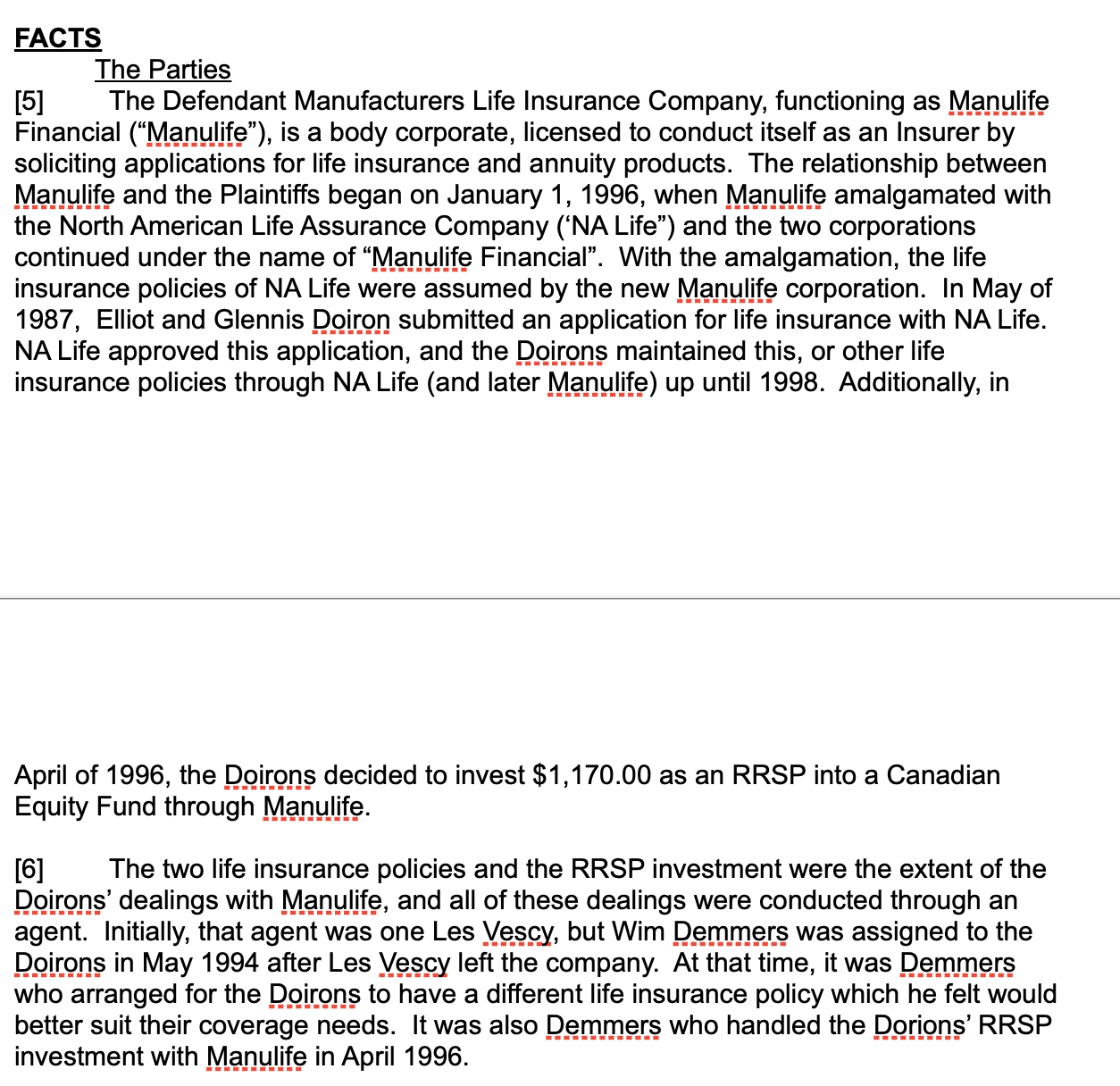
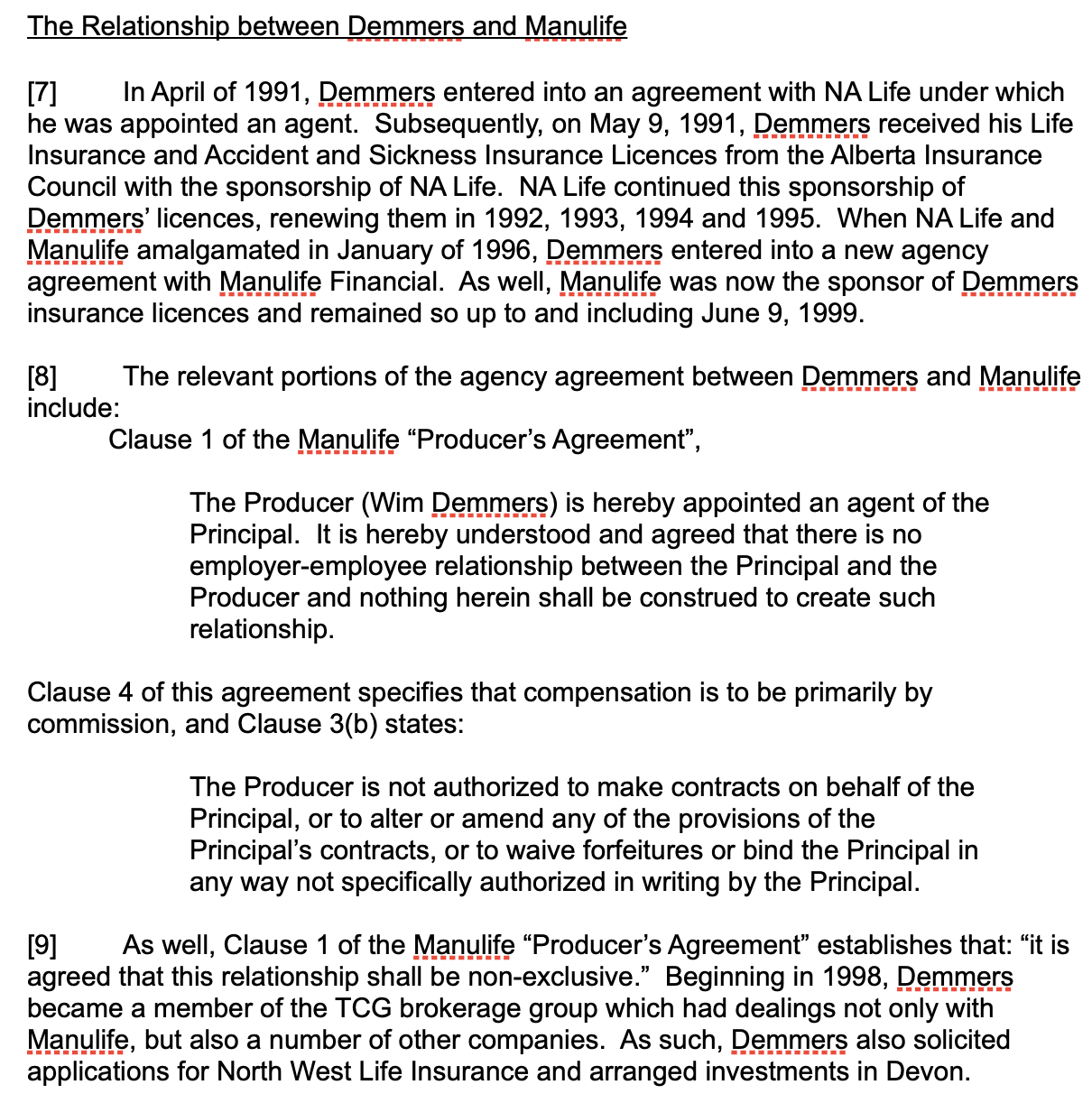
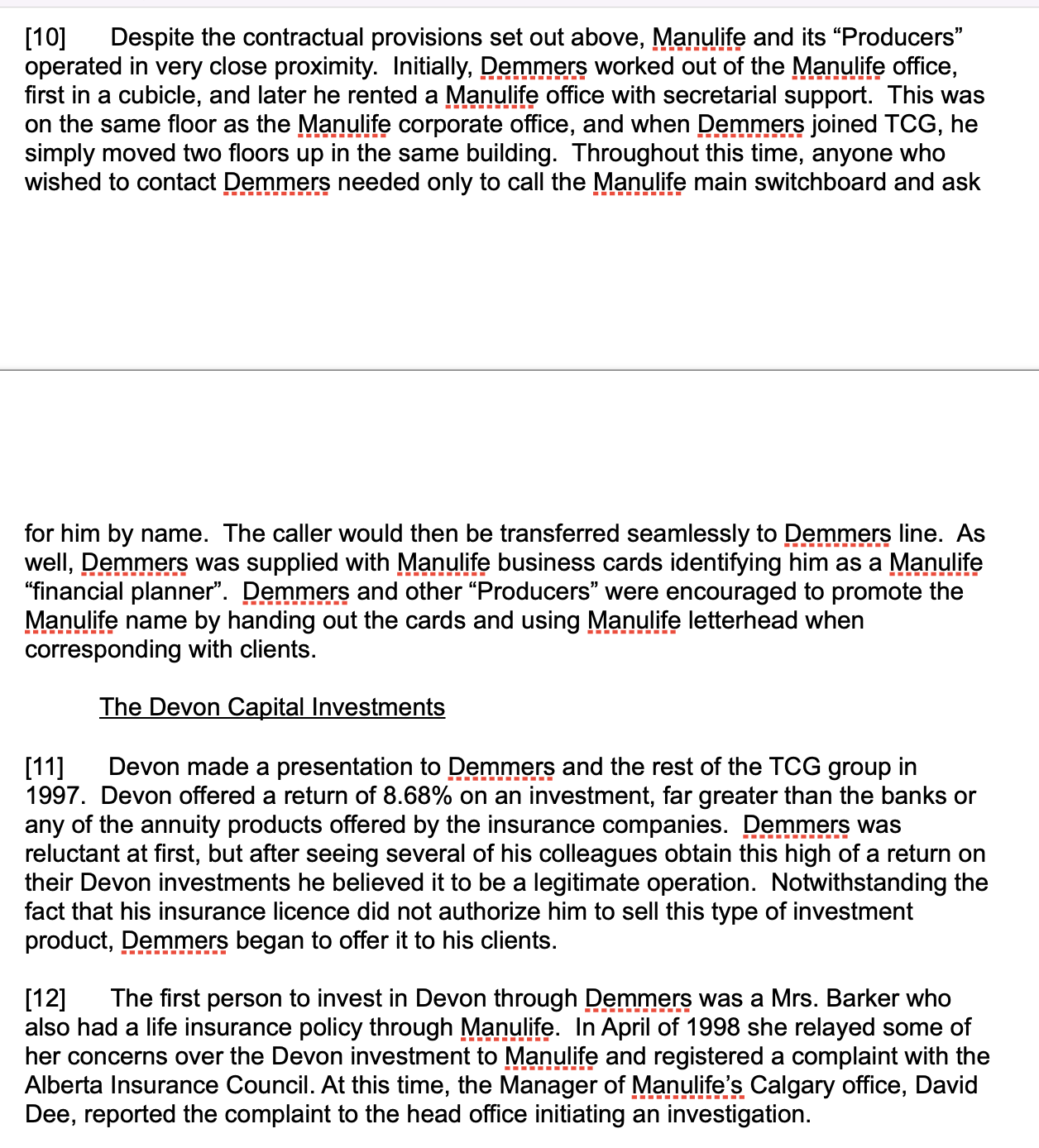
Calgary, and were in the process of building a new home in Airdrie. Following the sale, the Plaintiffs had $60,000.00 at their disposal, as the new home builder did not require a down-payment for several months. The Doirons decided to invest the money in the interim, in the hope of gaining additional funds on the interest. Having relatively little investment experience, the Doirons contacted William (Wim) Demmers for investment advice on no-risk ventures. Wim Demmers had arranged the Doirons life insurance and RRSP policies for Manulife Financial, and the Doirons thought he was a "logical choice" for assistance. [2] On July 16, 1998, during a meeting with Demmers, the Doirons invested their $60,000.00 in the Devon Capital Corporation ("Devon") for a 60 day term, and expected to receive a return of 8.68%. When the investment was about to come to term, the Doirons authorized Demmers to roll the investment over for another month. When that term came due in mid-November, Elliot Doiron received a cheque from Devon in the amount of $61,726.00 and attempted to deposit it into his account. At that point, the cheque was dishonoured and, even though on June 4,1999, the Doirons obtained judgment against Devon, they have not received any of this money. [3] On November 15, 1999, Wim Demmers made a voluntary assignment into bankruptcy, leaving Manulife as the only solvent defendant. [4] This matter will determine whether Manulife Financial is liable for the investment loss the Plaintiffs have suffered, or whether the loss should fall solely on Devon, Wim Demmers and consequently, the Plaintiffs themselves. The Plaintiffs allege that Manulife is responsible for the loss, either directly, or by virtue of its association with Wim Demmers. The decision therefore hinges on a legal assessment of these relationships, and on the extent (if any) to which they subject Manulife Financial to liability. FACTS The Parties [5] The Defendant Manufacturers Life Insurance Company, functioning as Manulife Financial ("Manulife"), is a body corporate, licensed to conduct itself as an Insurer by soliciting applications for life insurance and annuity products. The relationship between Manulife and the Plaintiffs began on January 1, 1996, when Manulife amalgamated with the North American Life Assurance Company ("NA Life") and the two corporations continued under the name of "Manulife Financial". With the amalgamation, the life insurance policies of NA Life were assumed by the new Manulife corporation. In May of 1987, Elliot and Glennis Doiron submitted an application for life insurance with NA Life. NA Life approved this application, and the Doirons maintained this, or other life insurance policies through NA Life (and later Manulife) up until 1998. Additionally, in April of 1996, the Doirons decided to invest $1,170.00 as an RRSP into a Canadian Equity Fund through Manulife. [6] The two life insurance policies and the RRSP investment were the extent of the Doirons' dealings with Manulife, and all of these dealings were conducted through an agent. Initially, that agent was one Les Vescy, but Wim Demmers was assigned to the Doirons in May 1994 after Les Vescy left the company. At that time, it was Demmers who arranged for the Doirons to have a different life insurance policy which he felt would better suit their coverage needs. It was also Demmers who handled the Dorions' RRSP investment with Manulife in April 1996. The Relationship between Demmers and Manulife [7] In April of 1991, Demmers entered into an agreement with NA Life under which he was appointed an agent. Subsequently, on May 9, 1991, Demmers received his Life Insurance and Accident and Sickness Insurance Licences from the Alberta Insurance Council with the sponsorship of NA Life. NA Life continued this sponsorship of Demmers' licences, renewing them in 1992, 1993, 1994 and 1995. When NA Life and Manulife amalgamated in January of 1996, Demmers entered into a new agency agreement with Manulife Financial. As well, Manulife was now the sponsor of Demmers insurance licences and remained so up to and including June 9, 1999. [8] The relevant portions of the agency agreement between Demmers and Manulife include: Clause 1 of the Manulife "Producer's Agreement", The Producer (Wim Demmers) is hereby appointed an agent of the Principal. It is hereby understood and agreed that there is no employer-employee relationship between the Principal and the Producer and nothing herein shall be construed to create such relationship. Clause 4 of this agreement specifies that compensation is to be primarily by commission, and Clause 3(b) states: The Producer is not authorized to make contracts on behalf of the Principal, or to alter or amend any of the provisions of the Principal's contracts, or to waive forfeitures or bind the Principal in any way not specifically authorized in writing by the Principal. [9] As well, Clause 1 of the Manulife "Producer's Agreement" establishes that: "it is agreed that this relationship shall be non-exclusive." Beginning in 1998, Demmers became a member of the TCG brokerage group which had dealings not only with Manulife, but also a number of other companies. As such, Demmers also solicited applications for North West Life Insurance and arranged investments in Devon. [10] Despite the contractual provisions set out above, Manulife and its "Producers" operated in very close proximity. Initially, Demmers worked out of the Manulife office, first in a cubicle, and later he rented a Manulife office with secretarial support. This was on the same floor as the Manulife corporate office, and when Demmers joined TCG, he simply moved two floors up in the same building. Throughout this time, anyone who wished to contact Demmers needed only to call the Manulife main switchboard and ask for him by name. The caller would then be transferred seamlessly to Demmers line. As well, Demmers was supplied with Manulife business cards identifying him as a Manulife "financial planner". Demmers and other "Producers" were encouraged to promote the Manulife name by handing out the cards and using Manulife letterhead when corresponding with clients. The Devon Capital Investments [11] Devon made a presentation to Demmers and the rest of the TCG group in 1997. Devon offered a return of 8.68% on an investment, far greater than the banks or any of the annuity products offered by the insurance companies. Demmers was reluctant at first, but after seeing several of his colleagues obtain this high of a return on their Devon investments he believed it to be a legitimate operation. Notwithstanding the fact that his insurance licence did not authorize him to sell this type of investment product, Demmers began to offer it to his clients. [12] The first person to invest in Devon through Demmers was a Mrs. Barker who also had a life insurance policy through Manulife. In April of 1998 she relayed some of her concerns over the Devon investment to Manulife and registered a complaint with the Alberta Insurance Council. At this time, the Manager of Manulife's Calgary office, David Dee, reported the complaint to the head office initiating an investigation. [13] Sometime after this initial complaint, Demmers convinced several other clients, including the Doirons, to invest in Devon. The Doirons, being unsophisticated investors, had phoned Demmers for advice on a low or no-risk investment that would earn them the highest return. Demmers began by offering the Doirons a number of Manulife products, which they rejected because the return was too small. Demmers then offered the Doirons the terms of the Devon investment and they jumped at the opportunity. The Doirons later met Demmers in the lobby of the Crossroads Hotel to draw up the cheque and sign the necessary papers committing themselves to the investment. By November of 1998 it was clear that Devon was apparently a sham, and none of the people who invested through Demmers received a full return of their investment. To date, the Doirons have received nothing at all. PRELIMINARY ISSUES Employer or Independent Contractor? [14] The relevant test for determining the status of an employment relationship was recently recounted in 671122 Ontario Ltd. v. Sagaz Industries Canada Inc. (2001), 2001 SCC 59 (CanLII), 204 D.L.R. (4th) 542, wherein the Supreme Court of Canada affirmed the traditional approach of determining whether the tortfeasor is an employee or an independent contractor. Major J., speaking for a unanimous Court, set out the guiding factors at para 47 : The central question is whether the person who has been engaged to perform the services is performing them as a person in business on his own account. In making this determination, the level of control the employer has over the worker's activities will always be a factor. However, other factors to consider include whether the worker provides his or her own equipment, whether the worker hires his or her own helpers, the degree of financial risk taken by the worker, the degree of responsibility for investment and management held by the worker, and the worker's opportunity for profit in the performance of his or her tasks. [15] As applied to the current case, it is apparent that, in relation to Manulife, Demmers was an independent contractor. Clause 1 of the Manulife "Producer's Agreement", although not in itself determinative, states the intention of the parties to create an independent contractual arrangement. Additionally, the contract specifies that the relationship is non-exclusive, and that payment is to be by commission. This is in fact how the relationship was carried out, as Demmers also sold similar insurance products for another company and his remuneration was on a commissioned basis. [16] Apart from the contractual terms, Demmers also paid for his own office and secretarial staff, and his financial success or failure was entirely dependent upon his own work. Manulife had no control over his day-to-day operations and, apart from providing Demmers with office stationary and taking calls for him through its main switchboard, it was in substance an employer-independent contractor relationship. Was Demmers an Agent of Manulife? [17] A basic definition of "agency" is provided in G.H.L. Fridman, The Law of Agency, 7th ed. (Toronto: Butterworths, 1996) at 11: "Agency" is the relationship that exists between two persons when one, called the agent, is considered in law to represent the other, called the principal, in such a way as to be able to affect the principal's legal position in respect of strangers to the relationship by the making of contracts or the disposition of property. [18] Using this definition, Demmers was not an agent of Manulife. Clause 3(b) of the "Producer's Agreement" specifically prohibited Demmers from entering Manulife into any contractual relationship. All Demmers could do under the agreement was solicit insurance applications, he could not actually approve them. As such, I find that Demmers was not an agent of Manulife, and had no actual authority to bind Manulife in any way. MAIN ISSUES [19] The main issues of this case are as follows: 1. Did Manulife Financial owe the Doirons a duty of care to supervise Demmers and, if so, did it breach that duty? 2. Did Manulife Financial owe the Doirons a fiduciary duty? 3. Is Manulife Financial vicariously liable for the negligent acts of Demmers as an independent contractor? 4. If Demmers lacked the actual authority to bind Manulife as guarantors of the investment, did Manulife create apparent or ostensible authority for Demmers to do so? ANALYSIS Direct Liability 1. Did Manulife Financial owe the Doirons a duty of care to supervise Demmers, and if so, did it breach that duty? [20] There is no question that a financial investment corporation has a duty to protect the investments of its clients from the improper acts of its employees or agents. This duty has been affirmed in numerous cases, including Penner v. Yorkton Continental Securities Inc. (1996), 1996 CanLII 19956 (AB KB), 183 A.R. 5 (Q.B.) and Druiven et. al. v. Warrington et. al. (1999), 1999 CanLII 2571 (ON CA), 118 O.A.C. 353 (Ont. Gen. Div.). It is entirely foreseeable that an agent or broker of an investment company may use a client's funds either negligently or fraudulently, resulting in economic harm to the plaintiff. As such, it is incumbent upon investment companies to have proper procedures in place to prevent, or at least minimize, these types of transgressions. Of course, this duty to sulpervise only extends to those activities with which the investment company is involved. That is, a company must only supervise those activities the employee or agent is conducting by virtue of its contractual relationship with its employer or principal. It would be unreasonable to extend this duty to supervise acts performed independent of this affiliation, as such a task would prove impossible. [21] Accordingly, I find that Manulife had a duty to supervise Demmers, but that this duty only extended to his Manulife related activities. As mentioned, Demmers was neither an employee nor an agent of Manulife. Therefore, Manulife only had a duty to ensure that the life insurance policies and annuities that Demmers solicited on its behalf were appropriate for the particular clients, and that is where the duty ended. There is nothing before me to indicate that, as the sponsor of Demmers' insurance licence, Manulife's duty should be extended in any way. To impose such a broad duty is unrealistic, as the independent nature of the relationship dictated that Manulife had very little control over Demmers' collateral investment projects - including that of Devon. [22] Further, I find that the actions of Mr. Ironside, upon hearing Mrs. Barker's complaint about Demmers, were sufficient, especially given the lack of involvement by Manulife in the affair. The AIC was already conducting an investigation, at the urging of Mrs. Barker, and Mr. Dee asked Manulife's head office to do the same. It would have been premature for Manulife to take action by either suspending Demmers' licence or terminating their contractual relationship before the details of these investigations were known. Once Manulife became aware of the full extent of Demmers' impropriety, it properly terminated its sponsorship of his licence. [23] Therefore I find that Manulife had no duty to supervise Demmers with respect to his non-Manulife dealings, and that it acted appropriately under the circumstances. 2. Did Manulife Financial owe the Doirons a fiduciary duty? [24] The relationship between an investor and a financial planner, as a professional advisory relationship, is one that the courts have consistently found gives rise to a fiduciary duty: Hodgkinson v. Simms et al., 1994 CanLII 70 (SCC), [1994] 3 S.C.R. 377 . Such a relationship is marked by the presence of loyalty, trust and confidence that the advisor will act in the best interests of the vulnerable party. This is especially so in cases where the investor is particularly unsophisticated or inexperienced and therefore, the power imbalance is that much greater. [25] There is no question that Demmers owed the Doirons a fiduciary duty to use the utmost care when advising them. The Doirons had very little experience with investing, and placed a great deal of trust and reliance on the advice they received from Demmers. They were in no position to be able to investigate the legitimacy of Devon and simply did as Demmers advised. For his part, Demmers failed to fulfil his fiduciary obligation by not adequately inquiring as to the legitimacy of the Devon investment. Even though he had some reservations, and he knew the Doirons wanted a no-risk venture, he still recommended that the Doirons invest in Devon. Further, at no time did he advise the Dorions that Devon was not a Manulife company. This was clearly inappropriate, and the Doirons' loss flowed directly from this mismanagement. [26] This fiduciary obligation with respect to the Doirons' $60,000.00 investment does not, however, extend to Manulife. Again, because Manulife had nothing to do with Demmers' investments in Devon, they had no opportunity nor duty to ensure that it was a safe and viable investment in light of the Doirons' circumstances. The only duty they owed the Doirons was to ensure that all Manulife investments and policies were suitable for their needs. [27] Accordingly, I find that Manulife did not owe the Doirons a fiduciary duty with respect to their loss. Vicarious Liability 3. Is Manulife Financial vicariously liable for for the negligent acts of Demmers? [28] As stated in the previous section, although Demmers himself is directly liable for the Doirons' loss, Manulife Financial is not. The question then becomes whether, by virtue of their relationship, Manulife can or should be held liable for Demmers' conduct? [29] A survey of the traditional common law position on this question would result in an emphatic "no". Historically, vicarious liability has only attached to: (1) employers, for acts committed by employees in the course of their employment; (2) employers for unauthorized acts of employees so connected with authorized acts that they may be regarded as modes of doing an authorized act (Salmond test); and (3) employers, for wrongs committed by independent contractors in performing their contractual duties (Fridman, supra at 304-5). [30] Using this theory, as the employer of an independent contractor, Manulife is only vicariously responsible for the wrongs Demmers committed while fulfilling the terms of the Manulife agreement contract. Although not prohibited from doing so, nowhere in this agreement was Demmers obligated or encouraged to recommend investments in anything other than Manulife products. In fact, he is not authorized to sell this type of investment at all. Investments in Devon are not within the four-corners of the Producer's Agreement and therefore, under traditional agency principles, Manulife is not vicariously liable for damage caused by them. [31] These traditional principles have recently been questioned by the two British Columbia Supreme Court decisions of Thiessen v. Mutual Life Assurance Co. of Canada, [2001] B.C.J. No. 1849 (S.C.) and Wilson v. Clarica Life Insurance Co., 2001 BCSC 1696 (CanLII), [2001] B.C.J. No. 2668 (S.C.). Building upon the majority decision by McLachlin J. (as she then was) in Bazley v. Curry, 1999 CanLII 692 (SCC), [1999] 2 S.C.R. 534, both cases found the insurance company defendant to be vicariously liable for the acts of an independent contractor acting outside the scope of his contractual duties. [32] In Bazley v. Curry, supra, McLachlin restated the law of vicarious liability and emphasized a principled approach where the traditional categorizations of employment relationships fail to resolve the issue. At p. 545 she advocates a two-stage approach whereby: First, a court should determine whether there are precedents which unambiguously determine on which side of the line between vicarious liability and no liability the case falls. If prior cases do not clearly suggest a solution, the next step is to determine whether vicarious liability should be imposed in light of the broader policy rationales behind strict liability. [33] With this approach, the Supreme Court did not intend to discard the entire system of classifying employment relationships. Rather, it sought to provide additional guidance when precedent fails to clearly determine the liability of an employer for the unauthorized acts of an employee using the Salmond test. [34] Nowhere in the Bazley decision does McLachlin J. suggest that the Court use the principled approach to widen the scope of liability for independent contractors. To the contrary, she specifically states at 554 that "effective compensation must also be fair, in the sense that it must seem just to place liability for the wrong on the employer." It is not "fair" or "just" to hold an employer liable for the tortious act of an independent contractor that is unrelated to the contract. If the act is performed outside the four corners of the contract, as it was here, the employer has played no part in placing the tortfeasor in such a position and has therefore not created the risk. [35] This interpretation of the Bazely decision is supported by the subsequent Supreme Court decision of Sagaz, supra, where a unanimous Court, including McLachlin C.J., refused to extend liability to the employer of an independent contractor for acts performed outside the terms of the contract. The policy justification for this refusal is at 554 : Vicarious liability is fair in principle because the hazards of the business should be borne by the business itself; thus, it does not make sense to anchor liability on an employer for acts of an independent contractor, someone who was in business on his or her own account. In addition, the employer does not have the same control over an independent contractor as an employee to reduce accidents and intentional wrongs by efficient organization and supervision. [36] Therefore, to hold the employer of an independent contractor responsible for non-contract related wrongs, as in Thiessen, supra and Wilson, supra, is, in my respectful view, an over-extension of vicarious liability doctrine. [37] The policy reasoning in Sagaz is particularly befitting of the current case, and provides a number of reasons why Manulife should not be held vicariously liable for Demmers' negligent investments. When making the Devon investments, Demmers was conducting business on his own account as Manulife stood to gain nothing from these transactions. Due to the non-exclusive nature of the contract, Demmers was free to engage in these activities (subject, of course, to the restrictions imposed by his insurance licence), and Manulife had no ability to monitor or control his actions in any way. The only supervisory ability it had was with respect to Demmers' Manulife related business. [38] Consequently, I find there is no basis for a claim that Manulife is vicariously liable for Demmers conduct. Liability Through Traditional Agency Principles 4. If Demmers lacked the actual authority to bind Manulife as guarantors of the investment, did Manulife create apparent or ostensible authority for Demmers to do so? [39] A principal is liable for the acts of an agent as long as the agent is acting within the scope of his or her (1) actual or (2) ostensible (apparent) authority: Fridman, supra at 315 . As previously stated, Demmers was not, in substance, an agent of Manulife. He had no actual authority to bind Manulife to insurance policies and he certainly had no authority to bind it as the guarantor of investments in Devon. The only question, therefore, is whether Manulife represented to the Doirons that Demmers did have such authority. [40] Professor Fridman, supra, encapsulates the doctrine of ostensible authority at p. 114 where he states: Ostensible authority is created by a representation by the principal to the third party that the agent has the relevant authority: and the representation, when acted upon by the third party, operates as an estoppel, precluding the principal from asserting that he is not bound. [41] To satisfy the doctrine, the plaintiff must prove the four requirements laid out in Freeman \& Lockyer v. Buckhurst Park Properties (Mangal) Ltd., [1964] 1 All E.R. 630 (C.A.) at 664 , namely: (1) That a representation that the agent had authority to enter on behalf of the company into a contract of the kind sought to be enforced was made to the contractor; (2) That such representation was made by a person or persons who had actual authority to manage the business of the company either generally or in respect of those matters to which the contract relates; (3) That the contractor was induced by such representation to enter into the contract, i.e., that he in fact relied on it; (4) That under its memorandum or articles of association the company was not deprived of the capacity either to enter into a contract of the kind sought to be enforced or to delegate authority to enter into a contract of that kind to the agent. [42] The representations must be made by the principal to the person who has relied upon them, and such representations may be either express or implied. Additionally, they must be such that a reasonable person would believe the agent had the requisite authority to make such an agreement on behalf of the principal. [43] I find that this kind of apparent authority existed in the present case. Even though Demmers had no actual authority to bind Manulife to his dealings with Devon, the Doirons had every reason to believe that he did. In the eyes of the Doirons, Demmers was not an independent broker, but an employee of Manulife. To the Doirons, they were one and the same. Therefore, when they decided to invest in Devon, they reasonably believed they were investing in a Manulife product. [44] The Doirons were not privy to the details of the relationship laid out in the "Producer's Agreement", and could make no distinction between Demmers and Manulife. The only knowledge they had of the relationship between Demmers and Manulife was what they were able to glean from their interactions with the two. The following factors were important in creating ostensible authority: Demmers provided them with a Manulife Financial business card identifying him as a "financial planner"; to contact Demmers, the Doirons would call the Manulife office and be transferred directly to his line; the Doirons had visited Demmers in his office while he was on the same floor as the Manulife office; Demmers' office displayed Manulife promotional materials, and his door had the Manulife logo prominently displayed; prior to the Devon investment, correspondence from Demmers was printed on Manulife letterhead; Manulife had assigned Demmers to the Doirons when Les Vescy left the company. [45] All of these factors lead the Doirons to believe that their investment in Devon was a Manulife investment, and that Demmers had the authority to bind Manulife to it. [46] Pursuant to the second criteria from Freeman \& Lockyer, supra, any representations creating ostensible authority must have been made by someone with actual authority to bind the principal. Meanwhile, all of the direct interactions that created the ostensible authority in the present case were between the Doirons and Demmers, who had no such actual authority. However, Manulife knew of this mode of conduct, and Demmers' practice of representing himself as a Manulife agent. In spite of this knowledge, Manulife stood idly by and permitted Demmers, and other producers, to create this impression. In fact, this practice was not only tolerated by Manulife - it was encouraged. [47] As part of its effort to promote the Manulife name, the company provided its agents or producers with business cards, stationery and other Manulife paraphernalia, and encouraged them to use it. Additionally, Manulife ran a co-op advertising programme where it ran advertisements in newspapers with the producer's picture and the Manulife logo. All of this was done in an effort to endorse the company and attract more clients. [48] Unfortunately, these types of marketing techniques also led the Doirons put their faith in Demmers by virtue of their belief that he was an employee of Manulife. On the strength of these representations, the Doirons sought out Demmers' advice and they trusted it when he suggested they invest in Devon. This reliance led directly to their loss. [49] I make this finding notwithstanding the fact that following the Devon investment, the Doirons received a letter of confirmation from Devon. From this letter, the Doirons should have been alerted to the non-involvement of Manulife in the venture, and if this made them uneasy they could have attempted to cash out. By this time, however, they were already committed, and whether or not they would have succeeded in having their money returned at this point is just speculation. The fact remains that at the time of investing, they relied on the impression that they were investing in a Manulife product. This is what put the Doiron's money at risk, and any subsequent measures they could have taken is mere conjecture. CONCLUSION [50] The "Producer's Agreements" put in place by Manulife, reflect Manulife's desire to insulate itself from liability for the acts of its salespeople. At the same time, however, Manulife actively marketed these "Producers" using the Manulife name and logo. In short, Manulife was attempting to gain all of the benefits that accrue from this representation while incurring none of the liability. In doing so, Manulife undoubtedly benefited from increased clientele, but it also subjected others - including the Doirons to risk. When the Doirons invested with Demmers, they were in large part relying upon Manulife's image and reputation. Now that they have suffered as a result of that reliance, Manulife should bear the burden of its business operations. DISPOSITION [51] In the result, Manulife is liable to the Plaintiffs for the amount of $60,000.00 plus interest pursuant to the terms of the Judgment Interest Act. R.S.A. 2000 c.J-1 from July 16, 1998. In addition, the Plaintiff is entitled to costs of this action under the appropriate column pursuant to the provisions of the consolidated Rules of Court
Step by Step Solution
There are 3 Steps involved in it

Get step-by-step solutions from verified subject matter experts
 Study Help