







Question: Please show me a Haskell Bipartite Graph Partitioning DFS based on this psuedocode and using only Data.list and making it a module Bipartite ( bipartite
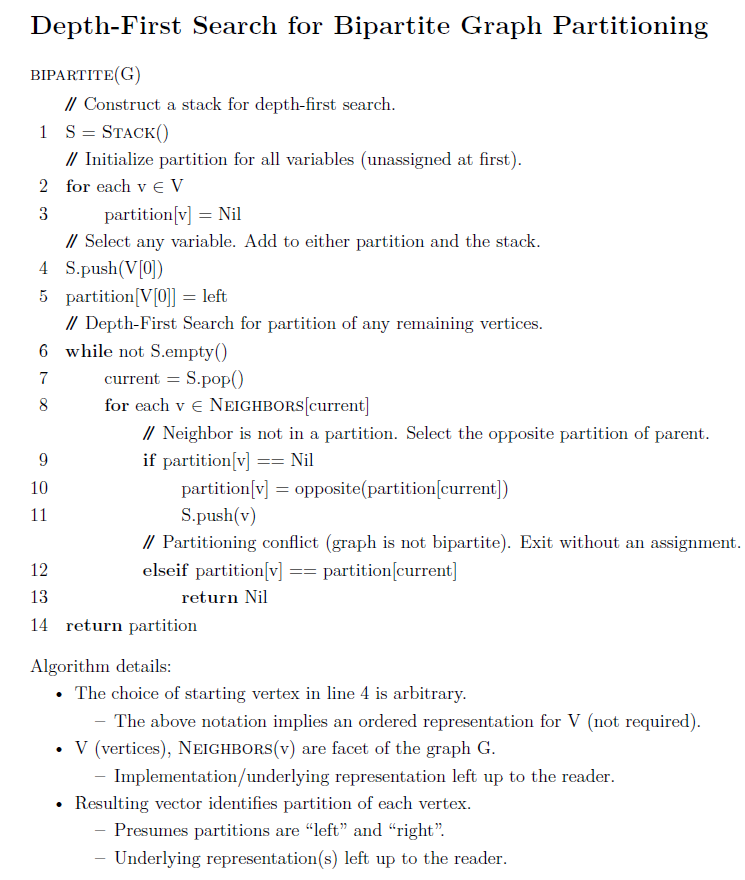
Please show me a Haskell Bipartite Graph Partitioning DFS based on this psuedocode and using only Data.list and making it a module Bipartite bipartite where, and using the function bipartite :: Char CharCharCharDepthFirst Search for Bipartite Graph Partitioning
BIPARTITEG
Construct a stack for depthfirst search.
STACK
Initialize partition for all variables unassigned at first
for each vinV
partition Nil
Select any variable. Add to either partition and the stack.
Spush
partition left
DepthFirst Search for partition of any remaining vertices.
while not Sempty
current pop
for each vin NEIGHBORScurrent
if partition Nil
partition oppositepartition current
Spushv
Partitioning conflict graph is not bipartite Exit without an assignment.
elseif partition partitioncurrent
return Nil
return partition
Algorithm details:
The choice of starting vertex in line is arbitrary.
The above notation implies an ordered representation for not required
V vertices NEIGHBorsv are facet of the graph G
Implementationunderlying representation left up to the reader.
Resulting vector identifies partition of each vertex.
Presumes partitions are "left" and "right".
Underlying representations left up to the reader.
Step by Step Solution
There are 3 Steps involved in it
1 Expert Approved Answer
Step: 1 Unlock

Question Has Been Solved by an Expert!
Get step-by-step solutions from verified subject matter experts
Step: 2 Unlock
Step: 3 Unlock
 Study Help