







Question: Please show work 5) You are crossing a river on a ferry. Assume there is no current in the river (that is, the water is
Please show work
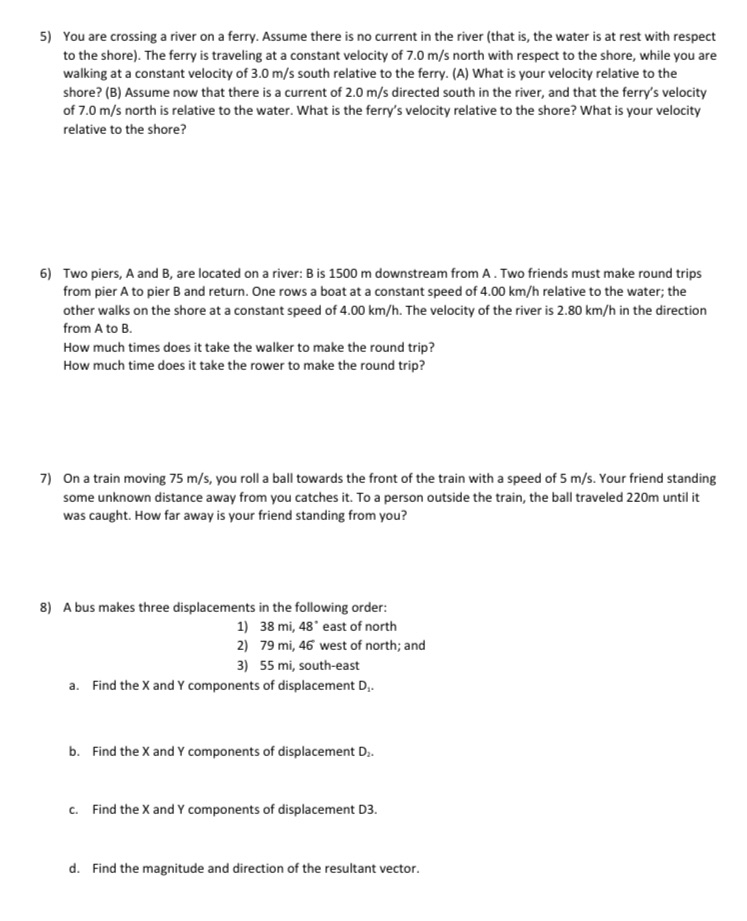
5) You are crossing a river on a ferry. Assume there is no current in the river (that is, the water is at rest with respect to the shore). The ferry is traveling at a constant velocity of 7.0 m/s north with respect to the shore, while you are walking at a constant velocity of 3.0 m/s south relative to the ferry. (A) What is your velocity relative to the shore? (B) Assume now that there is a current of 2.0 m/s directed south in the river, and that the ferry's velocity of 7.0 m/s north is relative to the water. What is the ferry's velocity relative to the shore? What is your velocity relative to the shore? 6) Two piers, A and B, are located on a river: B is 1500 m downstream from A . Two friends must make round trips from pier A to pier B and return. One rows a boat at a constant speed of 4.00 km/h relative to the water; the other walks on the shore at a constant speed of 4.00 km/h. The velocity of the river is 2.80 km/h in the direction from A to B. How much times does it take the walker to make the round trip? How much time does it take the rower to make the round trip? 7) On a train moving 75 m/s, you roll a ball towards the front of the train with a speed of 5 m/s. Your friend standing some unknown distance away from you catches it. To a person outside the train, the ball traveled 220m until it was caught. How far away is your friend standing from you? 8) A bus makes three displacements in the following order: 1) 38 mi, 48' east of north 2) 79 mi, 46 west of north; and 3) 55 mi, south-east a. Find the X and Y components of displacement D,. b. Find the X and Y components of displacement D.. C. Find the X and Y components of displacement D3. d. Find the magnitude and direction of the resultant vector
Step by Step Solution
There are 3 Steps involved in it

Get step-by-step solutions from verified subject matter experts
 Study Help