







Question: Pls answer part B and C, thank you so much. Problem 2 Conway's game of life is a cellular automaton. There aren't any actual players
 Pls answer part B and C, thank you so much.
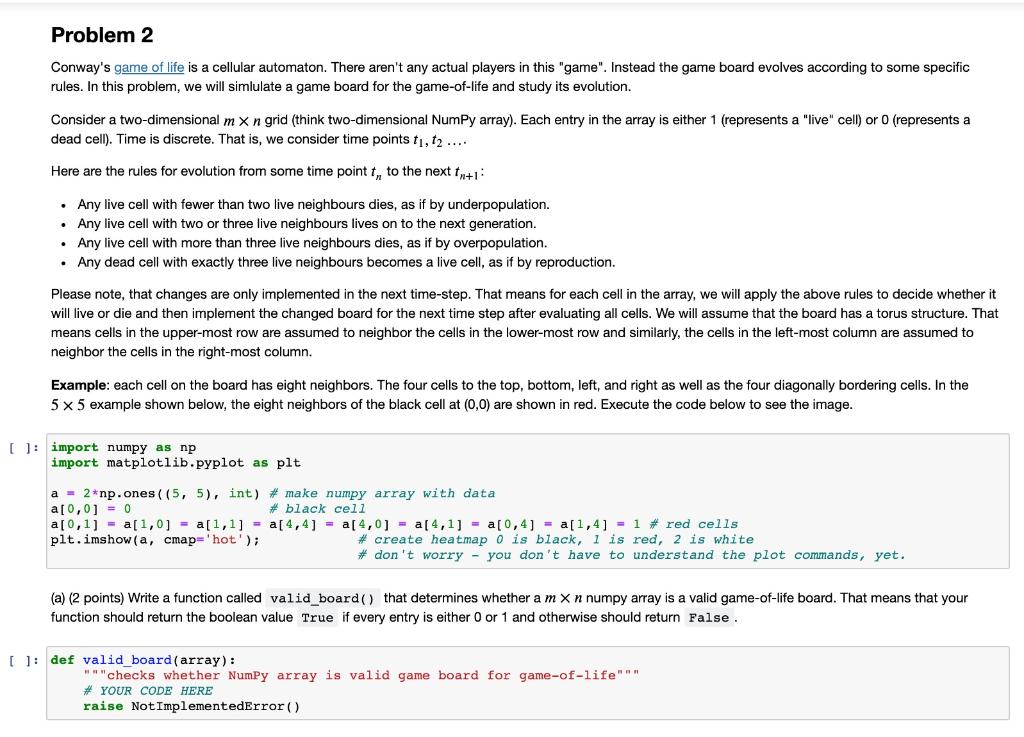
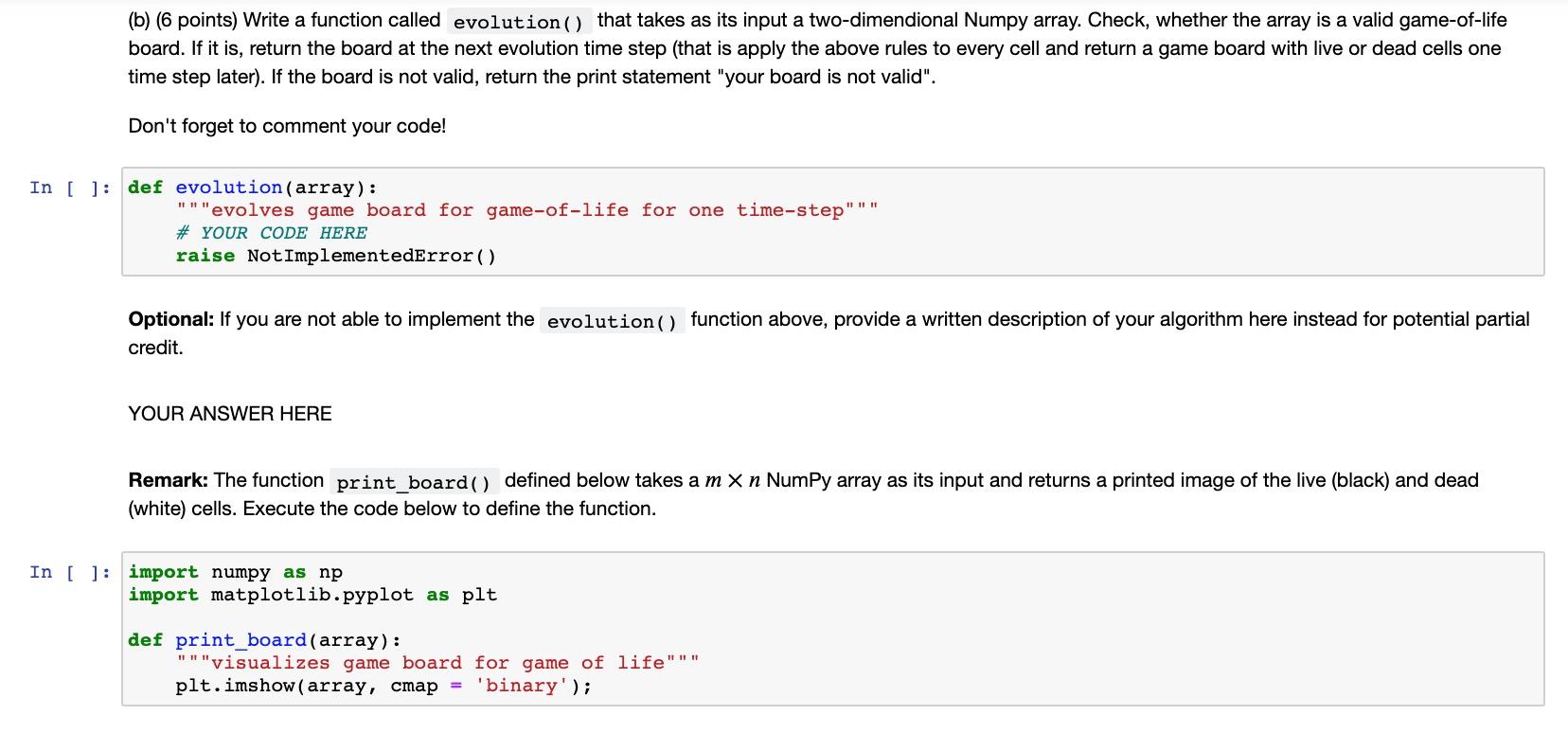
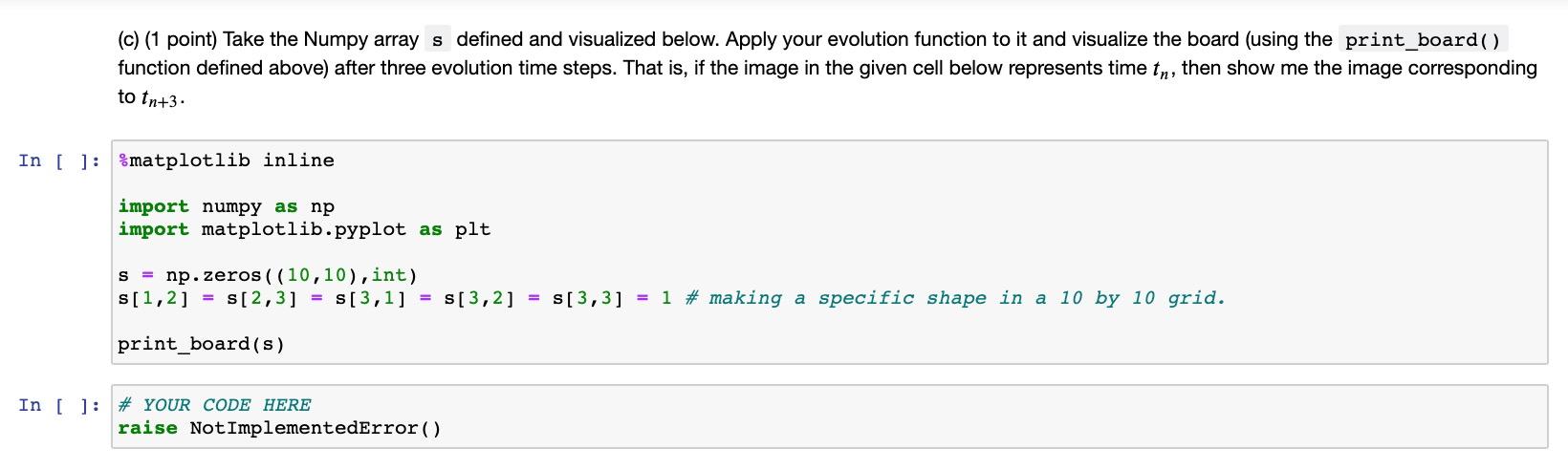
Problem 2 Conway's game of life is a cellular automaton. There aren't any actual players in this "game". Instead the game board evolves according to some specific rules. In this problem, we will simlulate a game board for the game-of-life and study its evolution. Consider a two-dimensional m X n grid (think two-dimensional NumPy array). Each entry in the array is either 1 (represents a "live" cell) or O (represents a dead cell). Time is discrete. That is, we consider time points ti, t2.... Here are the rules for evolution from some time point to the next t+1: Any live cell with fewer than two live neighbours dies, as if by underpopulation. Any live cell with two or three live neighbours lives on to the next generation. Any live cell with more than three live neighbours dies, as if by overpopulation. Any dead cell with exactly three live neighbours becomes a live cell, as if by reproduction. Please note that changes are only implemented in the next time-step. That means for each cell in the array, we will apply the above rules to decide whether it will live or die and then implement the changed board for the next time step after evaluating all cells. We will assume that the board has a torus structure. That means cells in the upper-most row are assumed to neighbor the cells in the lower-most row and similarly, the cells in the left-most column are assumed to neighbor the cells in the right- most column. Example: each cell on the board has eight neighbors. The four cells to the top, bottom, left, and right as well as the four diagonally bordering cells. In the 5 x 5 example shown below, the eight neighbors of the black cell at (0,0) are shown in red. Execute the code below to see the image. [ ]: import numpy as np import matplotlib.pyplot as plt a = 2*np.ones((5, 5), int) # make numpy array with data a[0,0] = 0 # black cell a[0,1] = a[1,0] = a[1,1] = a[4,4] = a[4,0] = a[4,1] = a[0,4] = a[1,4] = 1 # red cells plt.imshow(a, cmap='hot'); # create heatmap 0 is black, 1 is red, 2 is white # don't worry - you don't have to understand the plot commands, yet. (a) (2 points) Write a function called valid_board() that determines whether a m X n numpy array is a valid game-of-life board. That means that your function should return the boolean value True if every entry is either 0 or 1 and otherwise should return false. []: def valid_board (array): """checks whether Numpy array is valid game board for game-of-life""" # YOUR CODE HERE raise NotImplementedError() (b) (6 points) Write a function called evolution () that takes as its input a two-dimendional Numpy array. Check, whether the array is a valid game-of-life board. If it is, return the board at the next evolution time step (that is apply the above rules to every cell and return a game board with live or dead cells one time step later). If the board is not valid, return the print statement "your board is not valid". Don't forget to comment your code! In [ ]: def evolution (array): """evolves game board for game-of-life for one time-step""" # YOUR CODE HERE raise NotImplementedError() Optional: If you are not able to implement the evolution() function above, provide a written description of your algorithm here instead for potential partial credit. YOUR ANSWER HERE Remark: The function print_board() defined below takes a m X n NumPy array as its input and returns a printed image of the live (black) and dead (white) cells. Execute the code below to define the function. In [ ]: import numpy as np import matplotlib.pyplot as plt def print_board (array): " "visualizes game board for game of life""" plt.imshow(array, cmap = 'binary'); (c) (1 point) Take the Numpy array s defined and visualized below. Apply your evolution function to it and visualize the board (using the print_board() function defined above) after three evolution time steps. That is, if the image in the given cell below represents time tn, then show me the image corresponding to In+3 In [ ]: matplotlib inline import numpy as np import matplotlib.pyplot as plt s = np.zeros((10,10),int) s[1,2] = s[2,3] = s[3,1] = s[3,2] S[3,3] = 1 # making a specific shape in a 10 by 10 grid. print_board(s) In [ ]: # YOUR CODE HERE raise Not ImplementedError()
Step by Step Solution
There are 3 Steps involved in it

Get step-by-step solutions from verified subject matter experts
 Study Help