







Question: Preference ordering for (a) the Regime, (b) the moderate Religious Party, and (c) the radical Religious Party over the three possible outcomes. (b) Solve the
Preference ordering for
(a) the Regime,
(b) the moderate Religious Party, and
(c) the radical Religious Party over the three possible outcomes.
(b) Solve the subgame on the left, where the Religious Party is moderate, as if there were no uncertainty. What is the subgame perfect equilibrium? What is the expected outcome? What are the payoffs that each player receives?
(c) Solve the subgame on the right, where the Religious Party is radical as if there were no uncertainty. What is the subgame perfect equilibrium?
What is the expected outcome?
What are the payoffs that each player receives?
(a) What is the expected payoff for the Regime from "Cancel elections"?
(e) What is the expected payoff for the Regime from "Hold elections"?
(f) Use the expected payoffs from the two previous questions to calculate the critical probability at which the Regime will choose to hold elections rather than cancel them.
(g) If the Regime believes that the Religious Party is moderate with a probability of 0.75, will it choose to hold elections, will it cancel elections, or will it be indifferent between these two actions? Explain.
(h) If the Regime believes that the Religious Party is moderate with a probability of 0.8, will it choose to hold elections, will it cancel elections, or will it be indifferent between these two actions? Explain.
(i) If the Regime believes that the Religious Party is moderate with a probability of 0.5, will it choose to hold elections, will it cancel elections, or will it be indifferent between these two actions? Explain. () If you represented a moderate religious party poised to win the elections, would you want the Regime to believe that your party was moderate or radical?
(k) If you represented a radical religious party poised to win the elections, would you want the Regime to believe that your party was moderate or radical?
(1) If you solved the game correctly, you will find that the Regime will hold elections as long as it believes that the Religious Party is moderate with a high enough probability. If there is some uncertainty on the part of the Regime and you are representing a moderate religious party that wants the elections to go ahead, why might it not be enough for you to simply announce to the Regime that your party is a moderate religious party and not a radical one?
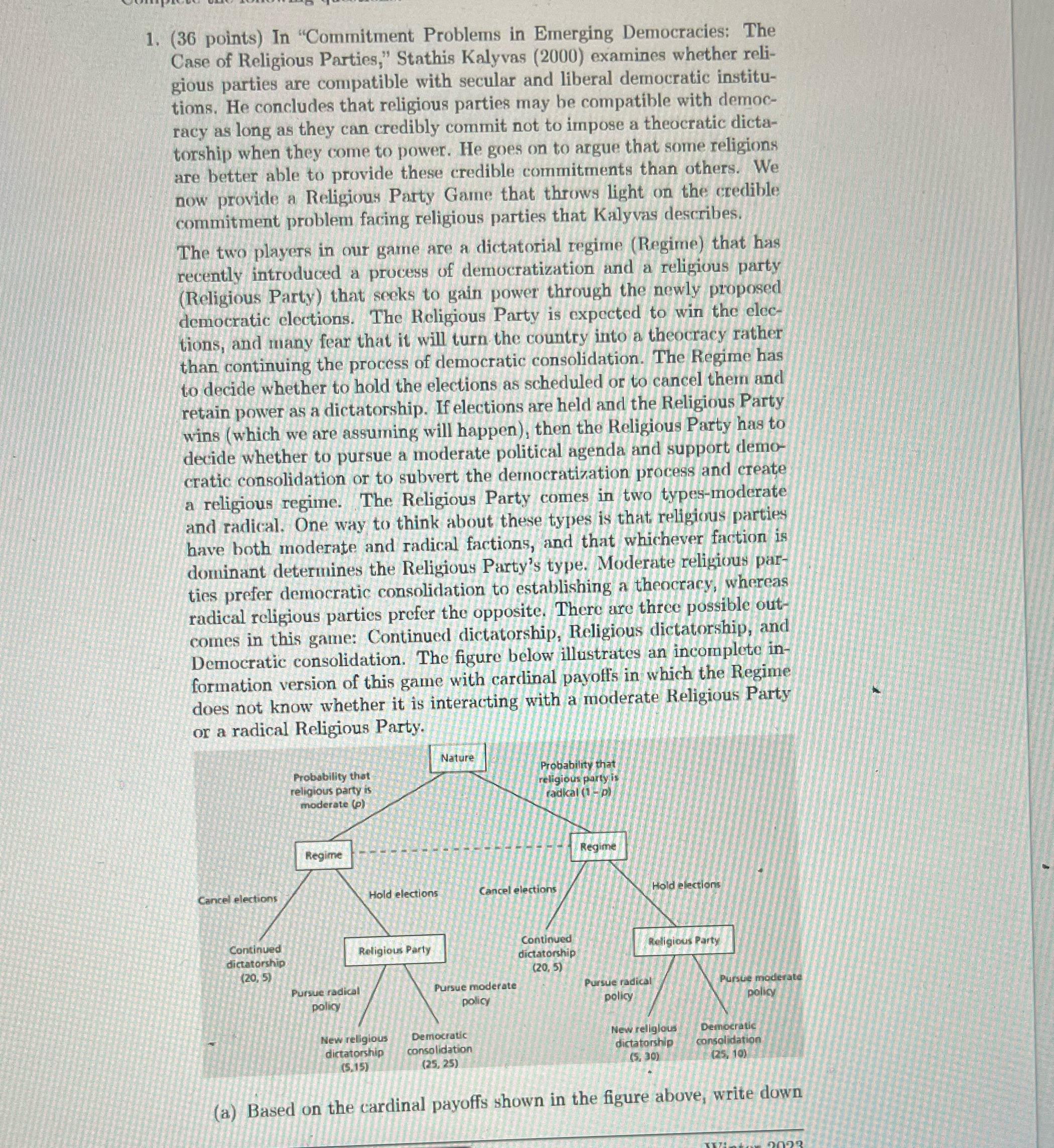
1. (36 points) In "Commitment Problems in Emerging Democracies: The Case of Religious Parties," Stathis Kalyvas (2000) examines whether reli- gious parties are compatible with secular and liberal democratic institu- tions. He concludes that religious parties may be compatible with democ- racy as long as they can credibly commit not to impose a theocratic dicta- torship when they come to power. He goes on to argue that some religions are better able to provide these credible commitments than others. We now provide a Religious Party Game that throws light on the credible commitment problem facing religious parties that Kalyvas describes. The two players in our game are a dictatorial regime (Regime) that has recently introduced a process of democratization and a religious party (Religious Party) that seeks to gain power through the newly proposed democratic elections. The Religious Party is expected to win the elec- tions, and many fear that it will turn the country into a theocracy rather than continuing the process of democratic consolidation. The Regime has to decide whether to hold the elections as scheduled or to cancel them and retain power as a dictatorship. If elections are held and the Religious Party wins (which we are assuming will happen), then the Religious Party has to decide whether to pursue a moderate political agenda and support demo- cratic consolidation or to subvert the democratization process and create a religious regime. The Religious Party comes in two types-moderate and radical. One way to think about these types is that religious parties have both moderate and radical factions, and that whichever faction is dominant determines the Religious Party's type. Moderate religious par- ties prefer democratic consolidation to establishing a theocracy, whereas radical religious parties prefer the opposite. There are three possible out- comes in this game: Continued dictatorship, Religious dictatorship, and Democratic consolidation. The figure below illustrates an incomplete in- formation version of this game with cardinal payoffs in which the Regime does not know whether it is interacting with a moderate Religious Party or a radical Religious Party. Cancel elections Continued dictatorship (20, 5) Probability that religious party is moderate (p) Regime Hold elections Religious Party Pursue radical policy Nature Probability that religious party is radikal (1-P) Cancel elections Pursue moderate policy Continued dictatorship (20,5) Regime Hold elections Religious Party Pursue radical policy New religious dictatorship (5,30) Pursue moderate policy New religious dictatorship (5,15) Democratic consolidation (25, 25) Democratic consolidation (25, 10) (a) Based on the cardinal payoffs shown in the figure above, write down Winter 2023
Step by Step Solution
3.46 Rating (156 Votes )
There are 3 Steps involved in it
Solution a the preference ordering for the regime over the three possible outcomes Democratic Consolidation New Religious Dictatorship Continued Dicta... View full answer

Get step-by-step solutions from verified subject matter experts
 Study Help