Question: Preliminary task: Earlier in the semester, inheritance was demonstrated with the different types of linked list classes that were studied. The ordered link list class
Preliminary task:
Earlier in the semester, inheritance was demonstrated with the different types of linked list classes that were studied. The ordered link list class extended the regular linked list class. In this case, the insert function in the ordered linked list class added items to the list in ascending order, resulting in a sorted list. A similar relationship exists between binary trees and binary search trees (BSTs). In a BST, an item is inserted in the left subtree of a node if it is less than the value of the parent node. Conversely, items that are greater than parent node are inserted in the right subtree. Extend the binary tree class from this weeks lab activity. Use the code from the book to implement the binary search tree class. For this assignment, you only need to implement the search and insert functions, but you should also know how the delete functions work.
The classes for the ordered linked list are provided. Create an ordered linked list object and a binary search tree object. Insert the items in hw10 insert.dat to both objects. As you are constructing each object, keep a running total of the total number of comparisons executed. Next, search the two objects for the items listed in the file hw10search.dat. Again, track the number of comparisons done for each search, but keep separate totals for successful searches and unsuccessful searches. Modify the classes however you need to capture this information.
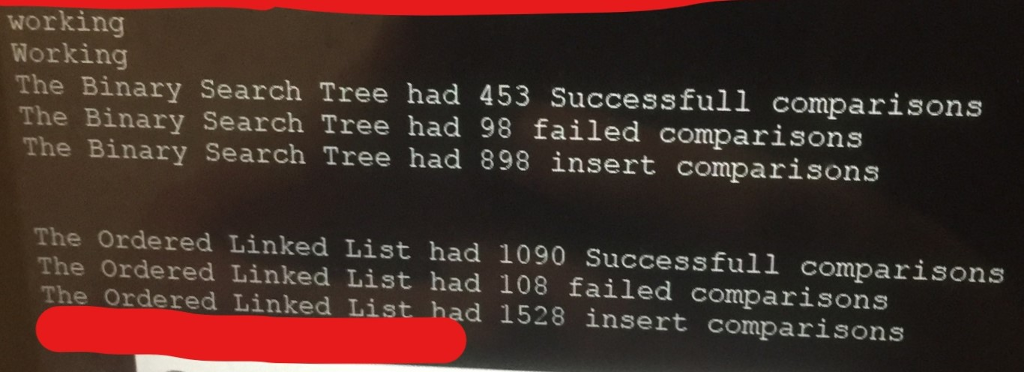
An example output is shown below.
OLL had 1528 comparisons for constructing the list.
OLL had 1090 comparisons for successful searches.
OLL had 108 comparisons for unsuccessful searches.
BST had 898 comparisons for constructing the tree.
BST had 453 comparisons for successful searches.
BST had 98 comparisons for unsuccessful searches.
------------------------------Included Files------------------------------
binaryTreeType.h
binarySearchTree.h
linkedListIterator.h
linkedListType.h
orderedLinkedList.h
hw10insert.dat
hw10search.dat
-----------------binarySearchTree.h-----------------
//Header File Binary Search Tree #ifndef H_binarySearchTree #define H_binarySearchTree #include #include #include "binaryTreeType.h" //************************************************************* // Author: D.S. Malik // // This class specifies the basic operations to implement a // binary search tree. //************************************************************* using namespace std; template class bSearchTreeType: public binaryTreeType { public: // Get parent variable using binaryTreeType::root; bSearchTreeType(); bool search(const elemType& searchItem); //Function to determine if searchItem is in the binary //search tree. //Postcondition: Returns true if searchItem is found in the // binary search tree; otherwise, returns false. void insert(const elemType& insertItem); //Function to insert insertItem in the binary search tree. //Postcondition: If no node in the binary search tree has the // same info as insertItem, a node with the info insertItem // is created and inserted in the binary search tree. private: }; template bSearchTreeType::bSearchTreeType() { // might need this } template bool bSearchTreeType::search(const elemType& searchItem) { return false; }//end search template void bSearchTreeType::insert(const elemType& insertItem) { return; }//end insert #endif
----------------------binaryTreeType.h--------------------
//Header File Binary Tree #ifndef H_binaryTree #define H_binaryTree //************************************************************* // Author: D.S. Malik // // class binaryTreeType // This class specifies the basic operations to implement a // binary tree. //************************************************************* #include using namespace std; //Definition of the node template struct binaryTreeNode { elemType info; binaryTreeNode *llink; binaryTreeNode *rlink; }; //Definition of the class template class binaryTreeType { public: const binaryTreeType& operator= (const binaryTreeType&); //Overload the assignment operator. bool isEmpty() const; //Returns true if the binary tree is empty; //otherwise, returns false. int treeHeight() const; //Returns the height of the binary tree. void destroyTree(); //Deallocates the memory space occupied by the binary tree. //Postcondition: root = NULL; binaryTreeType(const binaryTreeType& otherTree); //copy constructor binaryTreeType(); //default constructor ~binaryTreeType(); //destructor void buildExampleTree(); protected: binaryTreeNode *root; private: void copyTree(binaryTreeNode* &copiedTreeRoot, binaryTreeNode* otherTreeRoot); //Makes a copy of the binary tree to which //otherTreeRoot points. The pointer copiedTreeRoot //points to the root of the copied binary tree. void destroy(binaryTreeNode* &p); //Function to destroy the binary tree to which p points. //Postcondition: p = NULL int height(binaryTreeNode *p) const; //Function to return the height of the binary tree //to which p points. int max(int x, int y) const; //Returns the larger of x and y. }; //Definition of member functions template binaryTreeType::binaryTreeType() { root = NULL; } template void binaryTreeType::buildExampleTree() { root = new binaryTreeNode; root->info = 1; root->llink = new binaryTreeNode; root->llink->info = 3; root->llink->llink = NULL; root->llink->rlink = NULL; root->rlink = new binaryTreeNode; root->rlink->info = 2; root->rlink->llink = new binaryTreeNode; root->rlink->llink->info = 5; root->rlink->llink->llink = NULL; root->rlink->llink->rlink = NULL; root->rlink->rlink = new binaryTreeNode; root->rlink->rlink->info = 4; root->rlink->rlink->llink = NULL; root->rlink->rlink->rlink = NULL; return; } template bool binaryTreeType::isEmpty() const { return (root == NULL); } template int binaryTreeType::treeHeight() const { return height(root); } template void binaryTreeType::copyTree (binaryTreeNode* &copiedTreeRoot, binaryTreeNode* otherTreeRoot) { if (otherTreeRoot == NULL) copiedTreeRoot = NULL; else { copiedTreeRoot = new binaryTreeNode; copiedTreeRoot->info = otherTreeRoot->info; copyTree(copiedTreeRoot->llink, otherTreeRoot->llink); copyTree(copiedTreeRoot->rlink, otherTreeRoot->rlink); } } //end copyTree //Overload the assignment operator template const binaryTreeType& binaryTreeType:: operator=(const binaryTreeType& otherTree) { if (this != &otherTree) //avoid self-copy { if (root != NULL) //if the binary tree is not empty, //destroy the binary tree destroy(root); if (otherTree.root == NULL) //otherTree is empty root = NULL; else copyTree(root, otherTree.root); }//end else return *this; } template void binaryTreeType::destroy(binaryTreeNode* &p) { if (p != NULL) { destroy(p->llink); destroy(p->rlink); delete p; p = NULL; } } template void binaryTreeType::destroyTree() { destroy(root); } //copy constructor template binaryTreeType::binaryTreeType (const binaryTreeType& otherTree) { if (otherTree.root == NULL) //otherTree is empty root = NULL; else copyTree(root, otherTree.root); } template binaryTreeType::~binaryTreeType() { destroy(root); } template int binaryTreeType::height(binaryTreeNode *p) const { if (p == NULL) return 0; else return 1 + max(height(p->llink), height(p->rlink)); } template int binaryTreeType::max(int x, int y) const { if (x >= y) return x; else return y; } #endif
-------------------linkeListIterator.h-------------------
// // linkedListIterator.h // // Source: Data Structures Using C++ by D.S. Malik // // Purpose: This class specifies the members to implement an iterator // to a linked list. #ifndef __Lab__linkedListIterator__ #define __Lab__linkedListIterator__ #include using namespace std; //Definition of the node template struct nodeType { Type info; nodeType *link; }; template class linkedListIterator { public: linkedListIterator(); //Default constructor //Postcondition: current = NULL; linkedListIterator(nodeType *ptr); //Constructor with a parameter. //Postcondition: current = ptr; Type operator*(); //Function to overload the dereferencing operator *. //Postcondition: Returns the info contained in the node. linkedListIterator operator++(); //Overload the preincrement operator. //Postcondition: The iterator is advanced to the next node. bool operator==(const linkedListIterator& right) const; //Overload the equality operator. //Postcondition: Returns true if this iterator is equal to // the iterator specified by right, otherwise it returns // false. bool operator!=(const linkedListIterator& right) const; //Overload the not equal to operator. //Postcondition: Returns true if this iterator is not equal to // the iterator specified by right, otherwise it returns // false. private: nodeType *current; //pointer to point to the current /ode in the linked list }; template linkedListIterator::linkedListIterator() { current = NULL; } template linkedListIterator::linkedListIterator(nodeType *ptr) { current = ptr; } template Type linkedListIterator::operator*() { return current->info; } template linkedListIterator linkedListIterator::operator++() { current = current->link; return *this; } template bool linkedListIterator::operator==(const linkedListIterator& right) const { return (current == right.current); } template bool linkedListIterator::operator!=(const linkedListIterator& right) const { return (current != right.current); } #endif /* defined(__Lab__linkedListIterator__) */
--------------------linkedListType.h-------------------
// // linkedListType.h // // Source: Data Structures Using C++ by D.S. Malik // // Purpose: This class specifies the members to implement a linked // list type. #ifndef __Lab__linkedListType__ #define __Lab__linkedListType__ #include "linkedListIterator.h" #include template class linkedListType { public: const linkedListType& operator=(const linkedListType&); //Overload the assignment operator. void initializeList(); //Initialize the list to an empty state. //Postcondition: first = NULL, last = NULL, count = 0; bool isEmptyList() const; //Function to determine whether the list is empty. //Postcondition: Returns true if the list is empty, otherwise // it returns false. void print() const; //Function to output the data contained in each node. //Postcondition: none int length() const; //Function to return the number of nodes in the list. //Postcondition: The value of count is returned. void destroyList(); //Function to delete all the nodes from the list. //Postcondition: first = NULL, last = NULL, count = 0; Type front() const; //Function to return the first element of the list. //Precondition: The list must exist and must not be empty. //Postcondition: If the list is empty, the program terminates; // otherwise, the first element of the list is returned. Type back() const; //Function to return the last element of the list. //Precondition: The list must exist and must not be empty. //Postcondition: If the list is empty, the program // terminates; otherwise, the last // element of the list is returned. virtual bool search(const Type& searchItem) = 0; //Function to determine whether searchItem is in the list. //Postcondition: Returns true if searchItem is in the list, // otherwise the value false is returned. virtual void insertFirst(const Type& newItem) = 0; //Function to insert newItem at the beginning of the list. //Postcondition: first points to the new list, newItem is // inserted at the beginning of the list, last points to // the last node in the list, and count is incremented by // 1. virtual void insertLast(const Type& newItem) = 0; //Function to insert newItem at the end of the list. //Postcondition: first points to the new list, newItem is // inserted at the end of the list, last points to the // last node in the list, and count is incremented by 1. virtual void deleteNode(const Type& deleteItem) = 0; //Function to delete deleteItem from the list. //Postcondition: If found, the node containing deleteItem is // deleted from the list. first points to the first node, // last points to the last node of the updated list, and // count is decremented by 1. linkedListIterator begin(); //Function to return an iterator at the beginning of the //linked list. //Postcondition: Returns an iterator such that current is set // to first. linkedListIterator end(); //Function to return an iterator one element past the //last element of the linked list. //Postcondition: Returns an iterator such that current is set // to NULL. linkedListType(); //default constructor //Initializes the list to an empty state. //Postcondition: first = NULL, last = NULL, count = 0; linkedListType(const linkedListType& otherList); //copy constructor ~linkedListType(); //destructor //Deletes all the nodes from the list. //Postcondition: The list object is destroyed. protected: int count; //variable to store the number of list elements nodeType *first; //pointer to the first node of the list nodeType *last; //pointer to the last node of the list private: void copyList(const linkedListType& otherList); //Function to make a copy of otherList. //Postcondition: A copy of otherList is created and assigned // to this list. }; //default constructor template linkedListType::linkedListType() { first = NULL; last = NULL; count = 0; } template void linkedListType::destroyList() { nodeType *temp; //pointer to deallocate the memory occupied by the node while (first != NULL) { //while there are nodes in the list temp = first; first = first->link; //advance first to the next node delete temp; delete temp; //deallocate the memory occupied by temp } last = NULL; //initialize last to NULL; first has already been set to NULL by the while loop count = 0; } template bool linkedListType::isEmptyList() const { return (first == NULL); } template void linkedListType::initializeList() { destroyList(); //if the list has any nodes, delete them } template void linkedListType::print() const { nodeType *current; //pointer to traverse the list current = first; //set current point to the first node while (current != NULL) //while more data to print while (current != NULL) { //while more data to print{ cout info link; } }//end print template int linkedListType::length() const { return count; } template Type linkedListType::front() const { assert(first != NULL); return first->info; //return the info of the first node }//end front template Type linkedListType::back() const { assert(last != NULL); return last->info; //return the info of the last node }//end back template linkedListIterator linkedListType::begin() { linkedListIterator temp(first); return temp; } template linkedListIterator linkedListType::end() { linkedListIterator temp(NULL); return temp; } template void linkedListType::copyList(const linkedListType& otherList) { nodeType *newNode; //pointer to create a node nodeType *current; //pointer to traverse the list if (first != NULL) // if otherlist is not empty, make it empty destroyList(); if (otherList.first == NULL) { // otherlist is empty first = NULL; last = NULL; count = 0; } else { current = otherList.first; //current points to list to be copied count = otherList.count; //copy the first node first = new nodeType; //create the node first->info = current->info; // Copy the info first->link = NULL; //set the link field of the node to null last = first; //make last point to the first node current = current->link; //make current point to the next //copy the remaining list while (current != NULL) { newNode = new nodeType; //create a node newNode->info = current->info; //copy the info newNode->link = NULL; //set the link of newNode to NULL last->link = newNode; last = newNode; current = current->link; //make current point to the next node }//end while }//end else }//end copyList //destructor template linkedListType::~linkedListType() { destroyList(); } //end copy constructor template linkedListType::linkedListType (const linkedListType& otherList) { first = NULL; copyList(otherList); } template const linkedListType& linkedListType::operator=(const linkedListType& otherList) { if (this != &otherList) { //avoid self-copy copyList(otherList); } return *this; } #endif /* defined(__Lab__linkedListType__) */
-------------------orderedLinkedList.h--------------------
// // orderedLinkedList.h // // Source: Data Structures Using C++ by D.S. Malik // // Purpose: This class specifies the members to implement an // ordered linked list type. #ifndef __Lab__orderedLinkedList__ #define __Lab__orderedLinkedList__ #include "linkedListType.h" template class orderedLinkedList: public linkedListType { public: // Get parent variables using linkedListType::count; using linkedListType::first; using linkedListType::last; orderedLinkedList(); bool search(const Type& searchItem); //Function to determine whether searchItem is in the list. //Postcondition: Returns true if searchItem is in the list, // otherwise the value false is returned. void insert(const Type& newItem); //Function to insert newItem in the list. //Postcondition: first points to the new list, newItem // is inserted at the proper place in the list, and // count is incremented by 1. void insertFirst(const Type& newItem); //Function to insert newItem at the beginning of the list. //Postcondition: first points to the new list, newItem is // inserted at the beginning of the list, last points to the // last node in the list, and count is incremented by 1. void insertLast(const Type& newItem); //Function to insert newItem at the end of the list. //Postcondition: first points to the new list, newItem is // inserted at the end of the list, last points to the // last node in the list, and count is incremented by 1. void deleteNode(const Type& deleteItem); //Function to delete deleteItem from the list. //Postcondition: If found, the node containing deleteItem is // deleted from the list; first points to the first node // of the new list, and count is decremented by 1. If // deleteItem is not in the list, an appropriate message // is printed. private: }; template orderedLinkedList::orderedLinkedList() { // might need this } template bool orderedLinkedList::search(const Type& searchItem) { bool found = false; nodeType *current; //pointer to traverse the list current = first; //start the search at the first node while (current != NULL && !found) { if (current->info >= searchItem) found = true; else current = current->link; } if (found) { found = (current->info == searchItem); //test for equality } return found; }//end search template void orderedLinkedList::insert(const Type& newItem) { nodeType *current; //pointer to traverse the list nodeType *trailCurrent; //pointer just before current nodeType *newNode; //pointer to create a node bool found; newNode = new nodeType; //create the node newNode->info = newItem; //store newItem in the node newNode->link = NULL; //set the link field of the node //to NULL if (first == NULL) { //Case 1 first = newNode; last = newNode; count++; } else { current = first; found = false; while (current != NULL && !found) //search the list { if (current->info >= newItem) found = true; else { trailCurrent = current; current = current->link; } } if (current == first) { //Case 2 newNode->link = first; first = newNode; count++; } else { //Case 3 trailCurrent->link = newNode; newNode->link = current; if (current == NULL) last = newNode; count++; } }//end else return; }//end insert template void orderedLinkedList::insertFirst(const Type& newItem) { insert(newItem); }//end insertFirst template void orderedLinkedList::insertLast(const Type& newItem) { insert(newItem); }//end insertLast template void orderedLinkedList::deleteNode(const Type& deleteItem) { nodeType *current; //pointer to traverse the list nodeType *trailCurrent; //pointer just before current bool found; if (first == NULL) //Case 1 cout info >= deleteItem) found = true; else { trailCurrent = current; current = current->link; } } if (current == NULL) //Case 4 cout info == deleteItem) { //the item to be deleted is in the list if (first == current) { //Case 2 first = first->link; if (first == NULL) last = NULL; delete current; } else { //Case 3 trailCurrent->link = current->link; if (current == last) last = trailCurrent; delete current; } count--; } else cout
---------------------hw10insert.dat----------------------
735 341 646 229 842 620 741 222 165 182 943 150 250 350 228 344 828 110 987 777 191 545 878 900 351 291 854 404 607 305 199 395 809 504 841 149 492 613 386 929 481 853 729 205 482 774 338 194 743 108
--------------------hw10search.dat--------------------
828 110 987 77 191 545 878 90 351 291 854 404 617 305 199 395 809 504 842 149 492 338 294 743 108
working Working The Binary Search Tree had 453 The Binary Search Tree had 98 failed comparisons The Binary Search Tree had 898 insert comparisons Successfull comparisons The Ordered Linked List had 1090 Successfull comparisons The Ordered Linked List had 108 failed comparisons The Ordered Linked List had 1528 insert comparisons working Working The Binary Search Tree had 453 The Binary Search Tree had 98 failed comparisons The Binary Search Tree had 898 insert comparisons Successfull comparisons The Ordered Linked List had 1090 Successfull comparisons The Ordered Linked List had 108 failed comparisons The Ordered Linked List had 1528 insert comparisons









 Study Help