







Question: Pretty much any real object takes up space. This can cause confusion when asking, for instance, what is the r position of a car?
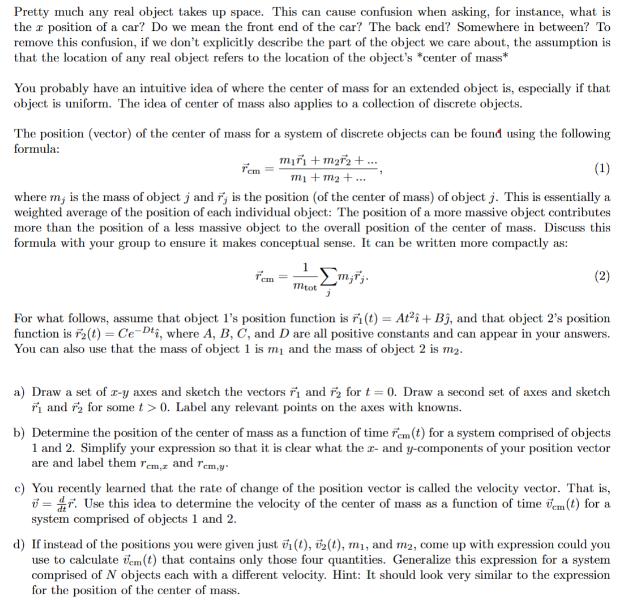
Pretty much any real object takes up space. This can cause confusion when asking, for instance, what is the r position of a car? Do we mean the front end of the car? The back end? Somewhere in between? To remove this confusion, if we don't explicitly describe the part of the object we care about, the assumption is that the location of any real object refers to the location of the object's *center of mass* You probably have an intuitive idea of where the center of mass for an extended object is, especially if that object is uniform. The idea of center of mass also applies to a collection of discrete objects. The position (vector) of the center of mass for a system of discrete objects can be found using the following formula: miri + mr2+... my + m + ... (1) where m, is the mass of object j and r; is the position (of the center of mass) of object j. This is essentially a weighted average of the position of each individual object: The position of a more massive object contributes more than the position of a less massive object to the overall position of the center of mass. Discuss this formula with your group to ensure it makes conceptual sense. It can be written more compactly as: mtot ;;. j (2) For what follows, assume that object I's position function is ri(t) = At + Bj, and that object 2's position function is 2(t) - Ce-Dti, where A, B, C, and D are all positive constants and can appear in your answers. You can also use that the mass of object 1 is my and the mass of object 2 is m. a) Draw a set of z-y axes and sketch the vectors 1 and 2 for t=0. Draw a second set of axes and sketch and 2 for some t > 0. Label any relevant points on the axes with knowns. b) Determine the position of the center of mass as a function of time Fem(t) for a system comprised of objects 1 and 2. Simplify your expression so that it is clear what the r- and y-components of your position vector are and label them rem, and rem,y c) You recently learned that the rate of change of the position vector is called the velocity vector. That is, 7 r. Use this idea to determine the velocity of the center of mass as a function of time em(t) for a system comprised of objects 1 and 2. d) If instead of the positions you were given just (t), 2(1), m, and m2, come up with expression could you use to calculate cm (t) that contains only those four quantities. Generalize this expression for a system comprised of N objects each with a different velocity. Hint: It should look very similar to the expression for the position of the center of mass.
Step by Step Solution
3.52 Rating (162 Votes )
There are 3 Steps involved in it
The skin friction coefficient Cf for a laminar boundary ... View full answer

Get step-by-step solutions from verified subject matter experts
 Study Help