





Question: Problem 1. Express (2,6) as a linear combination of u = (1,3) and v = (3, -1). Illustrate by plotting, and show and explain what
Problem 1. Express (2,6) as a linear combination
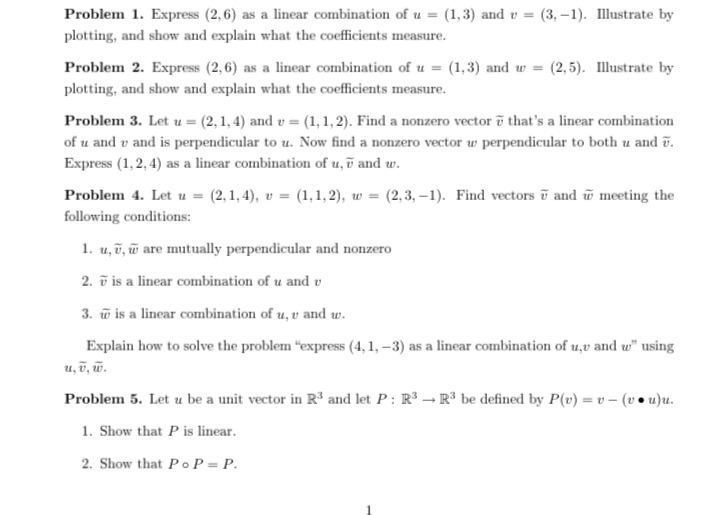
Problem 1. Express (2,6) as a linear combination of u = (1,3) and v = (3, -1). Illustrate by plotting, and show and explain what the coefficients measure. Problem 2. Express (2, 6) as a linear combination of u = (1,3) and w = (2,5). Illustrate by plotting, and show and explain what the coefficients measure. Problem 3. Let u = (2, 1,4) and v = (1, 1,2). Find a nonzero vector v that's a linear combination of u and v and is perpendicular to u. Now find a nonzero vector w perpendicular to both u and v. Express (1, 2, 4) as a linear combination of u, v and w. Problem 4. Let u = (2, 1,4), v = (1,1,2), w = (2,3, -1). Find vectors v and w meeting the following conditions: 1. u, v, w are mutually perpendicular and nonzero 2. vis a linear combination of u and v 3. w is a linear combination of u, v and w. Explain how to solve the problem "express (4, 1, -3) as a linear combination of u,v and w" using U. v. W. Problem 5. Let u be a unit vector in R3 and let P: R3 -+ R3 be defined by P(v) = v - (v . u)u. 1. Show that P is linear. 2. Show that Po P = P

Step by Step Solution

There are 3 Steps involved in it

1 Expert Approved Answer
Step: 1 Unlock blur-text-image

Question Has Been Solved by an Expert!

Get step-by-step solutions from verified subject matter experts

Step: 2 Unlock
Step: 3 Unlock

Students Have Also Explored These Related Mathematics Questions!