







Question: Problem 7 The equilibrium reaction shown below represents the dihydrogen phosphate buffer system. H2PO4(aq)+H2O(I)HPO42(aq)+H3O((aq)+ Kaa6.2108 a. Label the acid/base on each side of the equation.
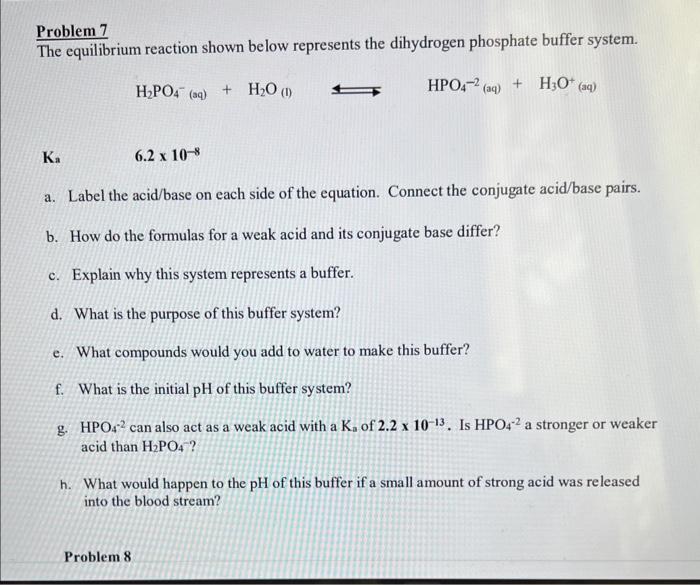
Problem 7 The equilibrium reaction shown below represents the dihydrogen phosphate buffer system. H2PO4(aq)+H2O(I)HPO42(aq)+H3O((aq)+ Kaa6.2108 a. Label the acid/base on each side of the equation. Connect the conjugate acid/base pairs. b. How do the formulas for a weak acid and its conjugate base differ? c. Explain why this system represents a buffer. d. What is the purpose of this buffer system? e. What compounds would you add to water to make this buffer? f. What is the initial pH of this buffer system? g. HPO42 can also act as a weak acid with a Ka of 2.21013. Is HPO42 a stronger or weaker acid than H2PO4? h. What would happen to the pH of this buffer if a small amount of strong acid was released into the blood stream
Step by Step Solution
There are 3 Steps involved in it

Get step-by-step solutions from verified subject matter experts
 Study Help