







Question: Problem: If the application described in Equations (2.8) and (2.9) could be manufactured in a smaller format, such that 72 cards could be fabricated on
Problem: If the application described in Equations (2.8) and (2.9) could be manufactured in a smaller format, such that 72 cards could be fabricated on a panel, what would the effective cost per card be after the reflow step?
Equations 2.8 and 2.9 are shown below.
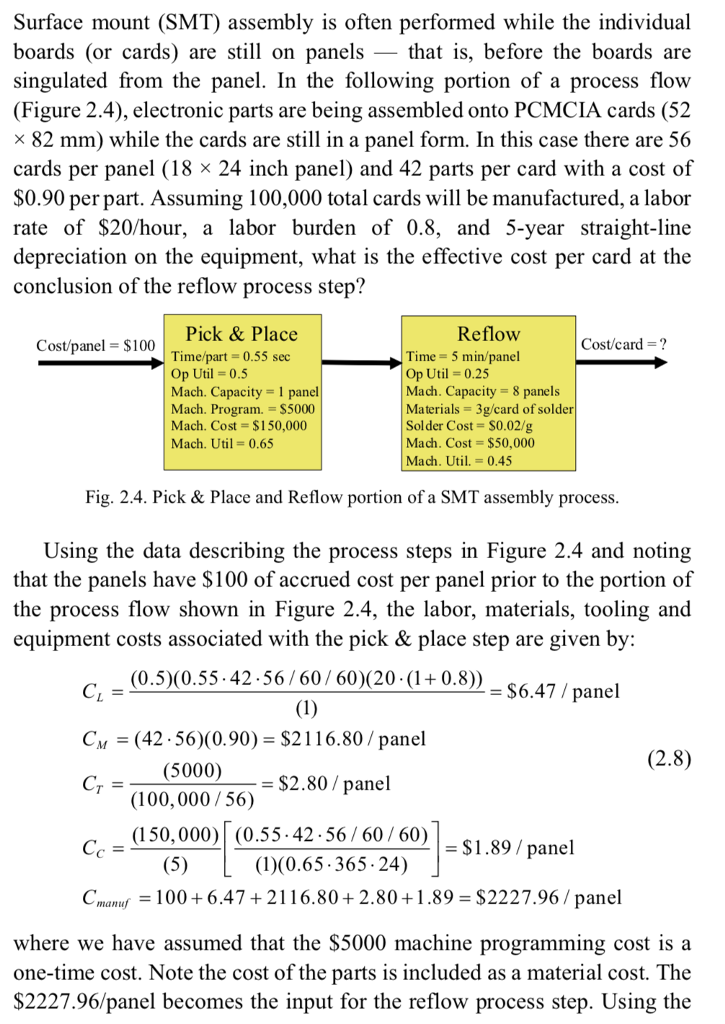
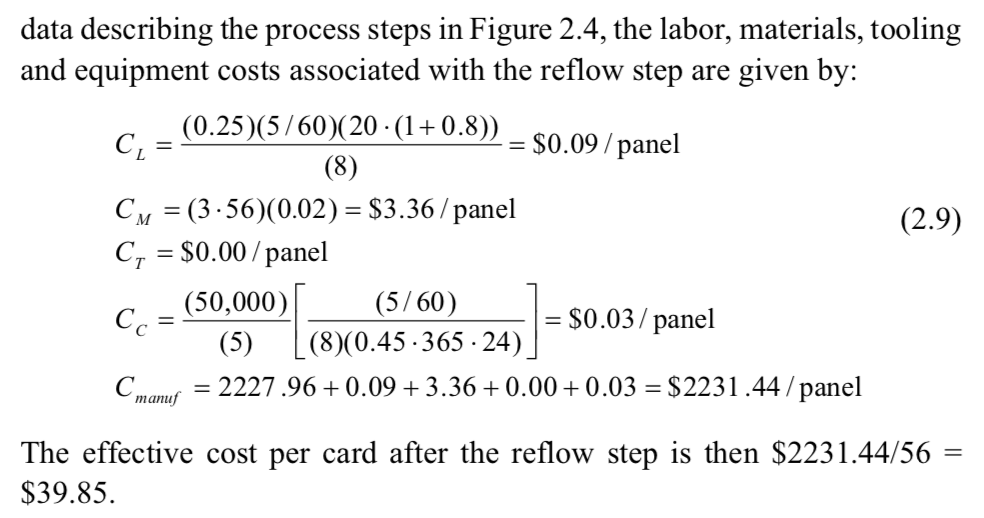
Surface mount (SMT) assembly is often performed while the individual boards (or cards) are still on panels _ that is, before the boards are singulated from the panel. In the following portion of a process flow (Figure 2.4), electronic parts are being assembled onto PCMCIA cards (52 82 mm) while the cards are still in a panel form. In this case there are 56 cards per panel (18 x 24 inch panel) and 42 parts per card with a cost of S0.90 per part. Assuming 100,000 total cards will be manufactured, a labor rate of $20/hour, a labor burden of 0.8, and 5-year straight-line depreciation on the equipment, what is the effective cost per card at the conclusion of the reflow process step? Reflow Cost/panel S100 Pick & Place Cost/card? Time/part-0.55 sec Op Util-0.5 Mach. Capacity- 1 panel Mach. Program. S5000 Mach. Cost- $150,000 Mach. Util-0.65 Time- 5 min/panel Op Util-0.25 Mach. Capacity -8 panels Materials-3g/card of solder Sol der Cost-$0.02/g Mach. Cost- $50,000 Mach. Util.-0.45 Fig. 2.4. Pick & Place and Reflow portion of a SMT assembly process Using the data describing the process steps in Figure 2.4 and noting that the panels have $100 of accrued cost per panel prior to the portion of the process flow shown in Figure 2.4, the labor, materials, tooling and equipment costs associated with the pick & place step are given by: (0.5)(0.55.42 56/60/60)(20.(1+ 0.8)) - $6.47 / panel CM-(42-56)(0.90)-$21 16.80 / panel (2.8) (5000) (100,000/56) (150,000) (0.55.42 56/60 /60) panel - $1.89/panel (1(0.65-365-24) Ca1006.47+ 2116.80+ 2.80+1.89- $2227.96/ panel where we have assumed that the $5000 machine programming cost is a one-time cost. Note the cost of the parts is included as a material cost. The S2227.96/panel becomes the input for the reflow process step. Using the Surface mount (SMT) assembly is often performed while the individual boards (or cards) are still on panels _ that is, before the boards are singulated from the panel. In the following portion of a process flow (Figure 2.4), electronic parts are being assembled onto PCMCIA cards (52 82 mm) while the cards are still in a panel form. In this case there are 56 cards per panel (18 x 24 inch panel) and 42 parts per card with a cost of S0.90 per part. Assuming 100,000 total cards will be manufactured, a labor rate of $20/hour, a labor burden of 0.8, and 5-year straight-line depreciation on the equipment, what is the effective cost per card at the conclusion of the reflow process step? Reflow Cost/panel S100 Pick & Place Cost/card? Time/part-0.55 sec Op Util-0.5 Mach. Capacity- 1 panel Mach. Program. S5000 Mach. Cost- $150,000 Mach. Util-0.65 Time- 5 min/panel Op Util-0.25 Mach. Capacity -8 panels Materials-3g/card of solder Sol der Cost-$0.02/g Mach. Cost- $50,000 Mach. Util.-0.45 Fig. 2.4. Pick & Place and Reflow portion of a SMT assembly process Using the data describing the process steps in Figure 2.4 and noting that the panels have $100 of accrued cost per panel prior to the portion of the process flow shown in Figure 2.4, the labor, materials, tooling and equipment costs associated with the pick & place step are given by: (0.5)(0.55.42 56/60/60)(20.(1+ 0.8)) - $6.47 / panel CM-(42-56)(0.90)-$21 16.80 / panel (2.8) (5000) (100,000/56) (150,000) (0.55.42 56/60 /60) panel - $1.89/panel (1(0.65-365-24) Ca1006.47+ 2116.80+ 2.80+1.89- $2227.96/ panel where we have assumed that the $5000 machine programming cost is a one-time cost. Note the cost of the parts is included as a material cost. The S2227.96/panel becomes the input for the reflow process step. Using the
Step by Step Solution
There are 3 Steps involved in it

Get step-by-step solutions from verified subject matter experts
 Study Help