







Question: Process Analysis - Berlin General Clinic (BGC) The Berlin General Clinic is an urban family clinic serving different patients since 2000. It is a small,
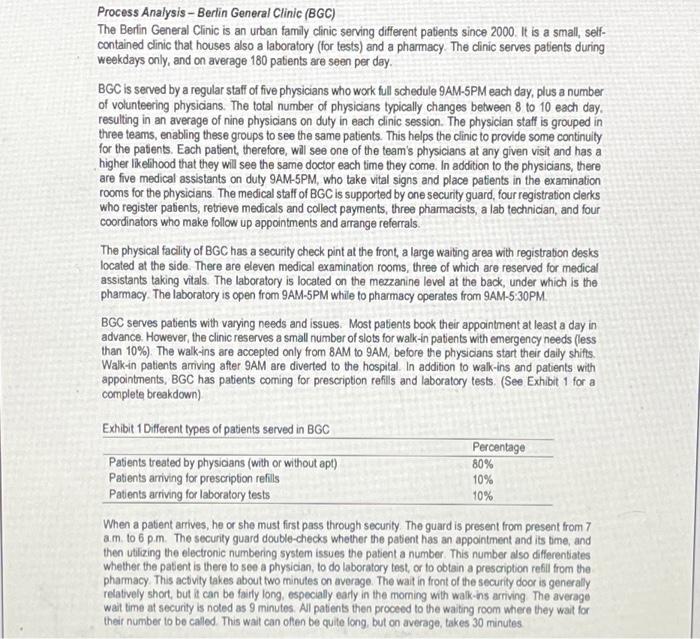
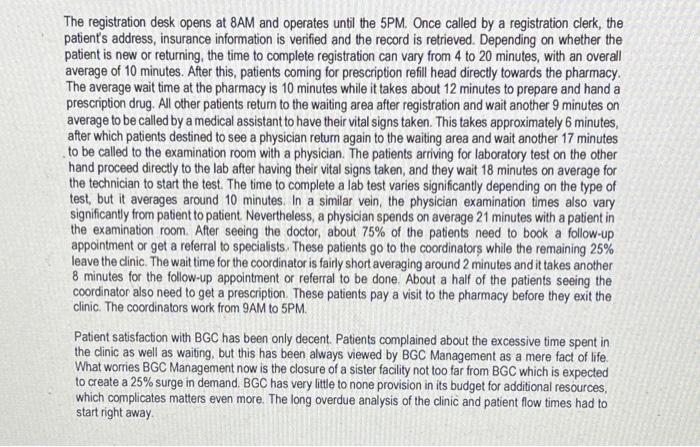
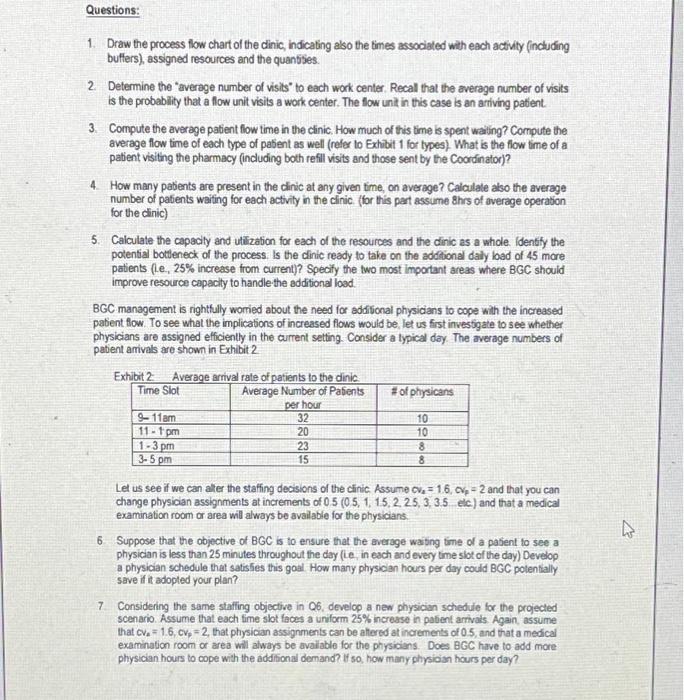
The registration desk opens at \\( 8 \\mathrm{AM} \\) and operates until the 5PM. Once called by a registration clerk, the patient's address, insurance information is verified and the record is retrieved. Depending on whether the patient is new or returning, the time to complete registration can vary from 4 to 20 minutes, with an overall average of 10 minutes. After this, patients coming for prescription refill head directly towards the pharmacy. The average wait time at the pharmacy is 10 minutes while it takes about 12 minutes to prepare and hand a prescription drug. All other patients return to the waiting area after registration and wait another 9 minutes on average to be called by a medical assistant to have their vital signs taken. This takes approximately 6 minutes, after which patients destined to see a physician return again to the waiting area and wait another 17 minutes to be called to the examination room with a physician. The patients arriving for laboratory test on the other hand proceed directly to the lab after having their vital signs taken, and they wait 18 minutes on average for the technician to start the test. The time to complete a lab test varies significantly depending on the type of test, but it averages around 10 minutes. In a similar vein, the physician examination times also vary significantly from patient to patient. Nevertheless, a physician spends on average 21 minutes with a patient in the examination room. After seeing the doctor, about \75 of the patients need to book a follow-up appointment or get a referral to specialists. These patients go to the coordinators while the remaining \25 leave the clinic. The wait time for the coordinator is fairly short averaging around 2 minutes and it takes another 8 minutes for the follow-up appointment or referral to be done. About a half of the patients seeing the coordinator also need to get a prescription. These patients pay a visit to the pharmacy before they exit the clinic. The coordinators work from 9AM to 5PM. Patient satisfaction with BGC has been only decent. Patients complained about the excessive time spent in the clinic as well as waiting, but this has been always viewed by BGC Management as a mere fact of life. What worries BGC Management now is the closure of a sister faclity not too far from BGC which is expected to create a \25 surge in demand. BGC has very little to none provision in its budget for additional resources, which complicates matters even more. The long overdue analysis of the clinic and patient flow times had to start right away. Questions: 1. Draw the process flow chart of the dinic, indicaling also the times associated with eech activity fincluding buffers), assigned resources and the quanfies. 2. Determine the \"average number of visits\" to each work center. Recal that the average number of visits is the probability that a flow unit visits a work center. The flow unit in this case is an arriving patient. 3. Compute the average patient flow time in the clinic. How much of this time is spent wailing? Compute the average flow time of each type of patent as well (refer to Exhibit 1 for types). What is the flow fime of a patient visitng the pharmacy (including both refill visits and those sent by the Coordinator)? 4. How many pabients are present in the clinic at any given time, on average? Calculate also the average number of patients waifing for each activity in the clinic. (for this part assume 8 hrs of average operation for the cinic) 5. Caiculate the capacily and utization for each of the resources and the dinic as a whole. identify the potential botteneck of the process. Is the clinic ready to take on the addifional daly load of 45 more patients (L.e, 25\\% increase from current)? Specify the two most important areas where BGC should improve resource capacity to handle the additional load. BGC management is righttully worried about the need for addifional physicians to cope with the increased pabient flow. To see what the implications of increased flows would be, let us first investigate to see whether physicians are assigned efficiently in the current setting. Consider a typical day. The average numbers of patient amivals are shown in Exhibit 2 Let us see if we can ater the staffing decisions of the clinic. Assume \\( c_{2}=1.6, \\propto_{p}=2 \\) and that you can change physician assignments at increments of \\( 0.5(0.5,1,15,2.25,3,3.5 \\mathrm{ec} \\) ) and that a medical examination room or area will always be available for the physicians. 6 Suppose that the objective of BGC is to ensure that the average waing time of a pasient to see a physican is less than 25 minutes throughout the day (Le, in each and every time slot of the day) Develog a physician schedule that satisfes this gaal. How many physican hours per day could BGC potentially save if it adopled your plan? 7. Considering the same stafing objective in Q6. develop a new physician schedule for the projected scenario. Assume that each fime slot faces a uniform \25 increase in patient artivals. Again, assume that \\( \\mathrm{cv}_{\\mathrm{n}}=1.6, \\mathrm{cv_{p }}=2 \\), that physician assignments can be attered at increments of 0.5 , and that a medical examination room \\( \\alpha \\) area will always be avaliable for the physicians. Does BGC have to add more physician hours to cope with the addifional demand? If so, how many physiosn hours per day? Process Analysis - Berlin General Clinic (BGC) The Berlin General Clinic is an urban family clinic serving different patients since 2000. It is a small, selfcontained clinic that houses also a laboratory (for tests) and a pharmacy. The clinic serves patients during weekdays only, and on average 180 patents are seen per day. BGC is served by a regular staff of five physicians who work full schedule 9AM-5PM each day, plus a number of volunteering physicians. The total number of physicians typically changes between 8 to 10 each day. resulting in an average of nine physicians on duty in each clinic session. The physician staff is grouped in three teams, enabling these groups to see the same patients. This helps the clinic to provide some continuity for the patients. Each patient, therefore, will see one of the team's physicians at any given visit and has a higher likelihood that they will see the same doctor each time they come. In addition to the physicians, there are five medical assistants on duty 9AM-5PM, who take vital signs and place patients in the examination rooms for the physicians. The medical staff of BGC is supported by one security guard, four registration derks Who register patients, retrieve medicals and collect payments, three pharmacists, a lab technician, and four coordinators who make follow up appointments and arrange referrals. The physical facility of BGC has a security check pint at the front, a large walting area with registration desks located at the side. There are eleven medical examination rooms, three of which are reserved for medical assistants taking vitals. The laboratory is located on the mezzanine level at the back, under which is the pharmacy. The laboratory is open from 9AM-5PM while to pharmacy operates from 9AM-5:30PM. BGC serves patients with varying needs and issues. Most patients book their appointment at least a day in advance. However, the clinic reserves a small number of slots for walk-in patients with emergency needs (less than \10. The walk-ins are accepted only from \\( 8 \\mathrm{AM} \\) to \\( 9 \\mathrm{AM} \\), before the physicans start their daily shifts. Walk-in patients arriving after 9AM are diverted to the hospital. In addition to walk-ins and patients with appointments, BGC has patients coming for prescription refills and laboratory tests. (See Exhibit 1 for a complete breakdown) When a patient arrives, he or she must first pass through secunity. The guard is present from present from 7 a.m. \\( 106 \\mathrm{pm} \\). The security guard double-checks whether the patient has an appointment and its time, and then utilizing the electronic numbering system issues the patient a number. This number also differentiates Whether the patient is there to see a physician, to do laboratory test, \\( \\alpha \\) to obtain a prescription refill from the pharmacy. This activity takes about two minutes on average. The wait in front of the security door is generally relatively short, but it can be fairly long, especially early in the moming with walk-ins arriving. The average wait time at security is noted as 9 minutes. All patients then proceed to the waiting room where they wait for their number to be called. This wait can often be quite long, but on average, takes 30 minutes The registration desk opens at \\( 8 \\mathrm{AM} \\) and operates until the 5PM. Once called by a registration clerk, the patient's address, insurance information is verified and the record is retrieved. Depending on whether the patient is new or returning, the time to complete registration can vary from 4 to 20 minutes, with an overall average of 10 minutes. After this, patients coming for prescription refill head directly towards the pharmacy. The average wait time at the pharmacy is 10 minutes while it takes about 12 minutes to prepare and hand a prescription drug. All other patients return to the waiting area after registration and wait another 9 minutes on average to be called by a medical assistant to have their vital signs taken. This takes approximately 6 minutes, after which patients destined to see a physician return again to the waiting area and wait another 17 minutes to be called to the examination room with a physician. The patients arriving for laboratory test on the other hand proceed directly to the lab after having their vital signs taken, and they wait 18 minutes on average for the technician to start the test. The time to complete a lab test varies significantly depending on the type of test, but it averages around 10 minutes. In a similar vein, the physician examination times also vary significantly from patient to patient. Nevertheless, a physician spends on average 21 minutes with a patient in the examination room. After seeing the doctor, about \75 of the patients need to book a follow-up appointment or get a referral to specialists. These patients go to the coordinators while the remaining \25 leave the clinic. The wait time for the coordinator is fairly short averaging around 2 minutes and it takes another 8 minutes for the follow-up appointment or referral to be done. About a half of the patients seeing the coordinator also need to get a prescription. These patients pay a visit to the pharmacy before they exit the clinic. The coordinators work from 9AM to 5PM. Patient satisfaction with BGC has been only decent. Patients complained about the excessive time spent in the clinic as well as waiting, but this has been always viewed by BGC Management as a mere fact of life. What worries BGC Management now is the closure of a sister faclity not too far from BGC which is expected to create a \25 surge in demand. BGC has very little to none provision in its budget for additional resources, which complicates matters even more. The long overdue analysis of the clinic and patient flow times had to start right away. Questions: 1. Draw the process flow chart of the dinic, indicaling also the times associated with eech activity fincluding buffers), assigned resources and the quanfies. 2. Determine the \"average number of visits\" to each work center. Recal that the average number of visits is the probability that a flow unit visits a work center. The flow unit in this case is an arriving patient. 3. Compute the average patient flow time in the clinic. How much of this time is spent wailing? Compute the average flow time of each type of patent as well (refer to Exhibit 1 for types). What is the flow fime of a patient visitng the pharmacy (including both refill visits and those sent by the Coordinator)? 4. How many pabients are present in the clinic at any given time, on average? Calculate also the average number of patients waifing for each activity in the clinic. (for this part assume 8 hrs of average operation for the cinic) 5. Caiculate the capacily and utization for each of the resources and the dinic as a whole. identify the potential botteneck of the process. Is the clinic ready to take on the addifional daly load of 45 more patients (L.e, 25\\% increase from current)? Specify the two most important areas where BGC should improve resource capacity to handle the additional load. BGC management is righttully worried about the need for addifional physicians to cope with the increased pabient flow. To see what the implications of increased flows would be, let us first investigate to see whether physicians are assigned efficiently in the current setting. Consider a typical day. The average numbers of patient amivals are shown in Exhibit 2 Let us see if we can ater the staffing decisions of the clinic. Assume \\( c_{2}=1.6, \\propto_{p}=2 \\) and that you can change physician assignments at increments of \\( 0.5(0.5,1,15,2.25,3,3.5 \\mathrm{ec} \\) ) and that a medical examination room or area will always be available for the physicians. 6 Suppose that the objective of BGC is to ensure that the average waing time of a pasient to see a physican is less than 25 minutes throughout the day (Le, in each and every time slot of the day) Develog a physician schedule that satisfes this gaal. How many physican hours per day could BGC potentially save if it adopled your plan? 7. Considering the same stafing objective in Q6. develop a new physician schedule for the projected scenario. Assume that each fime slot faces a uniform \25 increase in patient artivals. Again, assume that \\( \\mathrm{cv}_{\\mathrm{n}}=1.6, \\mathrm{cv_{p }}=2 \\), that physician assignments can be attered at increments of 0.5 , and that a medical examination room \\( \\alpha \\) area will always be avaliable for the physicians. Does BGC have to add more physician hours to cope with the addifional demand? If so, how many physiosn hours per day? Process Analysis - Berlin General Clinic (BGC) The Berlin General Clinic is an urban family clinic serving different patients since 2000. It is a small, selfcontained clinic that houses also a laboratory (for tests) and a pharmacy. The clinic serves patients during weekdays only, and on average 180 patents are seen per day. BGC is served by a regular staff of five physicians who work full schedule 9AM-5PM each day, plus a number of volunteering physicians. The total number of physicians typically changes between 8 to 10 each day. resulting in an average of nine physicians on duty in each clinic session. The physician staff is grouped in three teams, enabling these groups to see the same patients. This helps the clinic to provide some continuity for the patients. Each patient, therefore, will see one of the team's physicians at any given visit and has a higher likelihood that they will see the same doctor each time they come. In addition to the physicians, there are five medical assistants on duty 9AM-5PM, who take vital signs and place patients in the examination rooms for the physicians. The medical staff of BGC is supported by one security guard, four registration derks Who register patients, retrieve medicals and collect payments, three pharmacists, a lab technician, and four coordinators who make follow up appointments and arrange referrals. The physical facility of BGC has a security check pint at the front, a large walting area with registration desks located at the side. There are eleven medical examination rooms, three of which are reserved for medical assistants taking vitals. The laboratory is located on the mezzanine level at the back, under which is the pharmacy. The laboratory is open from 9AM-5PM while to pharmacy operates from 9AM-5:30PM. BGC serves patients with varying needs and issues. Most patients book their appointment at least a day in advance. However, the clinic reserves a small number of slots for walk-in patients with emergency needs (less than \10. The walk-ins are accepted only from \\( 8 \\mathrm{AM} \\) to \\( 9 \\mathrm{AM} \\), before the physicans start their daily shifts. Walk-in patients arriving after 9AM are diverted to the hospital. In addition to walk-ins and patients with appointments, BGC has patients coming for prescription refills and laboratory tests. (See Exhibit 1 for a complete breakdown) When a patient arrives, he or she must first pass through secunity. The guard is present from present from 7 a.m. \\( 106 \\mathrm{pm} \\). The security guard double-checks whether the patient has an appointment and its time, and then utilizing the electronic numbering system issues the patient a number. This number also differentiates Whether the patient is there to see a physician, to do laboratory test, \\( \\alpha \\) to obtain a prescription refill from the pharmacy. This activity takes about two minutes on average. The wait in front of the security door is generally relatively short, but it can be fairly long, especially early in the moming with walk-ins arriving. The average wait time at security is noted as 9 minutes. All patients then proceed to the waiting room where they wait for their number to be called. This wait can often be quite long, but on average, takes 30 minutes
Step by Step Solution
There are 3 Steps involved in it

Get step-by-step solutions from verified subject matter experts
 Study Help