







Question: Prove that if v(t) is any vector that depends on time (for example the velocity of a moving particle) but which has constant magnitude,
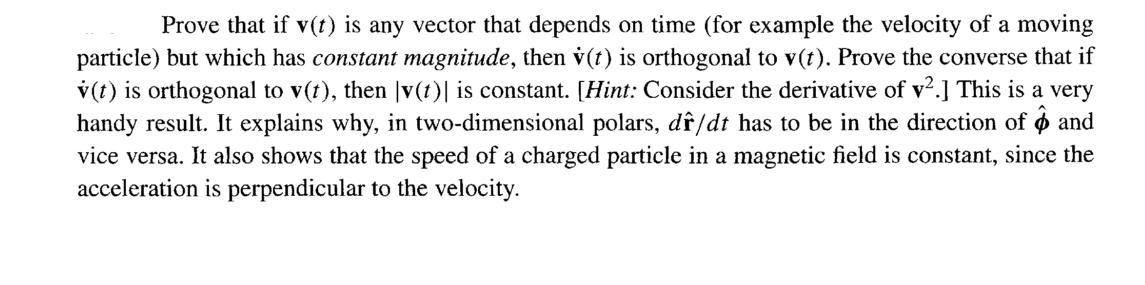
Prove that if v(t) is any vector that depends on time (for example the velocity of a moving particle) but which has constant magnitude, then v(t) is orthogonal to v(t). Prove the converse that if v(t) is orthogonal to v(t), then |v(t)] is constant. [Hint: Consider the derivative of v2.] This is a very handy result. It explains why, in two-dimensional polars, df/dt has to be in the direction of and vice versa. It also shows that the speed of a charged particle in a magnetic field is constant, since the acceleration is perpendicular to the velocity.
Step by Step Solution
3.41 Rating (160 Votes )
There are 3 Steps involved in it
To that if VCE 13 avector with Constant magnitude pove it is orthogonal to its derivedive Not... View full answer

Get step-by-step solutions from verified subject matter experts
 Study Help