Question: Q1. How does Timberland's commitment to social and environmental responsibility influence the ways in which it deals with the diversity, technology, and globalization chanllenges that
Q1. How does Timberland's commitment to social and environmental responsibility influence the ways in which it deals with the diversity, technology, and globalization chanllenges that it faces?
Q2. Consider the ethical, diversity, technology, and globalization challenges that have confronted Timberland. How has Timberland converted these challenges into opportunities for the company?
Q3. What are some advantages and disadvantages of Timberland's attempts to influence suppliers and customers regarding coporate social and environmental responsibility? How can these efforts help Timberland as it seeks to deal with its own ethical, diversity, technology, and globalization challenge?
Q4. Timberland operates in a country that demobnstrates;
select one
a. low diversity
b. low power distance
c. low individualism
d. high indulgence
Q5. Timerland's technology;
a. allows it to focus on customization
b. is not a key strategic differentiator
c. hurts its sustainability efforts
d. allows it to focus on batch productions
Q6Timberland can be considered;
a. a global company
b. a national company
c. a hybrid
d. a domestic company
Q7. Timberland's ethical approach most resembles;
a. character-based
b. consequence-based
c. rule-based
d. rationalization-based
Q8. Timberland faces both local and international pressures
TRUE or FALSE
Q9. Timberland is innovative in its technology.
TRUE or FALSE
Q10. Timberland does not engage in ethical practices.
TRUE or FALSE
Q11. Timberland focuses only on profit.
TRUE or FALSE
Q12. Timberland has demonstrated commitment to social responsibility.
TRUE or FALSE
Q13. Timberland shows that commerce and justice do not co-exist.
TRUE or FALSE
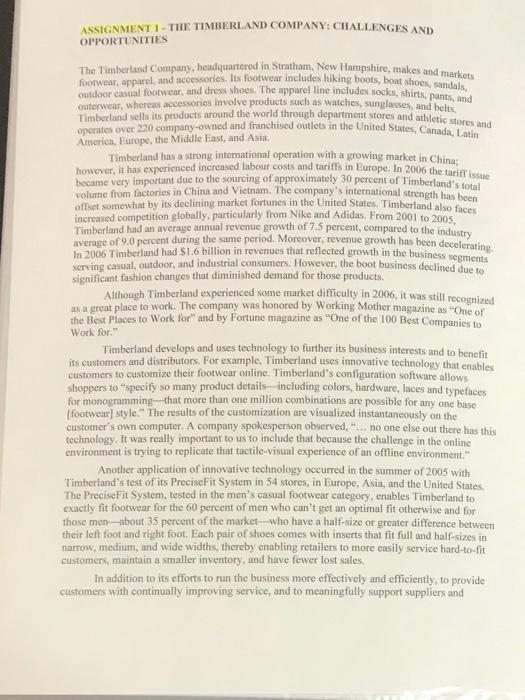
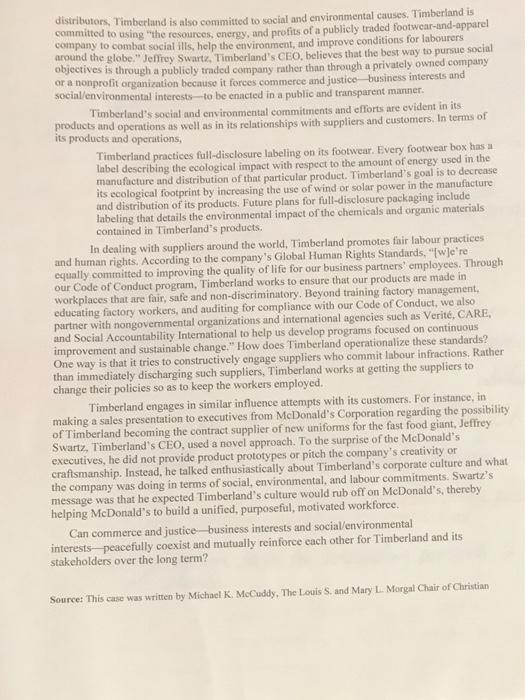
ASSIGNMENT 1 - THE TIMBERLAND COMPANY: CHALLENGES AND OPPORTUNITIES The Timberland Company, headquartered in Stratham, New Hampshire, makes and markets Outdoor castal footwear, and dress shoes. The apparel line includes socks, shirts, pants, and footwear, apparel, and accessories. Its footwear includes biking boots, boat shoes, sandals operates over 220 company-owned and franchised outlets in the United States, Canada, Latin Timberland sells its products around the world through department stores and athletic stores and America, Europe, the Middle East, and Asia. Timberland has a strong international operation with a growing market in China: however , it has experienced increased labour costs and tariffs in Europe. In 2006 the tariff issue volume from factories in China and Vietnam. The company's international strength has been offset somewhat by its declining market fortunes in the United States, Timberland also faces increased competition globally, particularly from Nike and Adidas. From 2001 to 2005, Timberlund had an average annual revenue growth of 7.5 percent, compared to the industry average of 9.0 percent during the same period. Moreover , revenue growth has been decelerating In 2006 Timberland had $1.6 billion in revenues that reflected growth in the business segments serving casual, outdoor, and industrial consumers. However, the boot business declined due to significant fashion changes that diminished demand for those products, Although Timberland experienced some market difficulty in 2006, it was still recognized the Best Places to Work for" and by Fortune magazine as "One of the 100 Best Companies to Timberland develops and uses technology to further its business interests and to benefit its customers and distributors. For example, Timberland uses innovative technology that enables customers to customize their footwear online. Timberland's configuration software allows shoppers to specify so many product details including colors, hardware, luces and typefaces for monogramming that more than one million combinations are possible for any one base [footwear style. The results of the customization are visualized instantaneously on the customer's own computer. A company spokesperson observed, "... no one else out there has this technology. It was really important to us to include that because the challenge in the online environment is trying to replicate that tactile-visual experience of an offline environment Another application of innovative technology occurred in the summer of 2005 with Timberland's test of its PreciseFit System in 54 stores, in Europe, Asin, and the United States. The PreciseFit System, tested in the men's casual footwear category, enables Timberland to exactly fit footwear for the 60 percent of men who can't get an optimal fit otherwise and for those men about 35 percent of the market. who have a half-size or greater difference between their left foot and right foot, Fach pair of shoes comes with inserts that fit full and half-sizes in narrow, medium, and wide widths, thereby enabling retailers to more easily service hard-to-fit customers, maintain a smaller inventory, and have fewer lost sales. In addition to its efforts to run the business more effectively and efficiently, to provide customers with continually improving service, and to meaningfully support suppliers and Work for." distributors, Timberland is also committed to social and environmental causes. Timberland is committed to using the resources, energy, and profits of a publicly traded footwear-and-apparel company to combat social ills, help the environment, and improve conditions for labourers around the globe." Jeffrey Swartz, Timberland's CEO, believes that the best way to pursue social objectives is through a publicly traded company rather than through a privately owned company or a nonprofit organization because it forces commerce and justice business interests and social/environmental interests--to be enacted in a public and transparent manner. Timberland's social and environmental commitments and efforts are evident in its products and operations as well as in its relationships with suppliers and customers. In terms of its products and operations, Timberland practices full-disclosure labeling on its footwear. Every footwear box has a label describing the ecological impact with respect to the amount of energy used in the manufacture and distribution of that particular product. Timberland's goal is to decrease its ecological footprint by increasing the use of wind or solar power in the manufacture and distribution of its products. Future plans for full-disclosure packaging include labeling that details the environmental impact of the chemicals and organic materials contained in Timberland's products, In dealing with suppliers around the world, Timberland promotes fair labour practices and human rights. According to the company's Global Human Rights Standards, "[w]e're equally committed to improving the quality of life for our business partners' employees. Through our Code of Conduct program, Timberland works to ensure that our products are made in workplaces that are fair, safe and non-discriminatory. Beyond training factory management, educating factory workers, and auditing for compliance with our Code of Conduct, we also partner with nongovernmental organizations and international agencies such as Verit, CARE, and Social Accountability International to help us develop programs focused on continuous improvement and sustainable change." How does Timberland operationalize these standards? One way is that it tries to constructively engage suppliers who commit labour infractions. Rather than immediately discharging such suppliers, Timberland works at getting the suppliers to change their policies so as to keep the workers employed. Timberland engages in similar influence attempts with its customers. For instance, in making a sales presentation to executives from McDonald's Corporation regarding the possibility of Timberland becoming the contract supplier of new uniforms for the fast food giant, Jeffrey Swartz, Timberland's CEO, used a novel approach. To the surprise of the McDonald's executives, he did not provide product prototypes or pitch the company's creativity or craftsmanship. Instead, he talked enthusiastically about Timberland's corporate culture and what the company was doing in terms of social, environmental, and labour commitments. Swartz's message was that he expected Timberland's culture would rub off on McDonald's, thereby helping McDonald's to build a unified, purposeful, motivated workforce. Can commerce and justice business interests and social/environmental interests peacefully coexist and mutually reinforce each other for Timberland and its stakeholders over the long term? Source: This case was written by Michael K. MoCuddy, The Louis S. and Mary L. Morgal Chair of Christian









 Study Help