







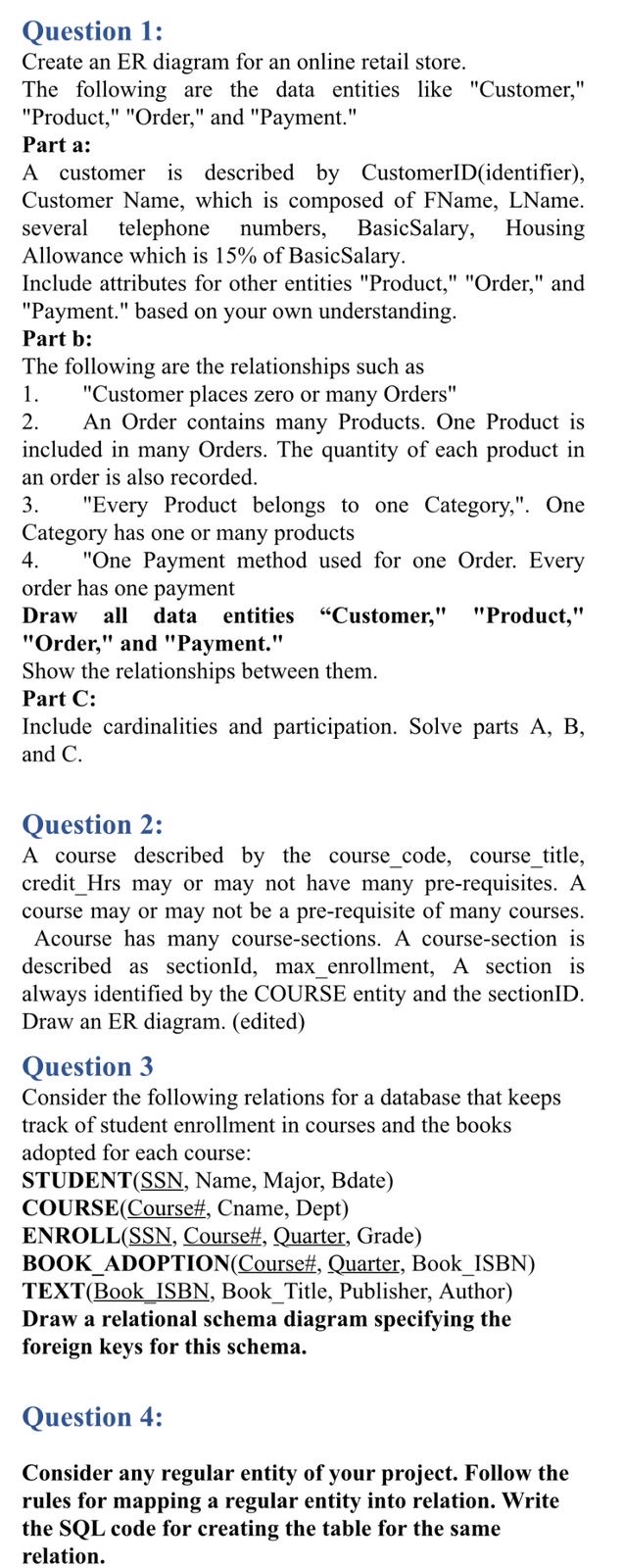
Question: Question 1 : Create an ER diagram for an online retail store. The following are the data entities like Customer, Product, Order, and Payment. Part
Question :
Create an ER diagram for an online retail store.
The following are the data entities like "Customer," "Product," "Order," and "Payment."
Part a:
A customer is described by CustomerIDidentifier Customer Name, which is composed of FName, LName. several telephone numbers, BasicSalary, Housing Allowance which is of BasicSalary.
Include attributes for other entities "Product," "Order," and "Payment." based on your own understanding.
Part b:
The following are the relationships such as
"Customer places zero or many Orders"
An Order contains many Products. One Product is included in many Orders. The quantity of each product in an order is also recorded.
"Every Product belongs to one Category,". One Category has one or many products
"One Payment method used for one Order. Every order has one payment
Draw all data entities "Customer," "Product," "Order," and "Payment."
Show the relationships between them.
Part C:
Include cardinalities and participation. Solve parts A B and
Question :
A course described by the coursecode, coursetitle, creditHrs may or may not have many prerequisites. A course may or may not be a prerequisite of many courses.
Acourse has many coursesections. A coursesection is described as sectionId maxenrollment, A section is always identified by the COURSE entity and the sectionID Draw an ER diagram. edited
Question
Consider the following relations for a database that keeps track of student enrollment in courses and the books adopted for each course:
STUDENTSSN Name, Major, Bdate
COURSECourse# Cname, Dept
ENROLLSSN Course# Quarter, Grade
BOOKADOPTIONCourse# Quarter, BookISBN TEXTBookISBN, BookTitle, Publisher, Author Draw a relational schema diagram specifying the foreign keys for this schema.
Question :
Consider any regular entity of your project. Follow the rules for mapping a regular entity into relation. Write the SQL code for creating the table for the same relation.
Step by Step Solution
There are 3 Steps involved in it
1 Expert Approved Answer
Step: 1 Unlock

Question Has Been Solved by an Expert!
Get step-by-step solutions from verified subject matter experts
Step: 2 Unlock
Step: 3 Unlock
 Study Help