







Question: Question 1. The centralized organizational structure is preferable under what circumstances? What about the decentralized organizational structure? If a company changes to a decentralized organizational

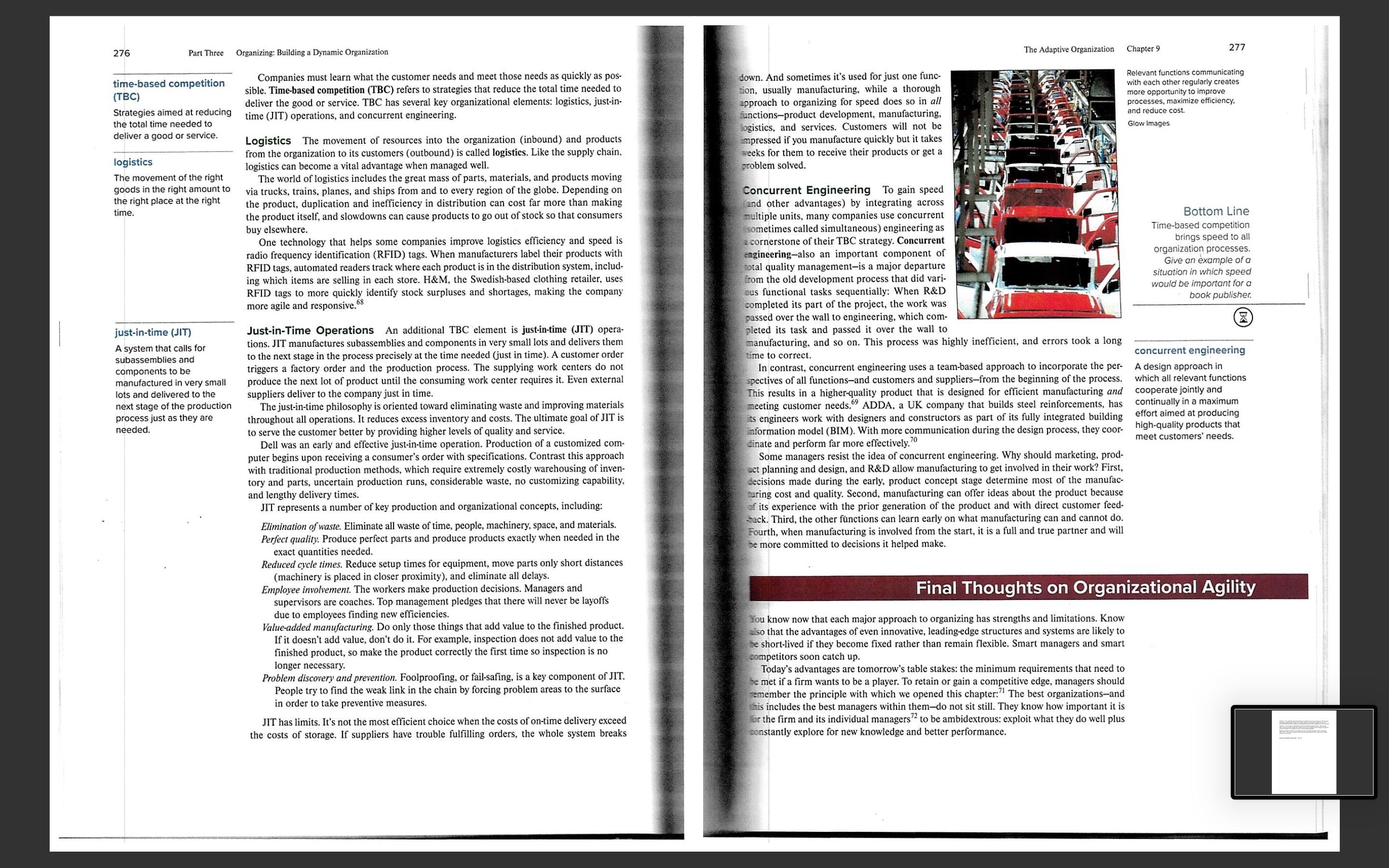
Question 1. The centralized organizational structure is preferable under what circumstances? What about the decentralized organizational structure? If a company changes to a decentralized organizational structure, would that mean that dynamic capabilities are being utilized? (Define dynamic capabilities in your own words) Question 2. Your company is implementing customer relationship management (CRM). What does tha entail? What do you know already that a customer expects of your company? (Hint 4 things) Is the customer merely the purchaser of the product or service or has the meaning expanded? Question 3. On page 276 and 277 in the textbook the term Time Based Competition (TBC) is introduced. What is TBC? The text then expands on TBC to introduce three elements of TBC, what are they? Explain each in your own words. Question 3) ISBN 978-1-264-12436-7 15TH ED276 Part Three Organizing: Building a Dynamic Organization The Adaptive Organization Chapter 9 277 Companies must learn what the customer needs and meet those needs as quickly as pos- down. And sometimes it's used for just one func- Relevant functions communicating time-based competition sible. Time-based competition (TBC) refers to strategies that reduce the total time needed to tion, usually manufacturing, while a thorough with each other regularly creates (TBC) deliver the good or service. TBC has several key organizational elements: logistics, just-in- more opportunity to improve Strategies aimed at reducing approach to organizing for speed does so in all processes, maximize efficiency. time (JIT) operations, and concurrent engineering. functions-product development, manufacturing, and reduce cost. the total time needed to deliver a good or service. logistics, and services. Customers will not be Glow Images Logistics The movement of resources into the organization (inbound) and products impressed if you manufacture quickly but it takes from the organization to its customers (outbound) is called logistics. Like the supply chain logistics weeks for them to receive their products or get a logistics can become a vital advantage when managed well. problem solved. The movement of the right The world of logistics includes the great mass of parts, materials, and products moving goods in the right amount to via trucks, trains, planes, and ships from and to every region of the globe. Depending on the right place at the right Concurrent Engineering To gain speed the product, duplication and inefficiency in distribution can cost far more than making time. and other advantages) by integrating across the product itself, and slowdowns can cause products to go out of stock so that consumers multiple units, many companies use concurrent Bottom Line buy elsewhere. sometimes called simultaneous) engineering as Time-based competition One technology that helps some companies improve logistics efficiency and speed is cornerstone of their TBC strategy. Concurrent brings speed to all radio frequency identification (RFID) tags. When manufacturers label their products with engineering-also an important component of organization processes RFID tags, automated readers track where each product is in the distribution system, include total quality management-is a major departure Give an example of a ing which items are selling in each store. H&M, the Swedish-based clothing retailer, uses from the old development process that did vari- situation in which speed RFID tags to more quickly identify stock surpluses and shortages, making the company ous functional tasks sequentially: When R&D would be important for a more agile and responsive. 68 completed its part of the project, the work was book publisher. passed over the wall to engineering, which com- just-in-time (JIT) Just-in-Time Operations An additional TBC element is just-in-time (JIT) opera- pleted its task and passed it over the wall to A system that calls for tions. JIT manufactures subassemblies and components in very small lots and delivers them manufacturing, and so on. This process was highly inefficient, and errors took a long subassemblies and to the next stage in the process precisely at the time needed (just in time). A customer order time to correct. concurrent engineering components to be triggers a factory order and the production process. The supplying work centers do not In contrast, concurrent engineering uses a team-based approach to incorporate the per- A design approach in manufactured in very small produce the next lot of product until the consuming work center requires it. Even external spectives of all functions-and customers and suppliers-from the beginning of the process. which all relevant functions lots and delivered to the suppliers deliver to the company just in time. This results in a higher-quality product that is designed for efficient manufacturing and cooperate jointly and next stage of the production The just-in-time philosophy is oriented toward eliminating waste and improving materials meeting customer needs. ADDA, a UK company that builds steel reinforcements, has continually in a maximum process just as they are throughout all operations. It reduces excess inventory and costs. The ultimate goal of JIT is needed. its engineers work with designers and constructors as part of its fully integrated building effort aimed at producing to serve the customer better by providing higher levels of quality and service. information model (BIM). With more communication during the design process, they coor- high-quality products that Dell was an early and effective just-in-time operation. Production of a customized com- dinate and perform far more effectively." meet customers' needs. puter begins upon receiving a consumer's order with specifications. Contrast this approach Some managers resist the idea of concurrent engineering. Why should marketing, prod with traditional production methods, which require extremely costly warehousing of inven- act planning and design, and R&D allow manufacturing to get involved in their work? First, tory and parts, uncertain production runs, considerable waste, no customizing capability. decisions made during the early, product concept stage determine most of the manufac and lengthy delivery times. uring cost and quality. Second, manufacturing can offer ideas about the product because JIT represents a number of key production and organizational concepts, including: of its experience with the prior generation of the product and with direct customer feed- Elimination of waste. Eliminate all waste of time, people, machinery, space, and materials back. Third, the other functions can learn early on what manufacturing can and cannot do. Perfect quality. Produce perfect parts and produce products exactly when needed in the Fourth, when manufacturing is involved from the start, it is a full and true partner and will exact quantities needed. be more committed to decisions it helped make. Reduced cycle times. Reduce setup times for equipment, move parts only short distances (machinery is placed in closer proximity), and eliminate all delays. Employee involvement. The workers make production decisions. Managers and supervisors are coaches. Top management pledges that there will never be layoffs Final Thoughts on Organizational Agility due to employees finding new efficiencies. Value-added manufacturing. Do only those things that add value to the finished product. You know now that each major approach to organizing has strengths and limitations. Know If it doesn't add value, don't do it. For example, inspection does not add value to the also that the advantages of even innovative, leading-edge structures and systems are likely to finished product, so make the product correctly the first time so inspection is no be short-lived if they become fixed rather than remain flexible. Smart managers and smart longer necessary. competitors soon catch up. Problem discovery and prevention. Foolproofing, or fail-safing, is a key component of JIT. Today's advantages are tomorrow's table stakes: the minimum requirements that need to People try to find the weak link in the chain by forcing problem areas to the surface e met if a firm wants to be a player. To retain or gain a competitive edge, managers should in order to take preventive measures. remember the principle with which we opened this chapter:" The best organizations-and his includes the best managers within them-do not sit still. They know how important it is JIT has limits. It's not the most efficient choice when the costs of on-time delivery exceed or the firm and its individual managers" to be ambidextrous: exploit what they do well plus he costs of storage. If suppliers have trouble fulfilling orders, the whole system breaks constantly explore for new knowledge and better performance
Step by Step Solution
There are 3 Steps involved in it

Get step-by-step solutions from verified subject matter experts
 Study Help