







Question: Question 11-10 and 11-13 360 PART 4 DYNAMIC PROCESSES AND INFORMATION SYSTEMS FIGURE 11-28 Ghostery in Use Source: O 2012 Ghostery, a service of Evidon,
Question
11-10 and 11-13
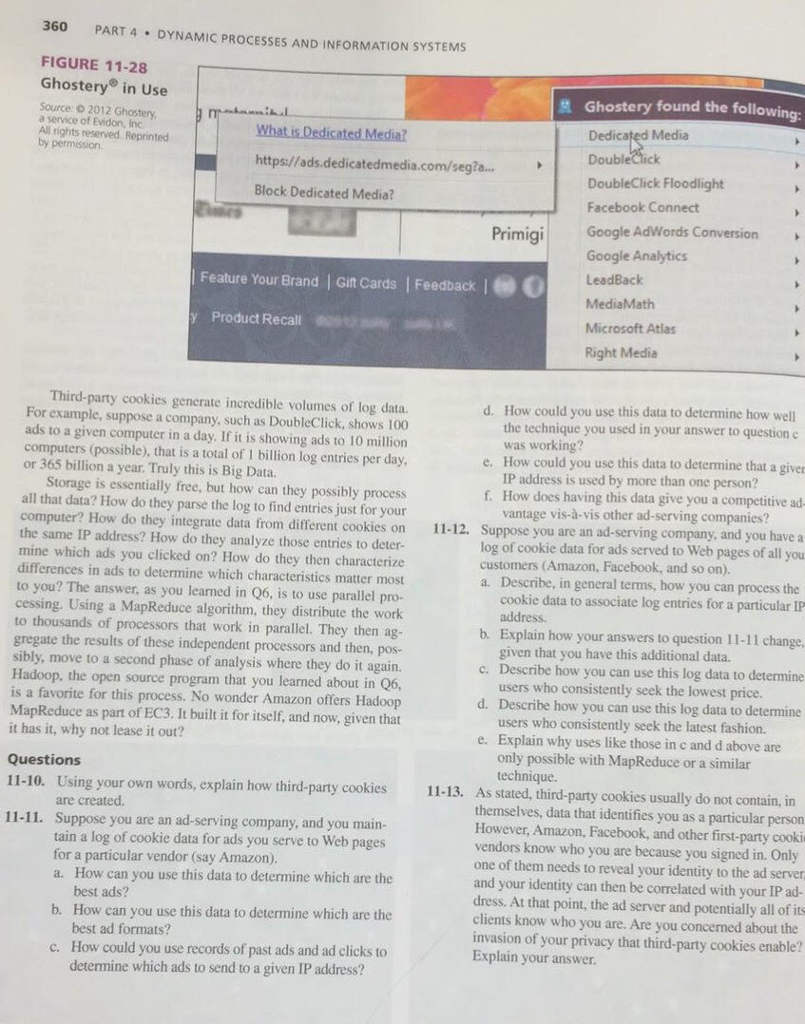
360 PART 4 DYNAMIC PROCESSES AND INFORMATION SYSTEMS FIGURE 11-28 Ghostery in Use Source: O 2012 Ghostery, a service of Evidon, Inc All rights reserved. Reprinted by permission What is Dedicated Media? https://ads.dedicatedmedia.com/seg?a... Block Dedicated Media? Primigi Ghostery found the following: Dedicated Media DoubleClick DoubleClick Floodlight Facebook Connect Google AdWords Conversion Google Analytics LeadBack MediaMath Microsoft Atlas Right Media Feature Your Brand | Gin Cards Feedback Product Recall Third-party cookies generate incredible volumes of log data. For example, suppose a company, such as DoubleClick, shows 100 ads to a given computer in a day. If it is showing ads to 10 million computers (possible), that is a total of 1 billion log entries per day, or 365 billion a year. Truly this is Big Data, Storage is essentially free, but how can they possibly process all that data? How do they parse the log to find entries just for your computer? How do they integrate data from different cookies on the same IP address? How do they analyze those entries to deter- mine which ads you clicked on? How do they then characterize differences in ads to determine which characteristics matter most to you? The answer, as you learned in Q6, is to use parallel pro- cessing. Using a MapReduce algorithm, they distribute the work to thousands of processors that work in parallel. They then ag- gregate the results of these independent processors and then, pos- sibly, move to a second phase of analysis where they do it again. Hadoop, the open source program that you learned about in Q6, is a favorite for this process. No wonder Amazon offers Hadoop MapReduce as part of EC3. It built it for itself, and now, given that it has it, why not lease it out? d. How could you use this data to determine how well the technique you used in your answer to questione was working? e. How could you use this data to determine that a giver IP address is used by more than one person? f. How does having this data give you a competitive ad- vantage vis--vis other ad-serving companies? 11-12. Suppose you are an ad-serving company, and you have a log of cookie data for ads served to Web pages of all you. customers (Amazon, Facebook, and so on). a. Describe, in general terms, how you can process the cookie data to associate log entries for a particular IP address. b. Explain how your answers to question 11-11 change, given that you have this additional data. c. Describe how you can use this log data to determine users who consistently seek the lowest price. d. Describe how you can use this log data to determine users who consistently seek the latest fashion. e. Explain why uses like those in c and d above are only possible with MapReduce or a similar technique. 11-13. As stated, third-party cookies usually do not contain, in themselves, data that identifies you as a particular person However, Amazon, Facebook, and other first-party cookie vendors know who you are because you signed in. Only one of them needs to reveal your identity to the ad server, and your identity can then be correlated with your IP ad- dress. At that point, the ad server and potentially all of its clients know who you are. Are you concerned about the invasion of your privacy that third-party cookies enable? Explain your answer. Questions 11-10. Using your own words, explain how third-party cookies are created. 11-11. Suppose you are an ad-serving company, and you main- tain a log of cookie data for ads you serve to Web pages for a particular vendor (say Amazon). a. How can you use this data to determine which are the best ads? b. How can you use this data to determine which are the best ad formats? C. How could you use records of past ads and ad clicks to determine which ads to send to a given IP address
Step by Step Solution
There are 3 Steps involved in it

Get step-by-step solutions from verified subject matter experts
 Study Help