







Question: Question 2 (10 points): Draw the 11-item hash table that results from using the hash function h(k)-k mod 11. To hash the keys 10, 22,
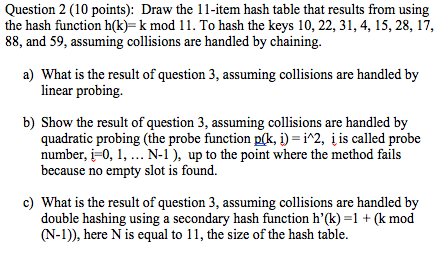
Question 2 (10 points): Draw the 11-item hash table that results from using the hash function h(k)-k mod 11. To hash the keys 10, 22, 31, 4, 15, 28, 17, 88, and 59, assuming collisions are handled by chaining linear probing. b) Show the result of question 3, assuming collisions are handled by quadratic probing (the probe function plk, i) = 1"2, is called probe number, i-0, 1, N-1), up to the point where the method fails because no empty slot is found. c) What is the result of question 3, assuming collisions are handled by (k mod double hashing using a secondary hash function h'(k)-1 (N-1)), here N is equal to 11, the size of the hash table
Step by Step Solution
There are 3 Steps involved in it

Get step-by-step solutions from verified subject matter experts
 Study Help