







Question: Question 3: A UNIX filesystem has 2--KB blocks and 4--byte disk addresses. Each i--node contains 10 direct entries, one single-indirect entry and one double--indirect entry
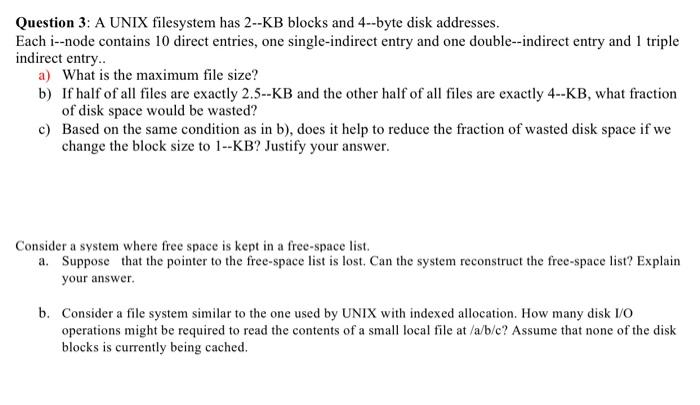
Question 3: A UNIX filesystem has 2--KB blocks and 4--byte disk addresses. Each i--node contains 10 direct entries, one single-indirect entry and one double--indirect entry and 1 triple indirect entry.. a) What is the maximum file size? b) If half of all files are exactly 2.5--KB and the other half of all files are exactly 4--KB, what fraction of disk space would be wasted? c) Based on the same condition as in b), does it help to reduce the fraction of wasted disk space if we change the block size to 1--KB? Justify your answer. Consider a system where free space is kept in a free-space list. a. Suppose that the pointer to the free-space list is lost. Can the system reconstruct the free-space list? Explain your answer. b. Consider a file system similar to the one used by UNIX with indexed allocation. How many disk I/O operations might be required to read the contents of a small local file at /a/b/c? Assume that none of the disk blocks is currently being cached
Step by Step Solution
There are 3 Steps involved in it

Get step-by-step solutions from verified subject matter experts
 Study Help