







Question: Question 5 Consider Table 1 depicting the lock requests of transactions T1, T2 and T3, and Table 2 depicting the lock requests of Transactions T4,
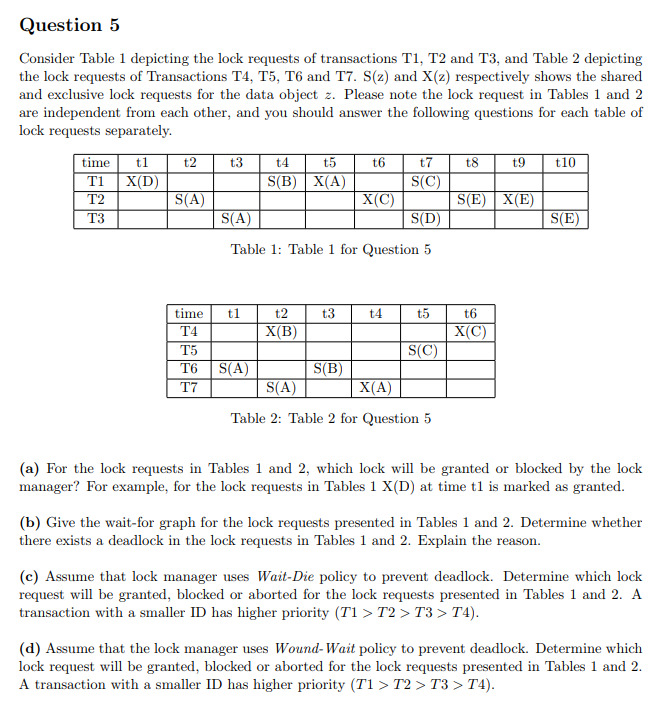
Question 5 Consider Table 1 depicting the lock requests of transactions T1, T2 and T3, and Table 2 depicting the lock requests of Transactions T4, T5, T6 and T7. S(z) and X(z) respectively shows the shared and exclusive lock requests for the data object z. Please note the lock request in Tables 1 and 2 are independent from each other, and you should answer the following questions for each table of lock requests separately. time t1 t3 t4 t5 t9 t10 t7 t8 S(C) t6 T2 T3 S(A S(D) S(E) Table 1: Table 1 for Question 5 time tl T4 T5 T6 S(A) T7 t2 t3 t4 t5 t6 X(B) X(C) S(C) S(B) S(A) X(A) Table 2: Table 2 for Question 5 (a) For the lock requests in Tables 1 and 2, which lock will be granted or blocked by the lock manager? For example, for the lock requests in Tables 1 X(D) at time t1 is marked as granted. (b) Give the wait-for graph for the lock requests presented in Tables 1 and 2. Determine whether there exists a deadlock in the lock requests in Tables 1 and 2. Explain the reason. (c) Assume that lock manager uses Wait-Die policy to prevent deadlock. Determine which lock request will be granted, blocked or aborted for the lock requests present transaction with a smaller ID has higher priority (T1 > T2 > T3> T4) ed in Tables 1 and 2. A (d) Assume that the lock manager uses Wound-Wait policy to prevent deadlock. Determine which lock request will be granted, blocked or aborted for the lock requests presented in Tables 1 and 2 A transaction with a smaller ID has higher priority (T1 T2 > T3 > T4)
Step by Step Solution
There are 3 Steps involved in it

Get step-by-step solutions from verified subject matter experts
 Study Help