







Question: Question: Consider the ER diagram shown below for a BANK database. Each bank can have multiple branches, and each branch can have multiple accounts and
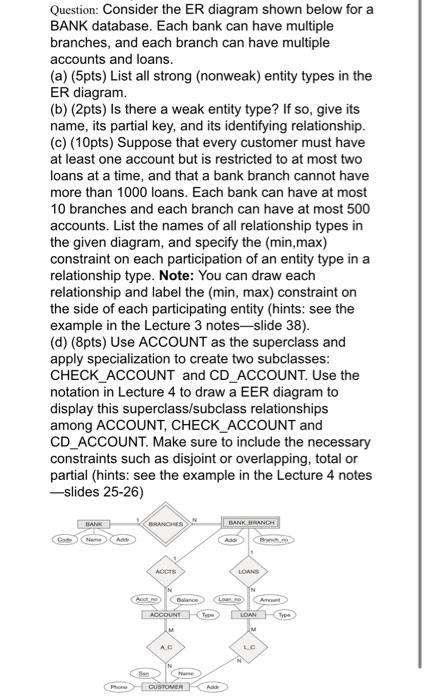
Question: Consider the ER diagram shown below for a BANK database. Each bank can have multiple branches, and each branch can have multiple accounts and loans. (a) (5pts) List all strong (nonweak) entity types in the ER diagram. (b) (2pts) Is there a weak entity type? If so, give its name, its partial key, and its identifying relationship. (c) (10pts) Suppose that every customer must have at least one account but is restricted to at most two loans at a time, and that a bank branch cannot have more than 1000 loans. Each bank can have at most 10 branches and each branch can have at most 500 accounts. List the names of all relationship types in the given diagram, and specify the (min, max) constraint on each participation of an entity type in a relationship type. Note: You can draw each relationship and label the (min, max) constraint on the side of each participating entity (hints: see the example in the Lecture 3 notes/slide 38). (d) (8pts) Use ACCOUNT as the superclass and apply specialization to create two subclasses: CHECK_ACCOUNT and CD_ACCOUNT. Use the notation in Lecture 4 to draw a EER diagram to display this superclass/subclass relationships among ACCOUNT, CHECK_ACCOUNT and CD_ACCOUNT. Make sure to include the necessary constraints such as disjoint or overlapping, total or partial (hints: see the example in the Lecture 4 notes -slides 25-26) BANK BRANCHES BANK BRANCHE Nam Add ACCES LOANS N Se ACCOUNT LOAN Type M M AG N CUSTOMER A
Step by Step Solution
There are 3 Steps involved in it

Get step-by-step solutions from verified subject matter experts
 Study Help