



Question: Question I You are given a relation, Club Events (Eventld, Clubld, Memberld) with the Functional Dependencies (FDs) as follows Eventld ---> Clubld (A given event
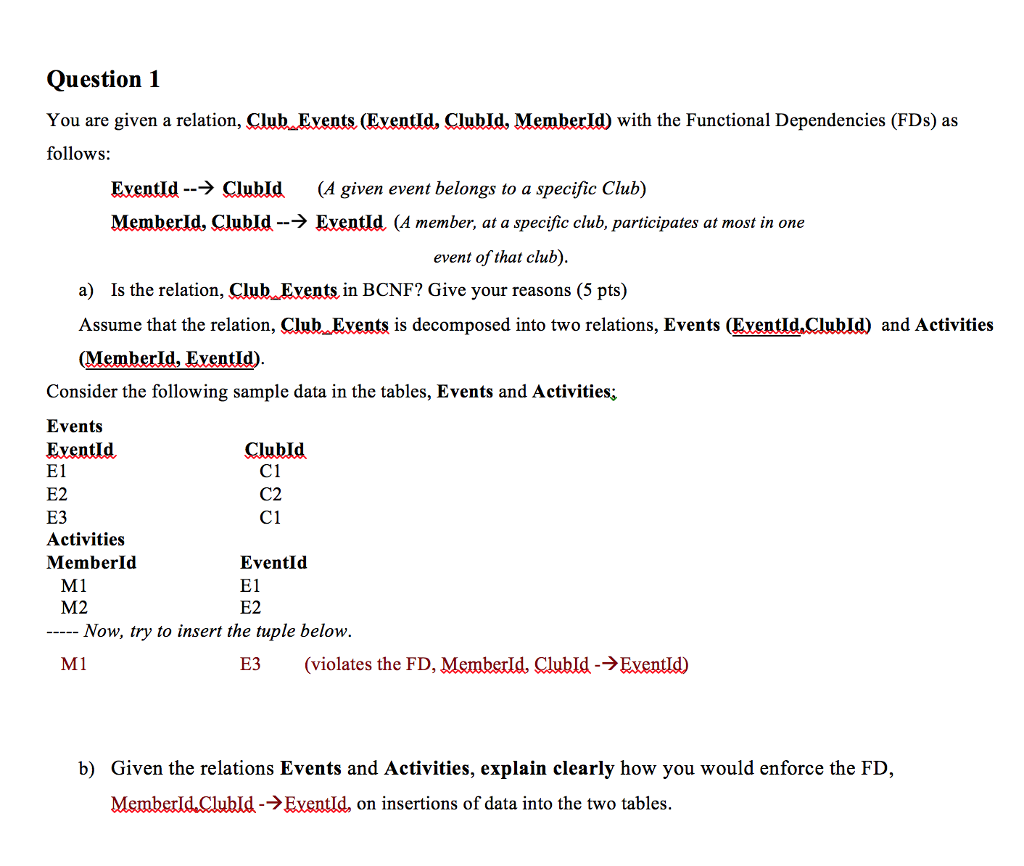
Question I You are given a relation, Club Events (Eventld, Clubld, Memberld) with the Functional Dependencies (FDs) as follows Eventld ---> Clubld (A given event belongs to a specific Club) Memberld, Clubld -> Eventld (A member, at a specific club, participates at most in one event of that club) a) Is the relation, Club Events in BCNF? Give your reasons (5 pts) Assume that the relation, ClubEvents is decomposed into two relations, Events (Eventld.Clubld) and Activities Memberld, Eventld Consider the following sample data in the tables, Events and Activities; Events Eventld El E2 ?? Activities Memberld Clubld C1 C2 C1 Eventld M1 M2 El E2 Now, try to insert the tuple below. M1 E3 (violates the FD, Memberld, Clubld -Eventld) b) Given the relations Events and Activities, explain clearly how you would enforce the FD, Eventld, on insertions of data into the two tables Question I You are given a relation, Club Events (Eventld, Clubld, Memberld) with the Functional Dependencies (FDs) as follows Eventld ---> Clubld (A given event belongs to a specific Club) Memberld, Clubld -> Eventld (A member, at a specific club, participates at most in one event of that club) a) Is the relation, Club Events in BCNF? Give your reasons (5 pts) Assume that the relation, ClubEvents is decomposed into two relations, Events (Eventld.Clubld) and Activities Memberld, Eventld Consider the following sample data in the tables, Events and Activities; Events Eventld El E2 ?? Activities Memberld Clubld C1 C2 C1 Eventld M1 M2 El E2 Now, try to insert the tuple below. M1 E3 (violates the FD, Memberld, Clubld -Eventld) b) Given the relations Events and Activities, explain clearly how you would enforce the FD, Eventld, on insertions of data into the two tables
Step by Step Solution
There are 3 Steps involved in it

Get step-by-step solutions from verified subject matter experts