







Question: Question is in the last page! (Due to ongoing negative press and past litigation, the name and location of the customer as well as the
Question is in the last page!
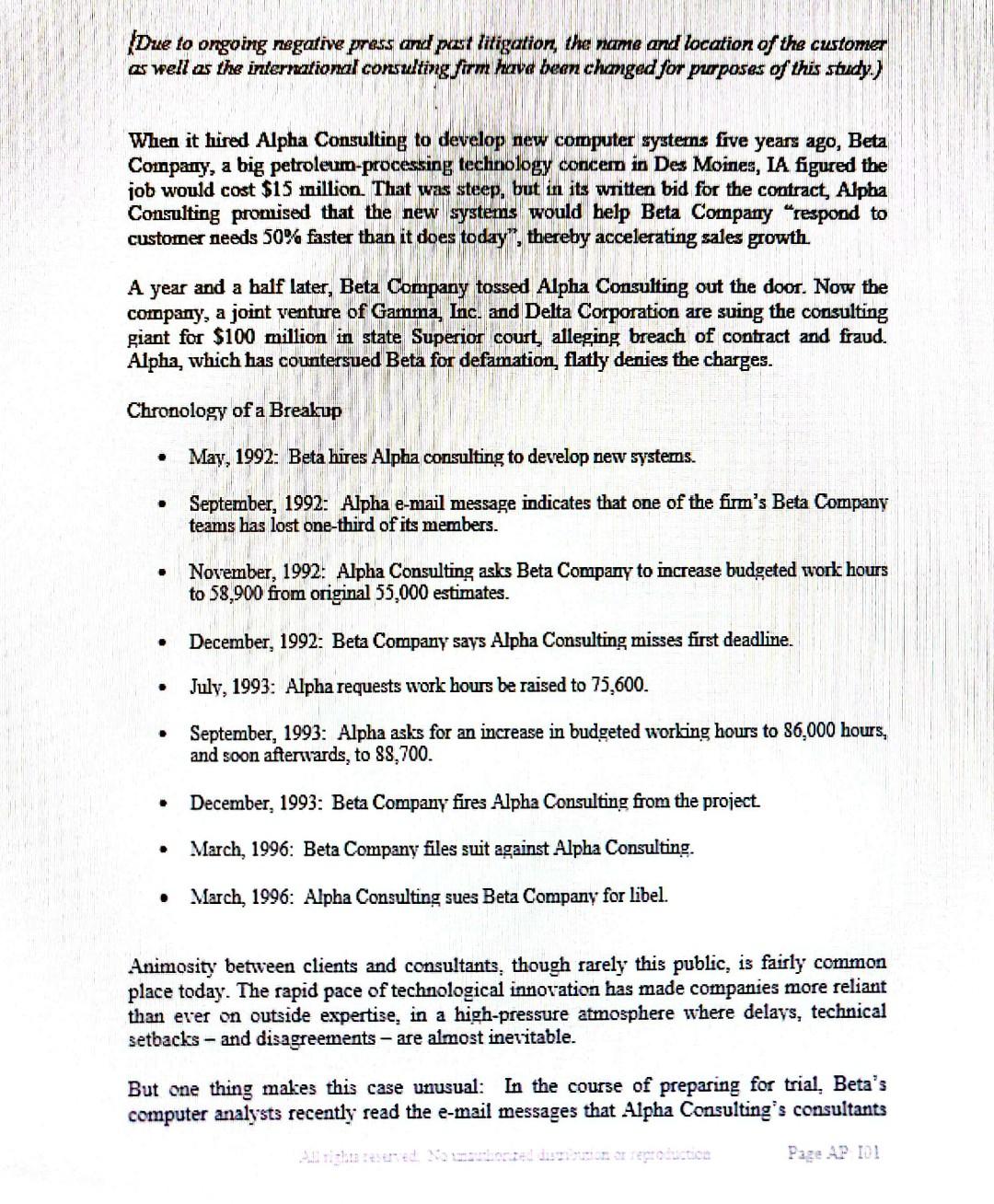
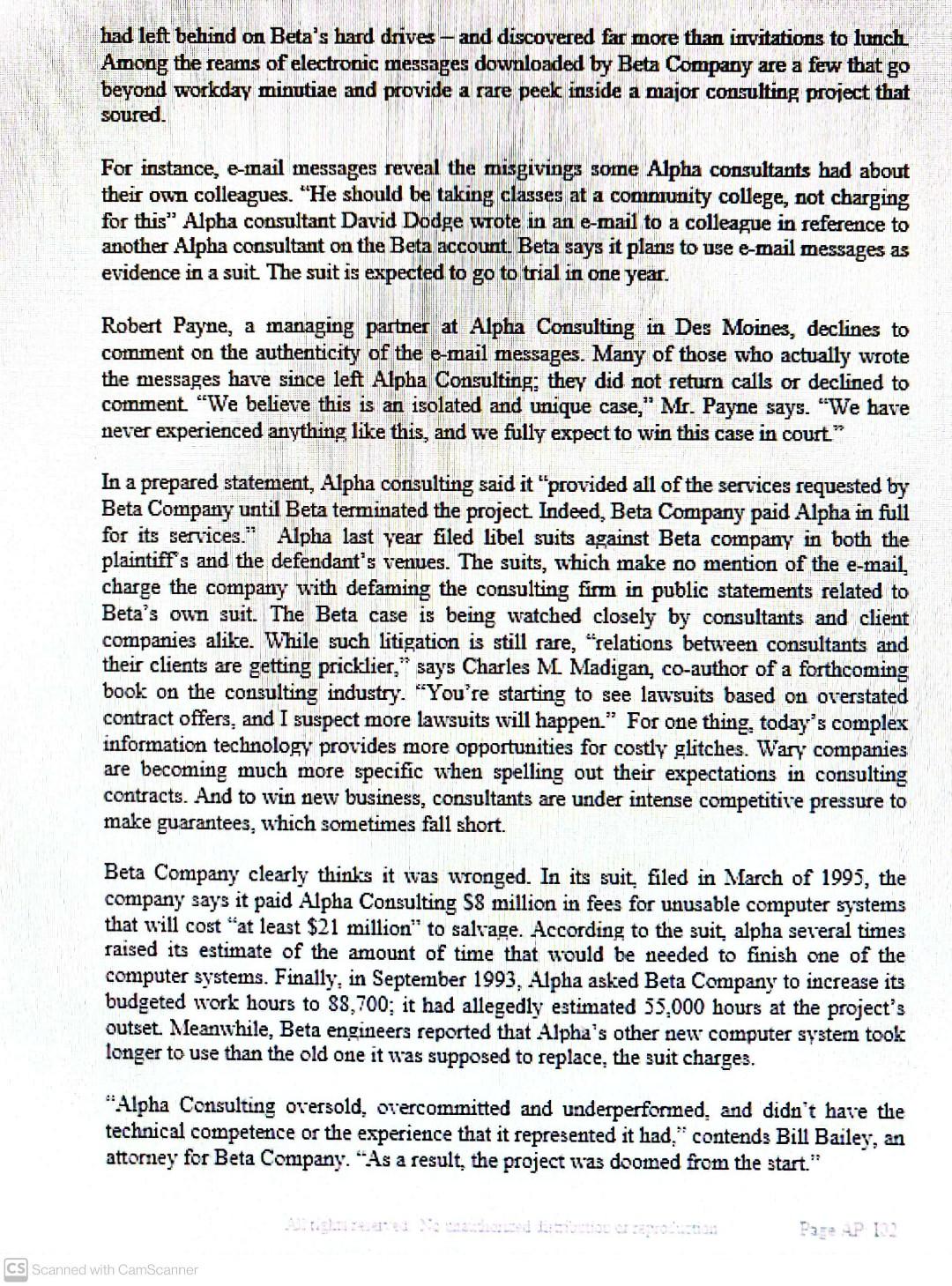
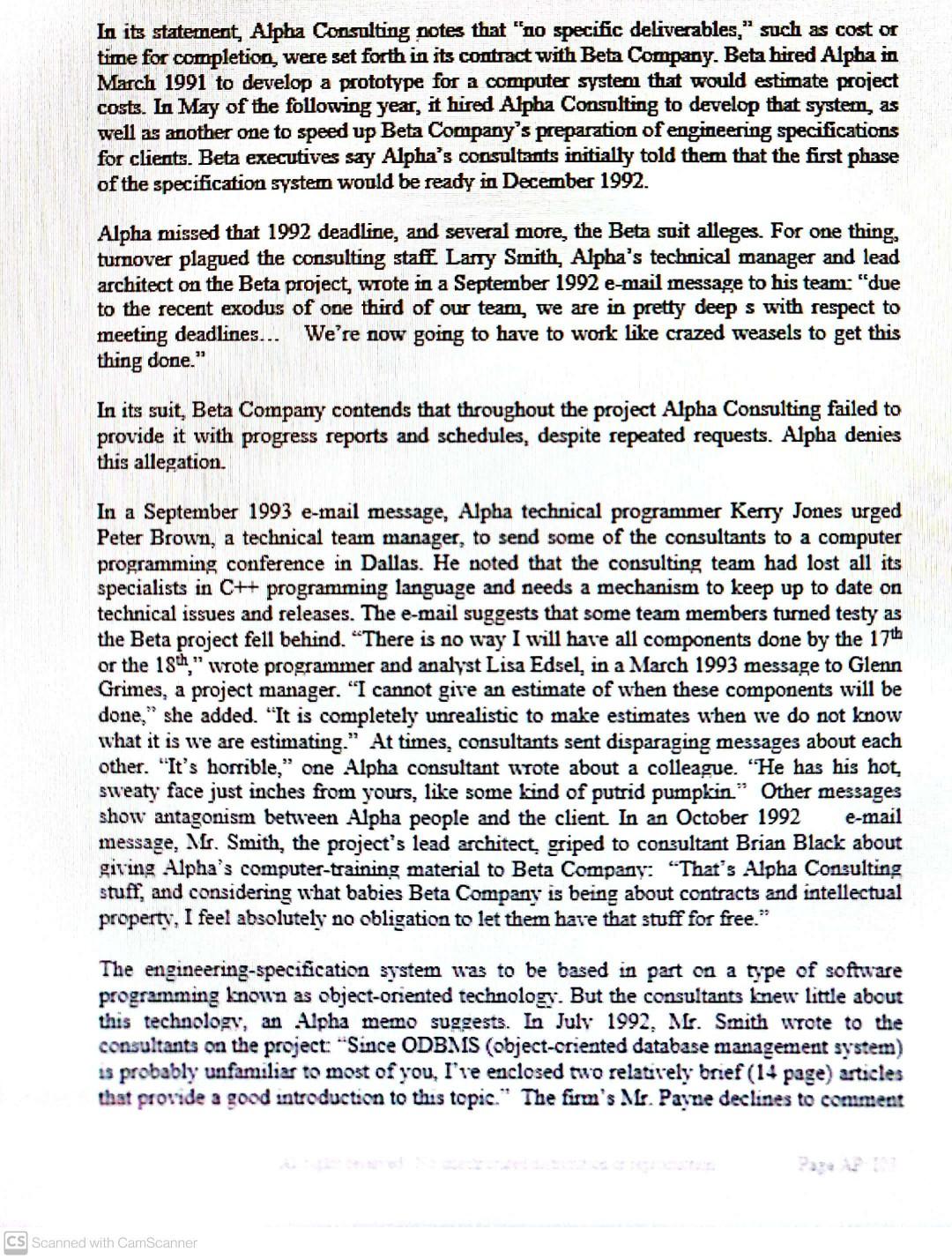
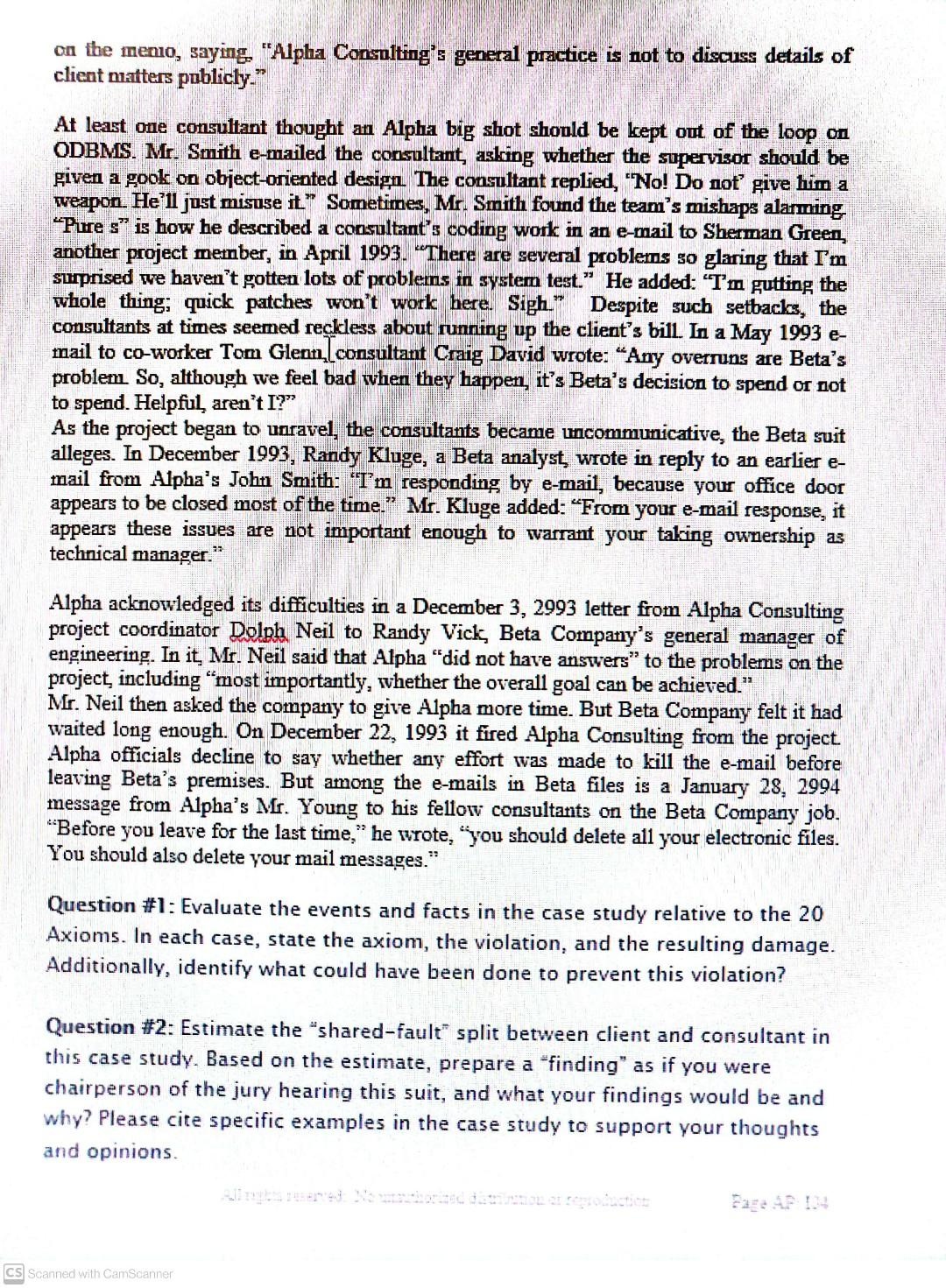
(Due to ongoing negative press and past litigation, the name and location of the customer as well as the international consulting firm have been changed for purposes of this study.) When it hired Alpha Consulting to develop new computer systems five years ago, Beta Company, a big petroleum-processing technology concem in Des Moines, IA figured the job would cost $15 million. That was steep, but in its written bid for the contract, Alpha Consulting promised that the new systems would help Beta Company "respond to customer needs 50% faster than it does today", thereby accelerating sales growth a trait de la day A year and a half later, Beta Company tossed Alpha Consulting out the door. Now the company, a joint venture of Gamma, Inc. and Delta Corporation are suing the consulting giant for $100 million in state Superior court, alleging breach of contract and fraud. Alpha, which has countersued Beta for defamation, flatly denies the charges. Chronology of a Breakup . May, 1992: Beta hires Alpha consulting to develop new systems. September, 1992: Alpha e-mail message indicates that one of the firm's Beta Company teams has lost one-third of its members. . November, 1992: Alpha Consulting asks Beta Company to increase budgeted work hours to 58,900 from original 55,000 estimates. . December, 1992: Beta Company says Alpha Consulting misses first deadline. . July, 1993: Alpha requests work hours be raised to 75,600. . September, 1993: Alpha asks for an increase in budgeted working hours to 86,000 hours, and soon afterwards, to 88,700. December, 1993: Beta Company fires Alpha Consulting from the project. . March, 1996: Beta Company files suit against Alpha Consulting. March, 1996: Alpha Consulting sues Beta Company for libel. Animosity between clients and consultants, though rarely this public, is fairly common place today. The rapid pace of technological innovation has made companies more reliant than ever on outside expertise, in a high-pressure atmosphere where delays, technical setbacks - and disagreements - are almost inevitable. But one thing makes this case unusual: In the course of preparing for trial. Beta's computer analysts recently read the e-mail messages that Alpha Consulting's consultants Page 101 had left behind on Beta's hard drives - and discovered far more than invitations to lunch Among the reams of electronic messages downloaded by Beta Company are a few that go beyond workday minutiae and provide a rare peek inside a major consulting project that soured. For instance, e-mail messages reveal the misgivings some Alpha consultants had about their own colleagues. He should be taking classes at a community college, not charging for this" Alpha consultant David Dodge wrote in an e-mail to a colleague in reference to another Alpha consultant on the Beta account. Beta says it plans to use e-mail messages as evidence in a suit The suit is expected to go to trial in one year. Robert Payne, a managing partner at Alpha Consulting in Des Moines, declines to comment on the authenticity of the e-mail messages. Many of those who actually wrote the messages have since left Alpha Consulting: they did not return calls or declined to comment "We believe this is an isolated and unique case," Mr. Payne says. We have never experienced anything like this, and we fully expect to win this case in court." In a prepared statement, Alpha consulting said it "provided all of the services requested by Beta Company until Beta terminated the project Indeed, Beta Company paid Alpha in full for its services." Alpha last year filed libel suits against Beta company in both the plaintiff's and the defendant's venues. The suits, which make no mention of the e-mail, charge the company with defaming the consulting firm in public statements related to Beta's own suit. The Beta case is being watched closely by consultants and client companies alike. While such litigation is still rare,"relations between consultants and their clients are getting pricklier," says Charles M. Madigan, co-author of a forthcoming book on the consulting industry. "You're starting to see lawsuits based on overstated contract offers, and I suspect more lawsuits will happen." For one thing, today's complex information technology provides more opportunities for costly glitches. Wary companies are becoming much more specific whe spelling out their expectations in consulting contracts. And to win new business, consultants are under intense competitive pressure to make guarantees, which sometimes fall short. Beta Company clearly thinks it was wronged. In its suit filed in March of 1995, the company says it paid Alpha Consulting S8 million in fees for unusable computer systems that will cost "at least $21 million" to salvage. According to the suit alpha several times raised its estimate of the amount of time that would be needed to finish one of the computer systems. Finally, in September 1993, Alpha asked Beta Company to increase its budgeted work hours to 88,700; it had allegedly estimated 55,000 hours at the project's outset. Meanwhile, Beta engineers reported that Alpha's other new computer system took longer to use than the old one it was supposed to replace, the suit charges. "Alpha Consulting oversold, overcommitted and underperformed, and didn't have the technical competence or the experience that it represented it had." contends Bill Bailey, an attorney for Beta Company. As a result, the project was doomed from the start." CS Scanned with CamScanner In its statement, Alpha Consulting notes that "no specific deliverables," such as cost or time for completion were set forth in its contract with Beta Company. Beta hired Alpha in March 1991 to develop a prototype for a computer system that would estimate project costs. In May of the following year, it hired Alpha Consulting to develop that system, as well as another one to speed up Beta Company's preparation of engineering specifications for clients. Beta executives say Alpha's consultants initially told them that the first phase of the specification system would be ready in December 1992. Alpha missed that 1992 deadline, and several more, the Beta suit alleges. For one thing, turnover plagued the consulting staff Larry Smith, Alpha's technical manager and lead architect on the Beta project, wrote in a September 1992 e-mail message to his team: "due to the recent exodus of one third of our team, we are in pretty deep s with respect to meeting deadlines... We're now going to have to work like crazed weasels to get this thing done." to In its suit, Beta Company contends that throughout the project Alpha Consulting faile provide it with progress reports and schedules, despite repeated requests. Alpha denies this allegation. In a September 1993 e-mail message, Alpha technical programmer Kerry Jones urged Peter Brown, a technical team manager, to send some of the consultants to a computer programming conference in Dallas. He noted that the consulting team had lost all its specialists in C++ programming language and needs a mechanism to keep up to date on technical issues and releases. The e-mail suggests that some team members tumed testy as the Beta project fell behind. There is no way I will have all components done by the 171 or the 18th," wrote programmer and analyst Lisa Edsel, in a March 1993 message to Glenn Grimes, a project manager. I cannot give an estimate of when these components will be done," she added. "It is completely unrealistic to make estimates when we do not know what it is we are estimating." At times, consultants sent disparaging messages about each other. "It's horrible," one Alpha consultant wrote about a colleague. "He has his hot, sweaty face just inches from yours, like some kind of putrid pumpkin" Other messages show antagonism between Alpha people and the client In an October 1992 e-mail message, Mr. Smith, the project's lead architect, griped to consultant Brian Black about giving Alpha's computer-training material to Beta Company: That's Alpha Consulting stuff, and considering what babies Beta Company is being about contracts and intellectual property, I feel absolutely no obligation to let them have that stuff for free." 29 The engineering-specification system was to be based in part on a type of software programming known as object-oriented technology. But the consultants knew little about this technology, an Alpha memo suggests. In July 1992, Mr. Smith wrote to the consultants on the project - Since ODBMS (object-oriented database management system) 1s probably unfamiliar to most of you, I've enclosed two relatively brief (14 page) articles that provide a good introduction to this topic." The firm's ML. Payne declines to comment CS Scanned with CamScanner on the meno, saying. "Alpha Consulting's general practice is not to discuss details of client matters publicly." At least one consultant thought an Alpha big shot should be kept out of the loop on ODBMS. Mr. Smith e-mailed the consultant, asking whether the supervisor should be given a gook on object-oriented design. The consultant replied, "No! Do not give him a weapon. He'll just misuse it" Sometimes, Mr. Smith found the team's mishaps alarming Pure s is how he described a consultant's coding work in an e-mail to Sherman Green, another project member, in April 1993. "There are several problems so glaring that I'm suprised we haven't gotten lots of problems in system test. He added: "I'm gutting the whole thing; quick patches won't work here. Sigh." Despite such setbacks, the consultants at times seemed reckless about running up the client's bill. In a May 1993 e- mail to co-worker Tom Glenn [consultant Craig David wrote: Any overruns are Beta's problem. So, although we feel bad when they happen, it's Beta's decision to spend or not to spend. Helpful aren't I? As the project began to unravel, the consultants became uncommunicative, the Beta suit alleges. In December 1993, Randy Kluge, a Beta analyst wrote in reply to an earlier e- mail from Alpha's John Smith: "I'm responding by e-mail, because your office door appears to be closed most of the time." Mr. Kluge added: From your e-mail response, it appears these issues are not important enough to warrant your taking ownership as technical manager." o Alpha acknowledged its difficulties in a December 3, 2993 letter from Alpha Consulting project coordinator Dolph Neil to Randy Vick, Beta Company's general manager of engineering. In it Mr. Neil said that Alpha "did not have answers to the problems on the project including "most importantly, whether the overall goal can be achieved." Mr. Neil then asked the company to give Alpha more time. But Beta Company felt it had waited long enough. On December 22, 1993 it fired Alpha Consulting from the project. Alpha officials decline to say whether any effort was made to kill the e-mail before leaving Beta's premises. But among the e-mails in Beta files is a January 28, 2994 message from Alpha's Mr. Young to his fellow consultants on the Beta Company job. **Before you leave for the last time," he wrote, "you should delete all your electronic files. You should also delete your mail messages." Question #1: Evaluate the events and facts in the case study relative to the 20 Axioms. In each case, state the axiom, the violation, and the resulting damage. Additionally, identify what could have been done to prevent this violation? Question #2: Estimate the shared-fault" split between client and consultant in this case study. Based on the estimate, prepare a "finding" as if you were chairperson of the jury hearing this suit, and what your findings would be and why? Please cite specific examples in the case study to support your thoughts and opinions. CS Scanned with CamScanner (Due to ongoing negative press and past litigation, the name and location of the customer as well as the international consulting firm have been changed for purposes of this study.) When it hired Alpha Consulting to develop new computer systems five years ago, Beta Company, a big petroleum-processing technology concem in Des Moines, IA figured the job would cost $15 million. That was steep, but in its written bid for the contract, Alpha Consulting promised that the new systems would help Beta Company "respond to customer needs 50% faster than it does today", thereby accelerating sales growth a trait de la day A year and a half later, Beta Company tossed Alpha Consulting out the door. Now the company, a joint venture of Gamma, Inc. and Delta Corporation are suing the consulting giant for $100 million in state Superior court, alleging breach of contract and fraud. Alpha, which has countersued Beta for defamation, flatly denies the charges. Chronology of a Breakup . May, 1992: Beta hires Alpha consulting to develop new systems. September, 1992: Alpha e-mail message indicates that one of the firm's Beta Company teams has lost one-third of its members. . November, 1992: Alpha Consulting asks Beta Company to increase budgeted work hours to 58,900 from original 55,000 estimates. . December, 1992: Beta Company says Alpha Consulting misses first deadline. . July, 1993: Alpha requests work hours be raised to 75,600. . September, 1993: Alpha asks for an increase in budgeted working hours to 86,000 hours, and soon afterwards, to 88,700. December, 1993: Beta Company fires Alpha Consulting from the project. . March, 1996: Beta Company files suit against Alpha Consulting. March, 1996: Alpha Consulting sues Beta Company for libel. Animosity between clients and consultants, though rarely this public, is fairly common place today. The rapid pace of technological innovation has made companies more reliant than ever on outside expertise, in a high-pressure atmosphere where delays, technical setbacks - and disagreements - are almost inevitable. But one thing makes this case unusual: In the course of preparing for trial. Beta's computer analysts recently read the e-mail messages that Alpha Consulting's consultants Page 101 had left behind on Beta's hard drives - and discovered far more than invitations to lunch Among the reams of electronic messages downloaded by Beta Company are a few that go beyond workday minutiae and provide a rare peek inside a major consulting project that soured. For instance, e-mail messages reveal the misgivings some Alpha consultants had about their own colleagues. He should be taking classes at a community college, not charging for this" Alpha consultant David Dodge wrote in an e-mail to a colleague in reference to another Alpha consultant on the Beta account. Beta says it plans to use e-mail messages as evidence in a suit The suit is expected to go to trial in one year. Robert Payne, a managing partner at Alpha Consulting in Des Moines, declines to comment on the authenticity of the e-mail messages. Many of those who actually wrote the messages have since left Alpha Consulting: they did not return calls or declined to comment "We believe this is an isolated and unique case," Mr. Payne says. We have never experienced anything like this, and we fully expect to win this case in court." In a prepared statement, Alpha consulting said it "provided all of the services requested by Beta Company until Beta terminated the project Indeed, Beta Company paid Alpha in full for its services." Alpha last year filed libel suits against Beta company in both the plaintiff's and the defendant's venues. The suits, which make no mention of the e-mail, charge the company with defaming the consulting firm in public statements related to Beta's own suit. The Beta case is being watched closely by consultants and client companies alike. While such litigation is still rare,"relations between consultants and their clients are getting pricklier," says Charles M. Madigan, co-author of a forthcoming book on the consulting industry. "You're starting to see lawsuits based on overstated contract offers, and I suspect more lawsuits will happen." For one thing, today's complex information technology provides more opportunities for costly glitches. Wary companies are becoming much more specific whe spelling out their expectations in consulting contracts. And to win new business, consultants are under intense competitive pressure to make guarantees, which sometimes fall short. Beta Company clearly thinks it was wronged. In its suit filed in March of 1995, the company says it paid Alpha Consulting S8 million in fees for unusable computer systems that will cost "at least $21 million" to salvage. According to the suit alpha several times raised its estimate of the amount of time that would be needed to finish one of the computer systems. Finally, in September 1993, Alpha asked Beta Company to increase its budgeted work hours to 88,700; it had allegedly estimated 55,000 hours at the project's outset. Meanwhile, Beta engineers reported that Alpha's other new computer system took longer to use than the old one it was supposed to replace, the suit charges. "Alpha Consulting oversold, overcommitted and underperformed, and didn't have the technical competence or the experience that it represented it had." contends Bill Bailey, an attorney for Beta Company. As a result, the project was doomed from the start." CS Scanned with CamScanner In its statement, Alpha Consulting notes that "no specific deliverables," such as cost or time for completion were set forth in its contract with Beta Company. Beta hired Alpha in March 1991 to develop a prototype for a computer system that would estimate project costs. In May of the following year, it hired Alpha Consulting to develop that system, as well as another one to speed up Beta Company's preparation of engineering specifications for clients. Beta executives say Alpha's consultants initially told them that the first phase of the specification system would be ready in December 1992. Alpha missed that 1992 deadline, and several more, the Beta suit alleges. For one thing, turnover plagued the consulting staff Larry Smith, Alpha's technical manager and lead architect on the Beta project, wrote in a September 1992 e-mail message to his team: "due to the recent exodus of one third of our team, we are in pretty deep s with respect to meeting deadlines... We're now going to have to work like crazed weasels to get this thing done." to In its suit, Beta Company contends that throughout the project Alpha Consulting faile provide it with progress reports and schedules, despite repeated requests. Alpha denies this allegation. In a September 1993 e-mail message, Alpha technical programmer Kerry Jones urged Peter Brown, a technical team manager, to send some of the consultants to a computer programming conference in Dallas. He noted that the consulting team had lost all its specialists in C++ programming language and needs a mechanism to keep up to date on technical issues and releases. The e-mail suggests that some team members tumed testy as the Beta project fell behind. There is no way I will have all components done by the 171 or the 18th," wrote programmer and analyst Lisa Edsel, in a March 1993 message to Glenn Grimes, a project manager. I cannot give an estimate of when these components will be done," she added. "It is completely unrealistic to make estimates when we do not know what it is we are estimating." At times, consultants sent disparaging messages about each other. "It's horrible," one Alpha consultant wrote about a colleague. "He has his hot, sweaty face just inches from yours, like some kind of putrid pumpkin" Other messages show antagonism between Alpha people and the client In an October 1992 e-mail message, Mr. Smith, the project's lead architect, griped to consultant Brian Black about giving Alpha's computer-training material to Beta Company: That's Alpha Consulting stuff, and considering what babies Beta Company is being about contracts and intellectual property, I feel absolutely no obligation to let them have that stuff for free." 29 The engineering-specification system was to be based in part on a type of software programming known as object-oriented technology. But the consultants knew little about this technology, an Alpha memo suggests. In July 1992, Mr. Smith wrote to the consultants on the project - Since ODBMS (object-oriented database management system) 1s probably unfamiliar to most of you, I've enclosed two relatively brief (14 page) articles that provide a good introduction to this topic." The firm's ML. Payne declines to comment CS Scanned with CamScanner on the meno, saying. "Alpha Consulting's general practice is not to discuss details of client matters publicly." At least one consultant thought an Alpha big shot should be kept out of the loop on ODBMS. Mr. Smith e-mailed the consultant, asking whether the supervisor should be given a gook on object-oriented design. The consultant replied, "No! Do not give him a weapon. He'll just misuse it" Sometimes, Mr. Smith found the team's mishaps alarming Pure s is how he described a consultant's coding work in an e-mail to Sherman Green, another project member, in April 1993. "There are several problems so glaring that I'm suprised we haven't gotten lots of problems in system test. He added: "I'm gutting the whole thing; quick patches won't work here. Sigh." Despite such setbacks, the consultants at times seemed reckless about running up the client's bill. In a May 1993 e- mail to co-worker Tom Glenn [consultant Craig David wrote: Any overruns are Beta's problem. So, although we feel bad when they happen, it's Beta's decision to spend or not to spend. Helpful aren't I? As the project began to unravel, the consultants became uncommunicative, the Beta suit alleges. In December 1993, Randy Kluge, a Beta analyst wrote in reply to an earlier e- mail from Alpha's John Smith: "I'm responding by e-mail, because your office door appears to be closed most of the time." Mr. Kluge added: From your e-mail response, it appears these issues are not important enough to warrant your taking ownership as technical manager." o Alpha acknowledged its difficulties in a December 3, 2993 letter from Alpha Consulting project coordinator Dolph Neil to Randy Vick, Beta Company's general manager of engineering. In it Mr. Neil said that Alpha "did not have answers to the problems on the project including "most importantly, whether the overall goal can be achieved." Mr. Neil then asked the company to give Alpha more time. But Beta Company felt it had waited long enough. On December 22, 1993 it fired Alpha Consulting from the project. Alpha officials decline to say whether any effort was made to kill the e-mail before leaving Beta's premises. But among the e-mails in Beta files is a January 28, 2994 message from Alpha's Mr. Young to his fellow consultants on the Beta Company job. **Before you leave for the last time," he wrote, "you should delete all your electronic files. You should also delete your mail messages." Question #1: Evaluate the events and facts in the case study relative to the 20 Axioms. In each case, state the axiom, the violation, and the resulting damage. Additionally, identify what could have been done to prevent this violation? Question #2: Estimate the shared-fault" split between client and consultant in this case study. Based on the estimate, prepare a "finding" as if you were chairperson of the jury hearing this suit, and what your findings would be and why? Please cite specific examples in the case study to support your thoughts and opinions. CS Scanned with CamScannerStep by Step Solution
There are 3 Steps involved in it
1 Expert Approved Answer
Step: 1 Unlock

Question Has Been Solved by an Expert!
Get step-by-step solutions from verified subject matter experts
Step: 2 Unlock
Step: 3 Unlock
 Study Help