







Question: Question Let ,ul and p2 denote true average densities for two different types of brick. Assuming normality of the two density distributions, test: H0: p1
Question
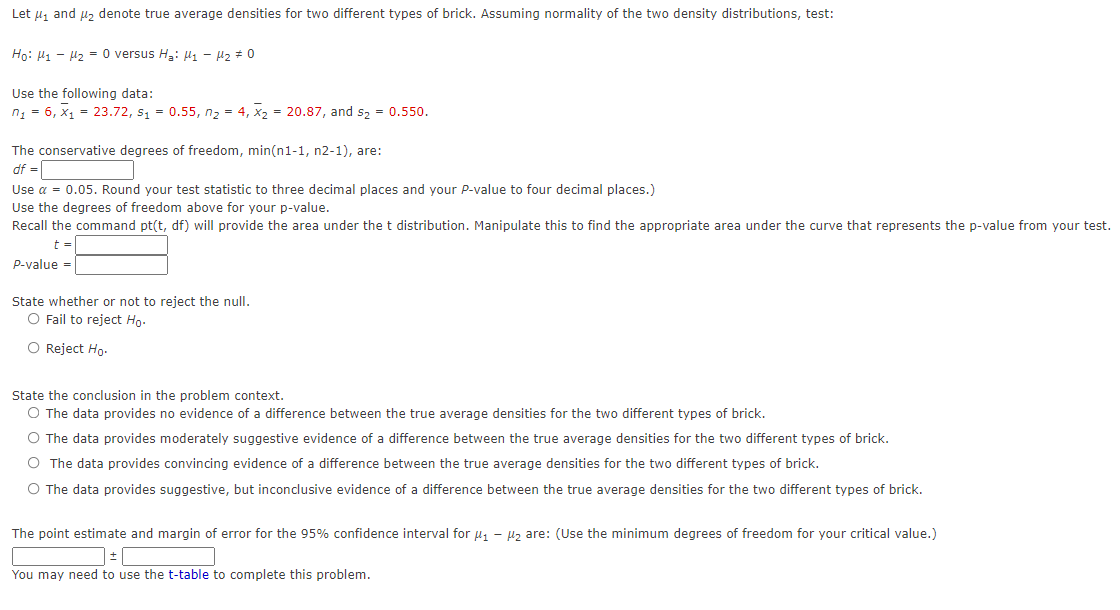
Let ,ul and p2 denote true average densities for two different types of brick. Assuming normality of the two density distributions, test: H0: p1 ,uz = 0 versus Ha: _u.1 #2 0 Use the following data: :11 = 6, x1 = 23.72, 51 = 0.55, n; = 4, x2 = 20.87, and s: = 0.550. The conservative degrees offreedom, min(nl1, n21), are: Use a = 0.05. Round your test statistic to three decimal places and your Pvalue to four decimal places.) Use the degrees of freedom above for your pvalue. Recall the command pt(t, clf) will provide the area under the t distribution. Manipulate this to nd the appropriate area under the curve that represents the pvalue from your test. f = Pvalue = State whether or not to reject the null. O Fail to reject HO. O Reject H0. State the conclusion in the problem context. 0 The data provides no evidence of a difference between the true average densities for the two different types of brick. O The data provides moderately suggestive evidence of a difference between the true average densities for the two different types of brick. O The data provides convincing evidence of a difference between the true average densities for the two different types of brick. O The data provides suggestive, but inconclusive evidence of a difference between the true average densities for the two different types of brick. The point estimate and margin of error for the 95% condence interval for #1 p12 are: {Use the minimum degrees of freedom for your critical value.) |:|:|:| You may need to use the ttable to complete this
Step by Step Solution
There are 3 Steps involved in it

Get step-by-step solutions from verified subject matter experts
 Study Help