Question: Rather than demonstrating your ability to recall or search for course data, you will be applying the concepts and principles covered throughout the course in
Rather than demonstrating your ability to recall or search for course data, you will be applying the concepts and principles covered throughout the course in a case study analysis. We will be covering Minicase 27, Alibaba and Chinas E-Commerce: Reality Bites starting on page 509 of our textbook (page number may vary for electronic versions of our e-textbook, please look for the cases title). Textbook : Strategic Management 3e. By Frank T. Rothaermel
you are expected to:
- Apply course concepts; define them, explain them and use them to support your conclusions.
- Conduct independent research well beyond reading the case, then use this research in your responses and properly cite all sources used.
- Present a professional quality work-product.
- Support each of your answers with cited and documented facts.
- Address every issue posed in each of the questions.
Requirements: Please submit a paper not exceeding five double spaced pages in 12 point Arial font with 1 margins (you may have additional pages for a cover, bibliography, endnotes, tables, charts, etc.).
Your paper should address the first four discussion questions at the end of Minicase 27, Alibaba and Chinas E-Commerce: Reality Bites, plus the following additional question (to be addressed first):
| Question 0: | Apply a PESTEL framework to analyze Alibabas external environment. Then, conduct a SWOT framework to analyze internal and external factors for Alibaba. |
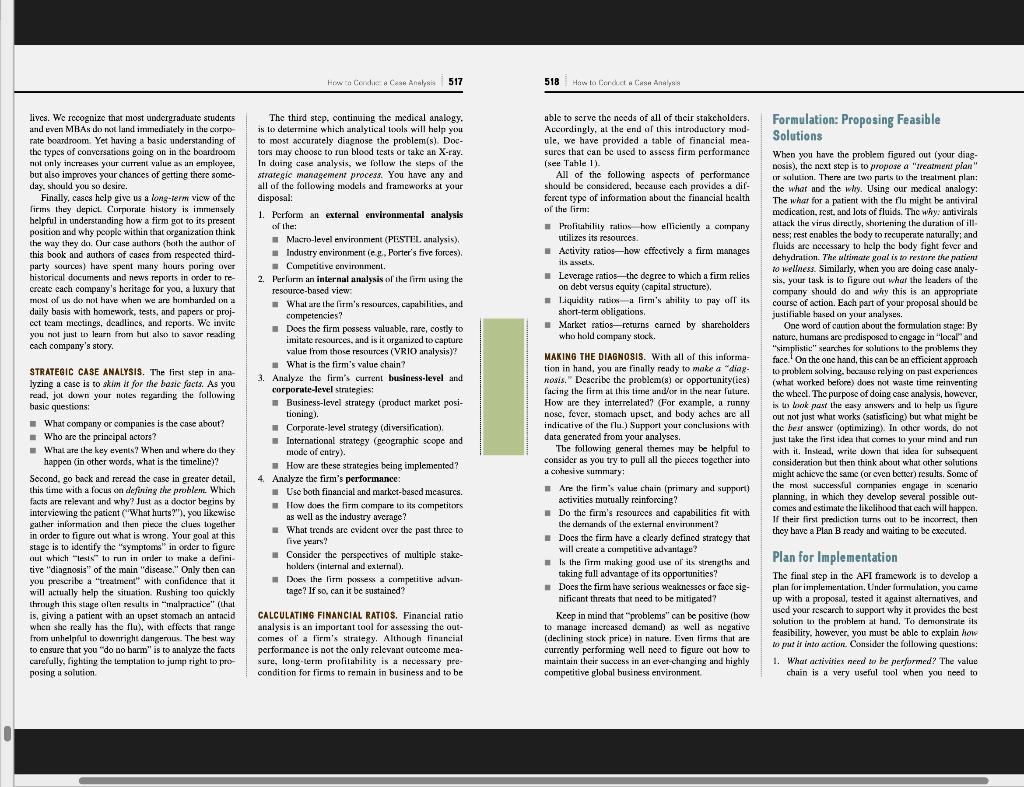
It is recommended that you read the section titled How to Conduct a Case Analysis, starting on page 516 of our textbook prior to working on your paper (you may ignore the part titled In-Class Discussion as it does not apply to our project).
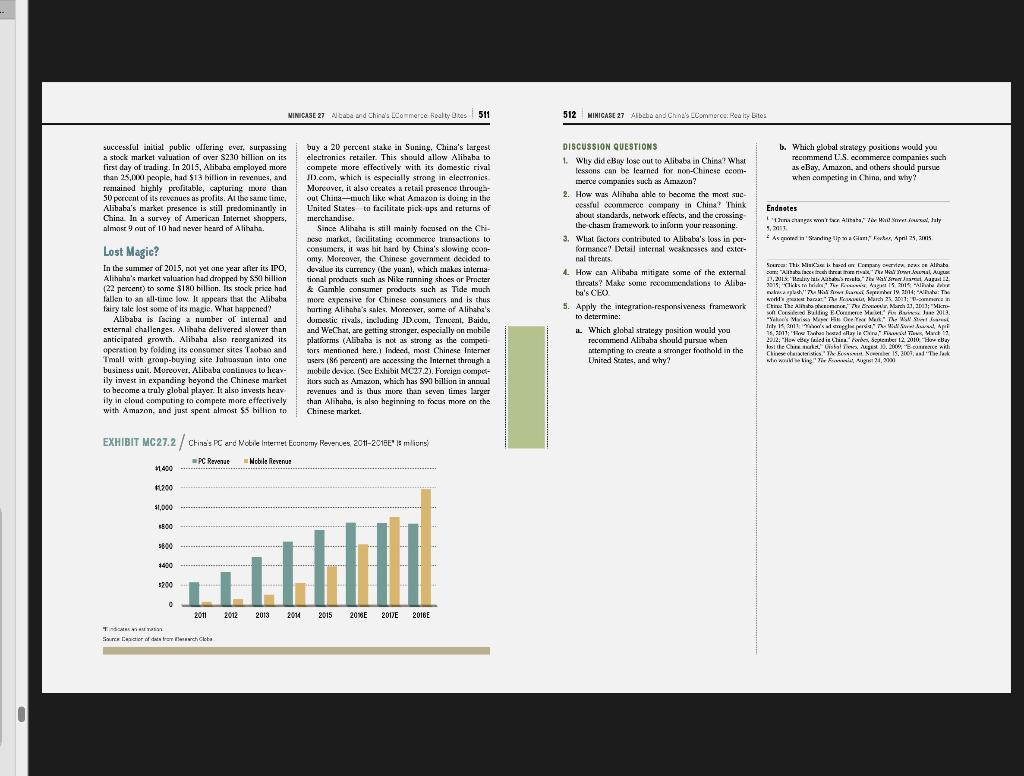
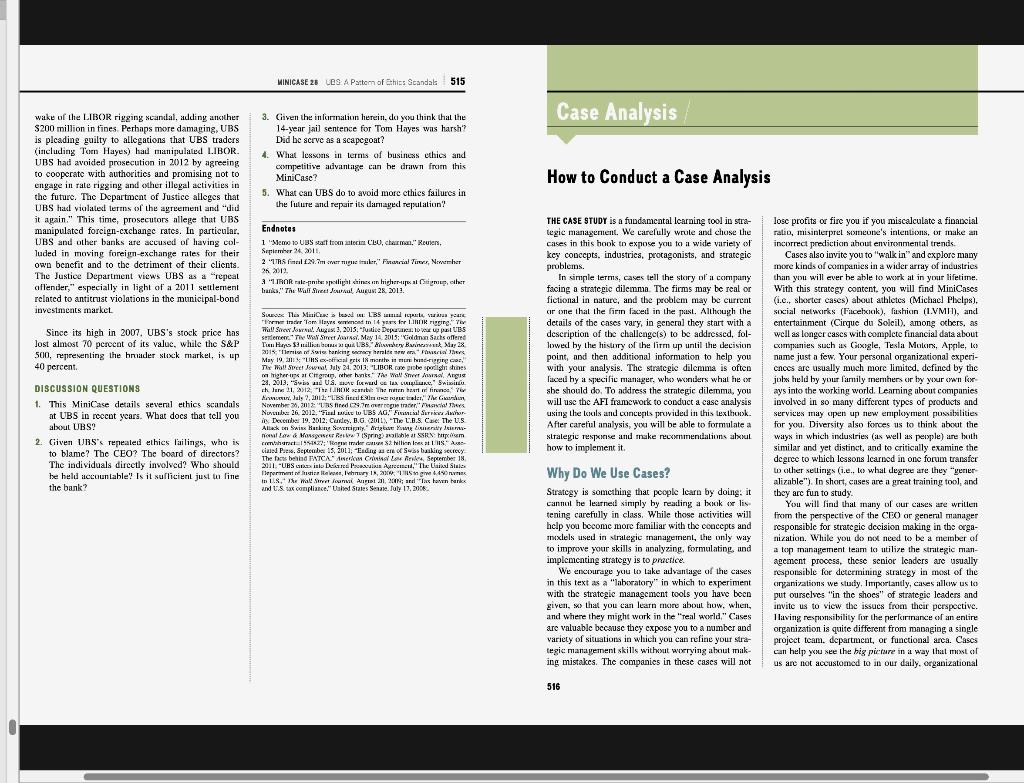
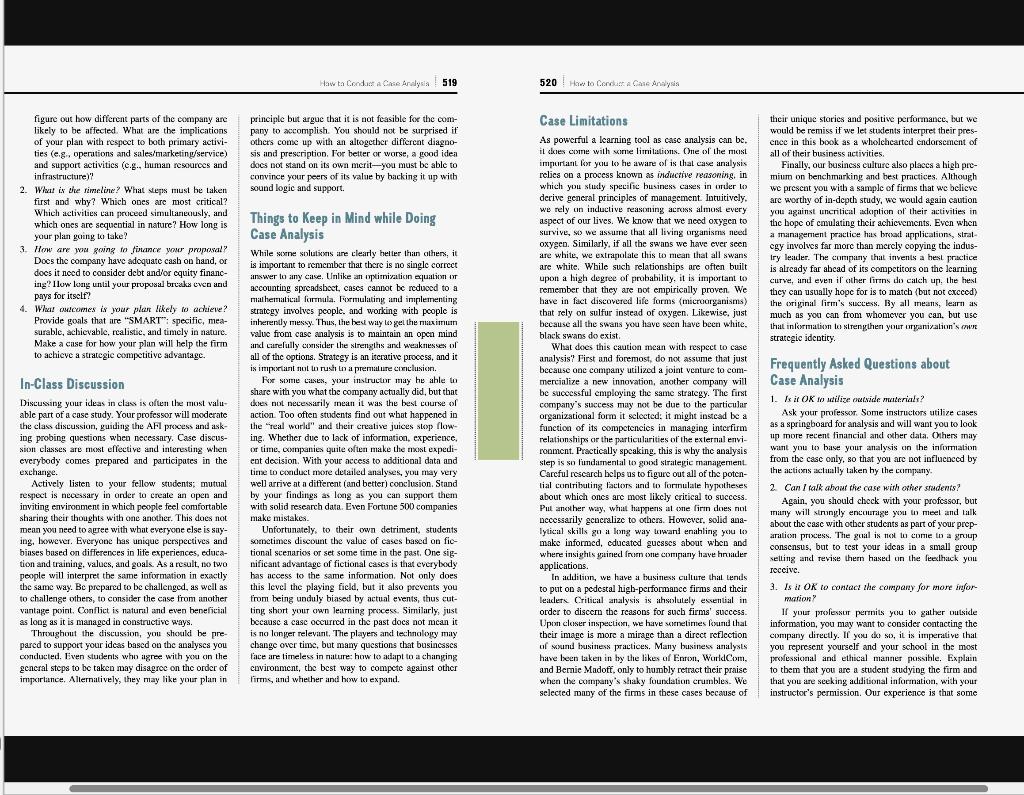
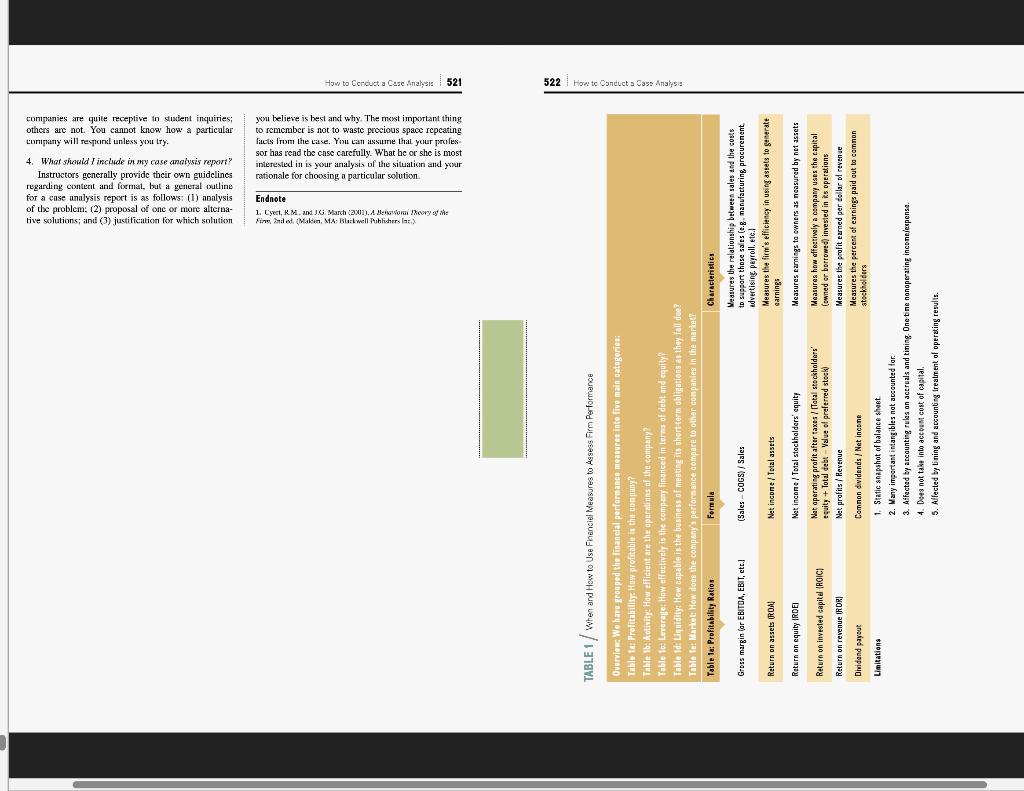
510 MINICASERT Altea and Chinas Commerce Reality Bites : MiniCase 27 EXHIBIT MC27.1/ China's Internet samdiangl 2004-20 TWIN dine delle ole you cu saskawin the owl CIENTS 800 Alibaba and China's ECommerce: Reality Bites 200 600 500 E2 100 300 200 Alibaba Group 100 0 2001 2000 2012 2011 2010 2009 2015 2009 2006 2005 2014 9004 2005 Ad had a gringar 1230 Wiens first du ele&ione 19, 2014 Torrchro Chamiloomberg Gering 2018 20131 2018 E Se aplicando exte. Nanera 2016 2015 TODAY. ALIBABA GROUP is the largest Chinese eco- merce company. In the original Arabic tale of All Baba and the Forty Thieves, Ali Baba, the poor wood- cutter, opened the cave with hidden treasure hy calling the magic words "Open Sesama. Alibaba's founder selected the name to open up opporlunities for small Chinese manufacturers to sell their goods around the world, with the bope of finding treasures for Albatza's users and shareholders. Today, Alihnha is a family of commerce businesses, which The Wall Street Jour- na described as "oumparable to ebay, Amazon, and PayPal all rolled into ac, with a stake in Twiller-like Weibo thrown in to boot." Alibaba's main trading platforms are Taobao and Thali Just like Ali Baba in the folk talc, Albala bad humble beginnings. In 1999, a former English teacher named Jack Ma started the company with a team of 18 in his apartment in Hangzhou, a city sime 100 miles southwest of Shanghai. At this linc, China's explo- sive growth of Internet users was just beginning (see Exhibit MC 27.1). By 2015, China's Internet users had grown to 675 million. Alihaa rode this wave of expo nential growth to success. In comparison, the United States has some 260 million Internet users (less than 40 percent of Chinese Internet users) The number of internet users in Chia seems to be reaching plateau in recent years. Nonetheless, given be low percentage of online transactions in compar- ison to China's trual commerce, huge growth in per capita spending online is expected in the future, Initially. Alibaba's website was a business to business (B2B) platform wbere China's small and edium-sized businesses could showcase their prod- ucts to buyers around the world. Alihaha was not the first company to explore opportunities in introducing China's manufacturing to plahal demand, but it was the first to do so online. In is lirst year of operativa, Alibaba signed up new members at a rule of 1.200 per day. By 2002, the young startup was already profit- able. By 2012. Alibus facilitated transactions in nearly every country around the world, Alibaba vs. eBay At the same time as Alibaba was started. EachNet anesther Chinese Internet venture, was launched in Shanghai. Each Nel was founded by two Harva MBAS who wanted to create a Chinese eBay, an au tion site for locals to sell and bid for goods. By 2003. FachNet haut 2 million users and 85 percent market share in China's consumer-to-consumer (C2) trins- actions. At the time, eBay was actively looking to expand in China and eventually acquired FachNet as ils Cluna operation for $180 million in 2002 Fenring eBay would lure small businesses away, Alibaba launched a competing CC platform Thobo (meaning "digging treasure" in Chinese) as a defen sive strategy. Unlike FachNet, which charged listing and transaction fees from sellers, Taobao was free for sellers, But Taobao's free services did not crede Esco- Nel's loyal cuslubor base. Eacl.Net's dominant market position meant more products and more opportunities for both buyers and sellers to trade. Although Each.Net was competing halo-head with Tausch adver tising campaigns, eBay made a decision to terminate EachNet's homegrown technology platform and move all FachNet users to eBay's U.S. platform in 2004. At eBay, the internal term for this was migration." The intent was to create one global trading platform that would allow eBay users to trade with each other, no matter where they Incated The problem wns that cHay's U.S platform did not ciffer features that EachNet needed to compete in China The online data that once freely flowed within China suudenly became cross-border Iralic and liad w pass through the Chinese government's firewall. The speed to load Each Ni's web pages slowed significantly Frustrated users left Ench Nes in craves and turned to Taobno for a better alternative. While most decisions at EachNet had to go eBay's U.S. headquarters for approval, Alibaba swiftly launched a number of innova Live services to assist transactions a Taobao, inclu ing Aliwangwang, an instant messaging service helping buyers and selles interact in real time, and Alipay, an esc payment system to reduce online transaction risks. Just three months after eBay's migration, Tao bao captured 60 percent of the C2C market share, car ing ExtNct al 30 percent. In 2006, eBay sbul down FachNet and closed its Chine operation Commenting on Alibaba's competition with eBay, founder Ma noted. "eBay may be a shark in the nean, but I am a cmcodile in the Yangwe River. If we list in the ocean, we lose. but if we fight in the river, we win." Alibaba coatinued to build its ecommerce venture around Tanhan. In 2007, it set up Alisoft, where Tao ho sellers could buy customized third-party software to help with their day to day operations, and Ali mama, where Tachan sellers could post ads on a net- work of specialized websites. Anticipating a growing share of business-to-consumer (B2C) transactions of online retailing, Taobao lau bod TMall, a dedicated R2C platform to complement Tanhar in 2008. Today, Alibaba has a massive footprint in the largest and fast- est growing ecommerce market globally. Irak I. Madzia presa la Mic free able to Wykonais Niis dergel Bethesda shullistiese be for aty kad kar rare vor dife- EEtlw initia: IKLI. Again Hd, I - resowy w Raw Augue 2018 FT Rowel 509 Most Successful IPO Ever On September 19, 2014, Alibaba went public on the New York Stock Exchange (NYSE). It had the most MINICASE 27 de and China's commerce Realty 511 512 MINIGASE 27 Albaba and China's Commerce Reality Bites b. Wzich global strategy positives would you recommend L. S. ecommerce companies such u eBay, Amazon, and others should pursue when competing in China, and why? successful initial public offering ever, supussing a stock market valuation of over S230 hillion on its first day of trading. In 2015, Alibaba employed more than 25,000 people, had $13 billion in revenues, and remained highly profilable, capturing more than 50 percent of its rules as profils. Al be sume time, Alibaba's market presence is still predominantly in China. In a survey of American Internet shoppers, almasr 9 out of 10 hnd never heard of Alihaha. Endnates CTP WTA, Wallaby 5.311 * As Santing pacater, April 25, Lost Magic? In the summer of 2015, not yet one year after its IPO, Alihah's market valuarion had dropped by S50 billion (22 percent) to some $180 billion. Its stock price had falken to an all-time low It spears that the Alibaba fairy tale lost some of its mglo. What hopened? Alibaba is facing a number of internal and external challenger. Alibaba delivered slower than anticipated growth. Alibaha also reorganized its operation by folding its consumer sites Tabs and Tmall with group-buying site Jatrason into one business unit. Murcover. Alibaba continues to lear ily invest in expanding heyond the Chinese market to become a truly global player. It also invests heay ity in cloud computing to compete more effectively with Amazon, and just spent almost $5 billion to buy a 20 perceel stake in Suning, China's largest electronics retailer. This should allow Alibaba to compete more effectively with its domestic rival JD.com, which is especially strong in electronics Murouver, it also creates a retail presenov truy out Cluna-much like what Amazon is doing in the United States to facilitate pick ups and returns of merchandise. Since Alibaha is still mainly focused on the Chi- Desc marka, facilitating netve transactions to consumers, it was hit Bard by China's slowing 2008- amy. Moreover, the Chinese government decided to devalue is currency (the yuan), which makes interna- tional products such as Nike running shoes or Procter & Gamble consumer products such as Tide much more expensive for Chinese consumers and is thus harting Alihah's sales. Moreower, some of Alihaha's Juistic tivals, including JD.COIL, Tenuen. Baidu. and WeChat, are getting stronger, especially on mobile platforms (Alibaba is not as strong as the competi tors mentioned here. Indeert, most Chinese Internet lasers 186 percent are accessing the Internet through mobile device. (See Exhibit MC27.2). Foreign coup itors such as Amazon, which has 890 billion in annual revenues and is thus more than seven times larger than Alihnho, is also heginning on focus more on the Chinese market. DISCUSSION QUESTIONS 1. Why did eBay lose out to Alibaba in China? What lessons can be learned for non-Chinese ecom- Here companies such as Amazon? 2. How was Alihaha ahle to become the most suc cessful commerce company in Chise? Think about standards, nelweck effects, and the crossing the-chas Cramework to inform your reasoning. 3. What factors contributed to Alibabu's loss in per- formance? Detail internal weaknesses and exter- nal threats 4. How can Alibaba mitigare some of the external threats? Make some recordations to Aliba- ba's CEO) 5. Apply the integration-responsiveness framework to determine: in which global strategy position would you recommend Alibaba sbould pursue when attempting to create a stranger foothold in the United States, and why? Scarca: The Meltd Century CCTV CA SE Altruita SET; inch ETENER Mart A 13. Hy het reel? Strana Agan2 2015 Tits to TF Niwe Town Sher 19 2014;:T do "The March 23001 - hire Thon, www.birch 31, 2007; wa Corside Billig En MP Bar 2013 Wh's Miss New Over NT. WU Selarus Ich www.www.wwww! Api 1,571; "Tules leader in Crowd Tv Wand 2012: "Hayalet Chifokki 12. 2016 the state. Men Chiesetta Best New IS.2007Telak stawie "Ti Fri 21, EXHIBIT MC 27.2 / China's PC and Mobile Internet Economy Revenues 2011-2018" 5 milions PC Revenue Nobile tevenue 41200 51.000 $500 560 1420 5200 0 2011 2012 2013 2014 2015 2018 2017 2018E TEM Source Decor of distretch Clota Dair 0 MINICASE 2Les A Patter of this Scandals 515 Case Analysis 3. Given the induration herein, deysu think that the 14-year jail sentence for Tom Hayes wis harsh? Did be serve as a scapegoat? 4. What lessons in terms of business ethics and cxcmpetitive advantage can he drawn from this MiniCase? 5. What can UBS do to avoid more cthies failures in the future and repair its damaged reputation! How to Conduct a Case Analysis wake of the LIBOR rigging scandal, adding ancher $200 million in tines. Perhaps more damaging, UBS is plcading guilty to allegations that UBS traders (including To Hayes) had manipulated LIBOR. UBS had avoided prosecution in 2012 by agreeing to cooperate with authorities and promising not to engage in rate rigging and the illegal activities in the future. The Department of Justice alleges that UBS had violated terms of the agreement and did it again." This time, prosecutors allege that UBS manipulated foreign-exchange rates. In particular, UBS and other banks are accused of having col- luded in moving foreign-exchange rates for their own bencfit and to be detriment of their clients. The Justice Department views UBS as a "repeal oflender," especially in light of a 2011 settlement related to antitrust violations in the municipal-bond investments market Endnotes 1 Memo UBS sad tromatec CDO, chem. Reuters, Super 24 21. 2 RS incl.7m Werniger," Financial Tireys, Newerher 2212 : TROR rale-finite pilight shines in higher wat gepler Branis." The Wall Street Journal August 28. 2012. Since its high in 2007, UBS's stock price has lost almost 70 percent of its value, while the S&P 500, representing the hunder sleck market, is up 40 percent DISCUSSION QUESTIONS 1. This MiniCase details several ethics scandals at UBS in roccot years. What docs that tell you abxul UBS! 2. Given US's repeated ethics l'ailings, who is to blame? The CEO? The board of directors? The individuals directly involved? Who should be held accountable'! Is it nullicient just to fine the bank? Su Ta Misitus : LBS na ule via oare The radiolom are cod 14 gars for Irige. Te Wall Strbs! August 3, 2015. Pustice Depuuroa past UES Serience.Wri May 14 2015: Goldman Sachs offerte Tuu Helli. LBS bery Banina Nay 28 31 Terindate barkut cacher. Phaser May 19 3 TUS -ffical pats Imani in druping cos The Wall Street swea! July 24, 2013: "LIBOR code probe spordist shines ligter is a Chegar, her hunts A Wall Sheer Anal Angie 23, 2013. Svi mi US. ut fund e l " Sisi ch Jan 21, 212, "The LHOR : The nel Y Ann, Jals 2.212: "Sfited her, The Gun Ne 2013 fed merepravilhas Nouube 26. 2012. "Fiaal wat lu LBS AG." Fin! Services thor in December 19.2012. Cudes, B.G. (2011). "The L.B.S. Cae: The US Alack Swiss Makine Sower Brite Yuwe seis nosile Monsieur Riring i SRX ilm comharct=1918;' trader CURS hlin Boek ats ciated Poex, September 15, 2011. Ending an ene Sess banking secrey The Das bend XTCA 1 C Love September 18 1.URSI islo Deared Pasculs Ayrected, "The Liai Stals Idesormente in verschmury 1, 2X Ung 40 tn is. Wat on AIR ON:das tent tanks IN US sa compliance." Ushed States Senne. Tuly 17.2008 THE CASE STUDY is a fundamental learning tool in stra- legic management. We carefully wrule and chose the cases in this book in expose you to a wide variety of key concepts, industries, protagonists, and strategic problems. In simple terms, cases tell the story of a company facing a strategic dilemma. The firms may be real or fictional in nature, and the problem may be current cir one that the firm laced in the past. Although the details of the cases vary, in general they start with a description of the challengels) to be addressed, fol- lowed by the history of the firm up until the decision point, and then additional information to help you with your analysis. The strategie dilemma is often laced by a specific manager, who wonders what he can she should do. To address the strategic dilemma, you will use the AFI framework to conduct a case analysis using the bus and concepts pruvided in this textbook. After careful analysis, you will be able to formulate a xtralegic response and make rummendations all how to implementit Why Do We Use Cases? Strategy is something that people Icaro by doing it cannual he learned simply by reading a bxok ex lis tening carefully in class. While those nctivities will help you become more familiar with the concepts and mxlels used in strategic management, the only way to improve your skills in analyzing, formulating, and implementing strategy is to practice. We encourage you to take advantage of the cases in this text as a "laboratory in which to experiment with the strategic management tools you have been given, so that you can learn more about how, when, and where they might work in the real wld Cases are valuable because they expose you to a number and variety of situations in which you can refine your stra- tegic management skills without wrying about mak- ing mistakes. The companies in these cases will not losc profits or fire you if you miscalculate a financial ratio, misinterpret someone's intentions, ut make an incorrect prediction ahout environmental trends Cascs also invite you to "walk in" and explore many more kinds of companies in a wider array of industries than you will ever be able to work at in your lifetime With this strategy content, you will find MiniCases (i.c., sbarter cases) about athletes (Michael Phelps). social networks (Ficelciak), fashion (I.VMI), ancl cntertainment (Cirque du Soleil), among obers, as well as longer cases with complete financial data about companies such as Google, Tesla Mulairs, Apple, lo name just a few. Your personnl organizational experi- cnces are usually much more limited. defined by the jobs held by your family members or by your own box ays into the working world. Learning about companies involved in so many different types of products and services may cpen up new employment possibilities for you. Diversity also forces us to think about the ways in which inclustries (as well as perple) are baith similar and yet distinct, and to critically examine the degree to which lessons learned in one forum transfer to other sellings (1.c.. lo whal degree are they "gerier alizable"). In short, cases are a great training tool, and tbcy arc fun to study You will find that many of our cases are wrillen from the perspective of the CEO or general manager responsible for strategic decision making in the orga- nization. While you do not need to be a member of a top management team to utilize the strategic man- agement process, these senior leaders are usually responsible for determining strategy in most of the organizations we study. Impartantly, cases allow us to put ourselves in the shoes" of strategic leaders and invite us to view the issues from their perspective. Having responsibility for the perkrnance of an entire organization is quite different from managing a single project team. department, or functional arca Cases can help you see the big picture in a way that most of us are not accustomed to in our daily. organizational 516 How to order a ceae Analysis 517 518 How to Corchata Cane Analyse lives. We rccognize that most undergraduate students and even MBAN do not land immediately in the op rate boardroom. Yet having a basic understanding of the types of conversations going on in the boardroom not only increases your current value as an employee, but also improves your chances of getting there some- day, should you so desire. Finally, cascs help give us a long-term vicw of the firms they depict Corporate history is immensely helpful in understanding how a firm got to its present position and why people within that organization think the way they in. Our case authors (both the author of this book and authors of cases from respected third- party sources) have spent many hours poring over historical documents and news reports in order to re- create cach company's heritage for you, a luxury that Text of us do not have when we are bomhanded on a daily basis with homework, tests, and papers or proj- cct team meetings, deadlines, and reports. We invite you not just to learn from hul also to sixar realing cach company's story. The third step. continuing the medical analogy. is to determine which analytical tools will help you to most accurately diagnose the problem(s). Doc- tors may choose to run blood tests or take an X-ray. In cering case analysis, we follow the steps of the strategic management process. You have any and all of the following models and frameworks at your disposal: 1. Perform an external environmental analysis of the Macro-level environment (PESTEL analysis), Industry environment (e , Porter's five forces). Competitive environment. 2. Perlurn an internal analysis of the l'im using the resource-based view What are the lito's resvurces, capabilities, and competencies? Does the firm possess valuable, rare, costly to imitate resources, and is it organized to capture value from those resources (VRIO analysis)? What is the firm's value chain? 3. Analyze the firm's current business-level and corporate-level strategies: Business-level strategy (product market posi- tioning). Corporate-level strategy (diversification), Internatioon strategy (geographic scope and mode of entry). How are these strategies being implemented ? 4 Analyze the firm's performance: Use both financial and market-based measures. How ties the firm compare to its competitors as well as the industry average? What trends are evident over the past three to five years? Consider the perspectives of multiple stake- holders (internal and external), Does the limpses a competitive advan- tage? If so, can it be sustained? able to serve the nocds of all of their stakcholders, Accordingly, at the end of this introductory mod ule, we have provided a table of financial mea- sures that can be used to assess firm performance (see Table 1). All of the following aspects of performance should be considered, because each provides a dif- ferent type of information about the financial hcalth of the firm: Prolichility ralis how elliciently a company utilizes its resources. Activity ratios-how effectively a firm manages ils assels. Leverage ratios the degree to which a firm relics on debt versus equity (capital structure). Liquidity ratixa lini's atrility to pay off its short-term obligations Market ratios-recurns carucd by shareholders who hold expany stock. MAKING THE DIAGNOSIS. With all of this informa- tion in hand, you are finally ready to make a "diag- rosis." Describe the problem(s) or opportunitytics) facing the lirm at this time and or in the near future. How are they interrelated? (For example, a runny nose, fever, stomach upset, and body aches are all inclicative of the flu.) Support your conclusions with data gencrated from your analyses. The following general themes may be helpful to consider as you try to pull all the pieces together into a cohesive summary: Are the firm's value chain (primary and support) activities mutually reinforcing? Do the firm's resources and capabilitics fit with the demands of the external envinnument? Does the firm have a clearly defined strategy that will create a cumprelitive advantage? Is the lim making your use of its strengths and taking full advantage of its opportunities? Does the firm have serious weaknesses or face sig- nificant threats that need to be mitigated? Keep in mind that "problems" can be positive (bow to manage increased demand) as well as negative (declining stock price) in nature. Even firms that are currently performing well need to figure out how to maintain their success in an ever changing and highly competitive global business environment, Formulation: Proposing Feasible Solutions When you have the problem figured out your ding- bosis), the next step is to propose a "reatment plan" IT Alumn. There are tw>parts to the realment plan: the whar nod the why. Using our medical analogy: The whar for a patient with the flu might be antiviral modication, rest, and lots of fluids. The why. antivirals allack the virus directly, shurlening the duration of ill Dess; rest combles the body to recuperate naturally; and fluids are necessary to help the body fight fever and dehydration. The ultimate goal is to restore the patien to wellness. Similarly, when you are doing casc analy- sis, your task is to figure out whar the leaders of the company should do and why this is an appropriate course of action. Each part of your proposal should be justifiable bused on your analyses. One word of caution about the formulation stage: By nature, humans are predisposed to engage in local and "simplistic" sekunches for solutions to the problems they face. On the one hand, this can be an efficient approach to problem solving, because relying on past experiences (what worked before) does not waste time reinventing the wheel. The purpose of doing casc analysis, bowever, is to book past the casy answers and to help us ligure out not just what works (satisticing) but what might be the best answer (optimizing). In other words, do not just lake the first idea that comes to your mind and run with it. Instead, write down that idea for subsequent consideration but then think about what other solutions might achicve the same (or evca botter) results. Some of the most successful companies engage in scenaria planning, in which they develop several possible out- comes and estimate the likelihood that each will happen. If their first prediction turns out to be incurrect, then they bave a Plan B ready and waiting to be executed. STRATEGIC CASE ANALYSIS. The first step in ana lyzing a case is to skin it for the basic facts. As you read, jol down your miles regarding the following basic questions: What company or companies is the case about? Who are the principal actors? What are the key events? When and where they happen in other words, what is the timeline)? Second, go back and reread the case in greater detail. this time with a focus on defining the problem. Which facts are relevant and why? Just as a doctor begins by interviewing the patient ("What hurts?"), you likewise gather information and then plece the clues together in order to figure out what is wrong. Your goal at this stage is to identify the "symptoms in der to figure ciut which "lests" to run in under to make a defini tive "diagnosis" of the main "discase." Only then can you prescribe a "treatment with confidence that it will actually help the situation. Rushing too quickly through this stage ollen results in malpractice" (that is, giving a patient with an upset stomach an antacid when she really has the flu), with effects that range from unhelpful to downright clangerous. The hest way to cosure that you do no barm" is to analyze the facts carefully, lighting the templation to jump right to pro posing a solution CALCULATING FINANCIAL RATIOS. Financial ratio analysis is an important tool for assessing the out- comes of a firm's strategy. Although financial performance is not the only relevant outcome mea- sure, long-term profitability is a necessary pre- condition for firms to remain in business and to be Plan for Implementation The final step in the AFI framework is to develop a plan for implementation. Under formulation, you came up with a proposal, tested it against alternatives, and used your research to support why it provides the best solution in the publern al hund. To demonstrate its feasibility, however, you must be able to explain how to put it into action. Consider the following questions: 1. What activities need to be performed? The value chain is a very useful tool when you need to C Hawta Conduct a Ca Analysis How to Cordit Care Analysis principle but argue that it is not feasible fox the com- pany to accomplish. You should not be surprised il others come up with an altogether different diagno- sis and prescription. For better or worse, a good idea does not stand on its own merit-you must be able to convince your peers of its value by backing it up with sound logic and support. figure out how different parts of the company are likely to be affected. What are the implications of your plan with respect to both primary activi- ties (eg, operations and sales/marketing/service) and support activities (c.g., human resources and infrastructure) 2. What is the timeline? What steps must be taken first and wby? Which ones are most critical? Which activities can proceed simultaneously, and which ones are sequential in nature? How long is your plan going to take? 3. How are wu going to finance your proposal? Does the company have adoquatc cash on hand, or does it need to consider debt and/or cquity financ- ing? Ilow long until your proposal breaks cvce and pays for itself? 4. Whil outcomes is your plar likely to achieve? Provide goals that are "SMART": specific, mea- surable, achievable, realistic, and timely in nature. Make a case for how your plan will help the firm to achieve a strategic competitive advantage. In-Class Discussion Discussing your ideas in class is often the most valu- able part of a case study. Your professor will moderate the class discussion, guiding the AF1 process and ask- ing probing questions when necessary. Case discus- sion classes are most effective and interesting when everybody comes prepared and participates in the exchange. Actively listen to your fellow students: mutual respect is necessary in order to create an open and inviting environment in which people feel comfortable sharing their thoughts with one another. This does not mean you need to agree with what everyone else is say- ing, lowever. Everyone has unique perspectives and biases based on differences in life experiences, educa- tion and training, values, and goals. As a result, no two people will interpret the same information in exactly the same way. Be prepared to be challenged, as well as to challenge others, to consider the case from another vantage point. Conflict is natural and even beneficial as long as it is managed in constructive ways. Throughout the discussion, you should be pre- pared to support your idcas based on the analyses you conducted. Even students who agree with you on the gcncral steps to be taken may disagree on the order of imparlance. Alternatively, they may like your plan in Things to Keep in Mind while Doing Case Analysis While some solutams are clearly helder than others, it is important to remember that there is no single correct answer to any case. Unlike anytimization ualimut accounting spreadsboet, cases cannot be reduced to a mathematical mula. Rumulating and implementing strategy involves people and working with people is inherently messy. Thus, the best way to get the maximu value from casc analysis is to maintain an open mind and carefully consider the trengths and weaknesses of all of the options. Strategy is an iterative process, and it is important nullo rush in a premure conclusion. Fx some cases, your instructor may be able to share with you what the company actually did, but that does not necessarily mean it was the best course of action. Too often students find out what happened in the real world and their creative juices stop flow- ing. Whether due to lack of information, experience, or time, companies quite often make the most expedi- ent decision. With your access to additional data and time to conduct more detailed analyses, you may very well arrive at a different and better) conclusion, Stand by your findings as long as you can support them with solid research data. Even Fortune 500 companies make mistakes. Unfortunately, to their wn detriment, students somctimes discount the value of cases based on fic- tional scenarios or set some time in the past. One sig- nificant advantage of fictional cases is that everybody has access to the same information. Not only does this level the playing field, but it also prevents you from being unduly biased by actual events, thus cut- ting short your own learning process. Similarly, just because a casc occurred in the past docs not mcan it is no longer relevant. The players and technology may change over time, but many questions that businesses face are timeless in nature: how to adapt to a changing covironment, the best way to compete against other firms, atid whether and how to expand Case Limitations As powerful a learning tool as casc analysis can be it ces come with some limitations. One of the most important for you to be aware of is that case analysis relics on a process known as inductive reasoning, in which you sludly specific business cases in order to derive general principles of management Intuitively. we rely on incluclive reasoning across almost every aspect of our lives. We know that we need oxygen to survive, so we assume that all living organisms need oxygen. Similarly, if all the swans we have ever seen are white, we extrapolate this to mean that all swans are white. While such relationships are often built upon a high degree of probability, it is important to remember that they are not empirically proven We have in fact discovered life forms (microorganisms) that rely on sulfur instead of oxygen. Likewise, just because all the swans you have seen have been white. black swans do exist What does this caution mean with respect to case analysis? First and foremost, do not assume that just because one company utilized a joint venture to com- mercialize a new innovation, another company will be successful employing the same strategy. The first company's success may not be due to the particular organizational form it selected: it might instead be a fanction of its competencies in managing interfirm relationships or the particularities of the external envi- roamcnt. Practically speaking, this is why the analysis step is so fundamental to good strategic managenient Carcful rescarcb belps us to figure out all of the poten- tial contributing factors and to formulate hypotheses about which oncs are most likely critical to success Put another way, what happens aal me firin does not necessarily gencralize to others. However, solid an- lytical skills go a long way lwand enabling you to make informed, educatod gucascs about when and where insights gained from one company have hader applications. In addition, we have a business culture that lends to put on a pedestal high-performance firms and their leaders Critical analysis is absolutely essential in order to disceru the reasons for such firms' success. Upon closer inspection, we have sometimes found that their image is more a mirage than a direct reflection of sound business practices. Many business analysts have been taken in try the likes of Enton, World Com, and Bernie Madoff, only to humbly retract their praise when the company's shaky foundation crumbles. We selected many of the firms in these cases because of their unique stories and positive performance, but we would be remiss if we let students interpret their pres- ence in this book as a wholchcatted endorsement of all of their business activities. Finally, our business culture also places a high pre- mium on benchmarking and best practices. Although we present you with a sample of firms that we believe are worthy of in-depth study, we would again caution you against uncritical adoption of their activities in the hope of cmulating their achievements. Even when a management practice has brcal plications, stral cgy involves far more than mcrcly copying the indus- Iry leader. The company that invents a best practice is alrcady far abcad of its competitors on the learning curve, and even il cher litos do catch up, the best they can usually hope for is to match (but not cxcced) the original firm's success. By all means, learn as much as you can from whomever you can but use that inkormation to strengthen your litaniyalion's mur strategic identity Frequently Asked Questions about Case Analysis 1. Is it OK 10 wine cuiside miterial? Ask your professor. Some instructors utilize cases as a springboard for analysis and will want you to look up more recent financial and other data. Others may want you to have your analysis on the information from the case only, so that you are not influcocod by the actions actually taken by the company 2. Can I talk about the case with other students? Again, you should check with your professor, but many will stingly encourage you to meel and talk about the case with other students as part of your prep- aration process. The goal is to come in a group consensus, but to test your ideas in a small group selling and revise thern haned un the feelhuck you receive 3. Is OK to contact the company for more infor marion If your professor permite you to gather outside information, you may want to consider contacting the company directly. If you do no, it is imperative that you represent yourself and your school in the most professional and ethical manner possible. Explain to them that you are a student studying the firm and that you are seeking additional information, with your instructor's permission. Our experience is that some of the problem: tive solutions; and (3) justification for which solution for a case analysis report is as follows: (1) analysis proposal of one or more alterna- regarding content and format, but a general outline Instruktors generally provide their own guidelines company will respiciri unless you try. 4. What should I include in my case analysis repart others are not. You cannot know how a particular companies are quite receptive in student inquiries Endnote FindetMike, MA Rockwell hlicher las 1. Cyect, KM. and JG March (2001). BeWorry me rationale for choosing a particular solution interested in is your analysis of the situation and your sor has read the case carefully. Wbat he or she is most facts from the case. You can assume that your parcoles to remember is not to waste procious space repeating you believe is best and why. The most important thing How to Conduct a Case Analysis 521 TABLE 1 / When and How to Use Financial Measures to Asess Firm Performance Overview We hare grouped the financial performance measures into five main categories Tablete Profitability: How profitable is the company? Table 16: Activity: How efficient are the operating of the company? Table 10: Leverage: How effectively is the company financed in terms of debt and equity? Table Id: Liquidity: How capable is the business of meeting its short term obligations as they fall due? Tablete: Market How does the company's performance compare to other companies in the market? Table de Profitability Ration am Characteristics 522 How to Conduct a Case Analysis ap 1199 Yuas plus Sales - COGS) / Sales To support those sales manufacturing procurement advertise Return on assets RON Return on equity IRDEI Return on invested capitel (ROICI Dividend payout Net Income / Total assets Garnings Net income / Total stockholders' equity Measures earnings to owners as it after aftale Measure how effectively equity + Total debt - Value of preferred stock) (owned or borrowed invested in its operations Net profits / Revenue Measures the profit earned per dollar of revenue non dividends / Net incon Measures the percent of earnings paid out to common stockholders hot of balance shee infant intangibles not accounted for Affected by accounting rules an accruals and timin Does not take into account cost of capital Affected by lining and accounting treatment of operating results









 Study Help