Question: RIU - CHEM 14C - SPRING 2025 C) What term best describes the relationship D) Assign the chiral center in the molecule. between Ho and
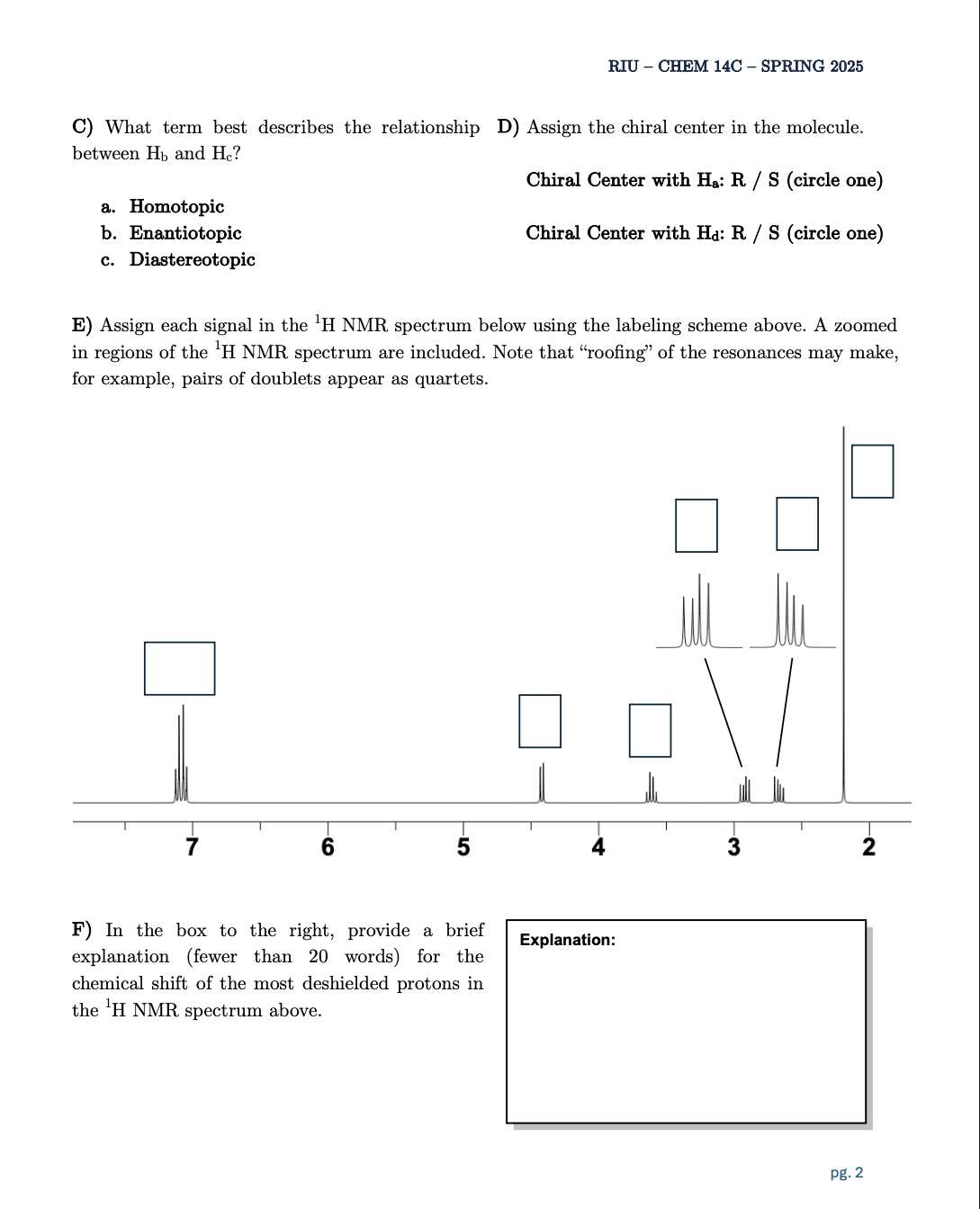
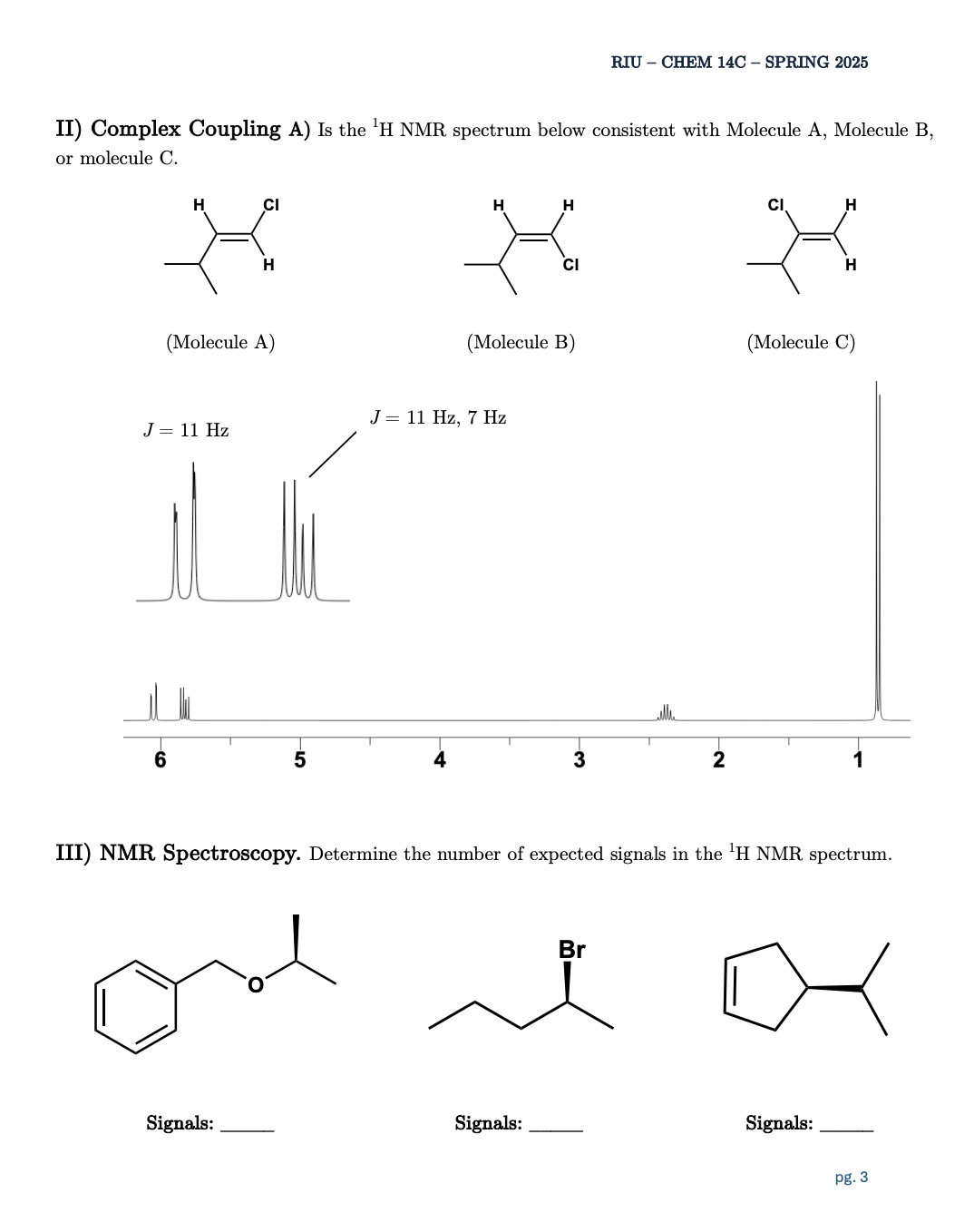
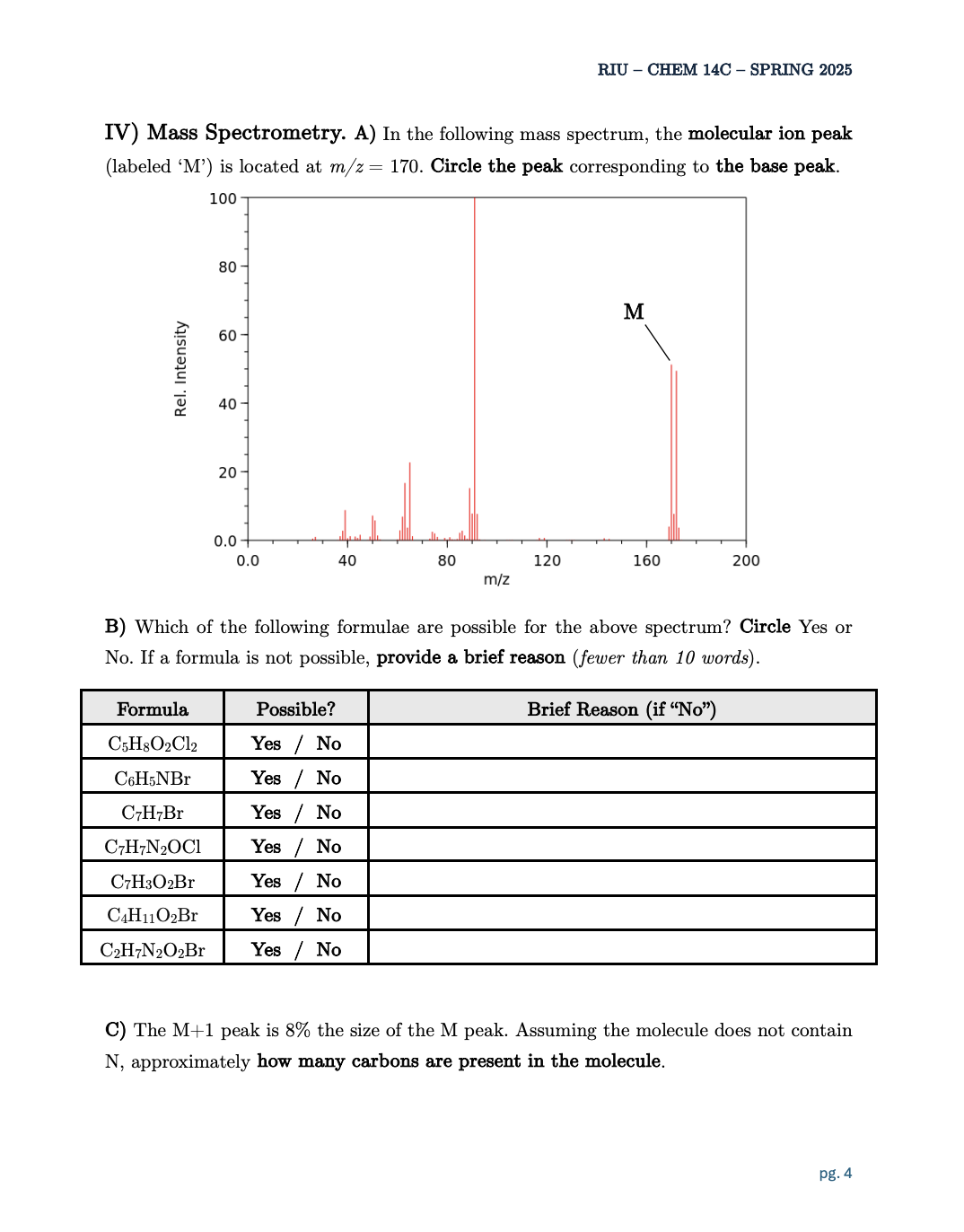
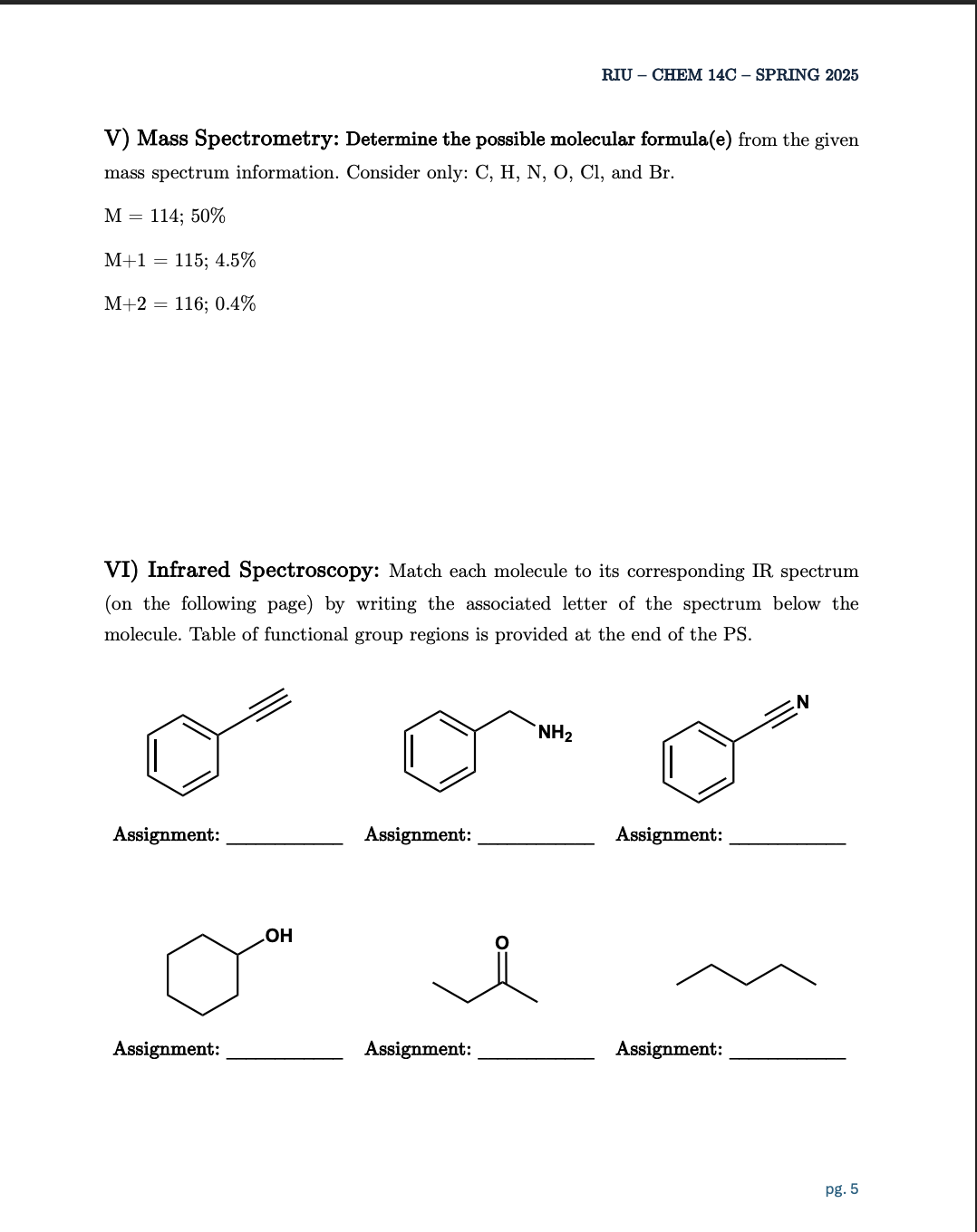
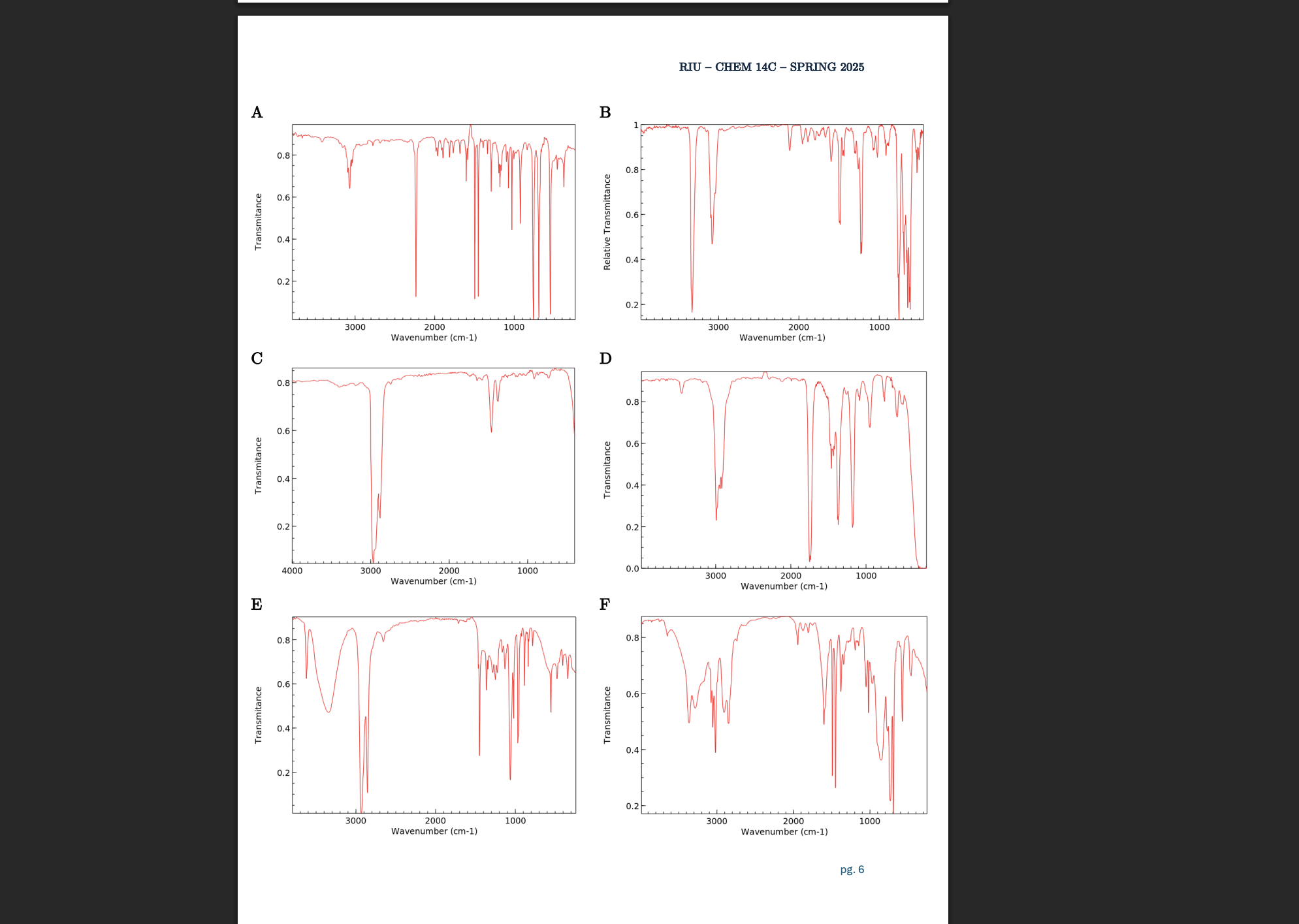
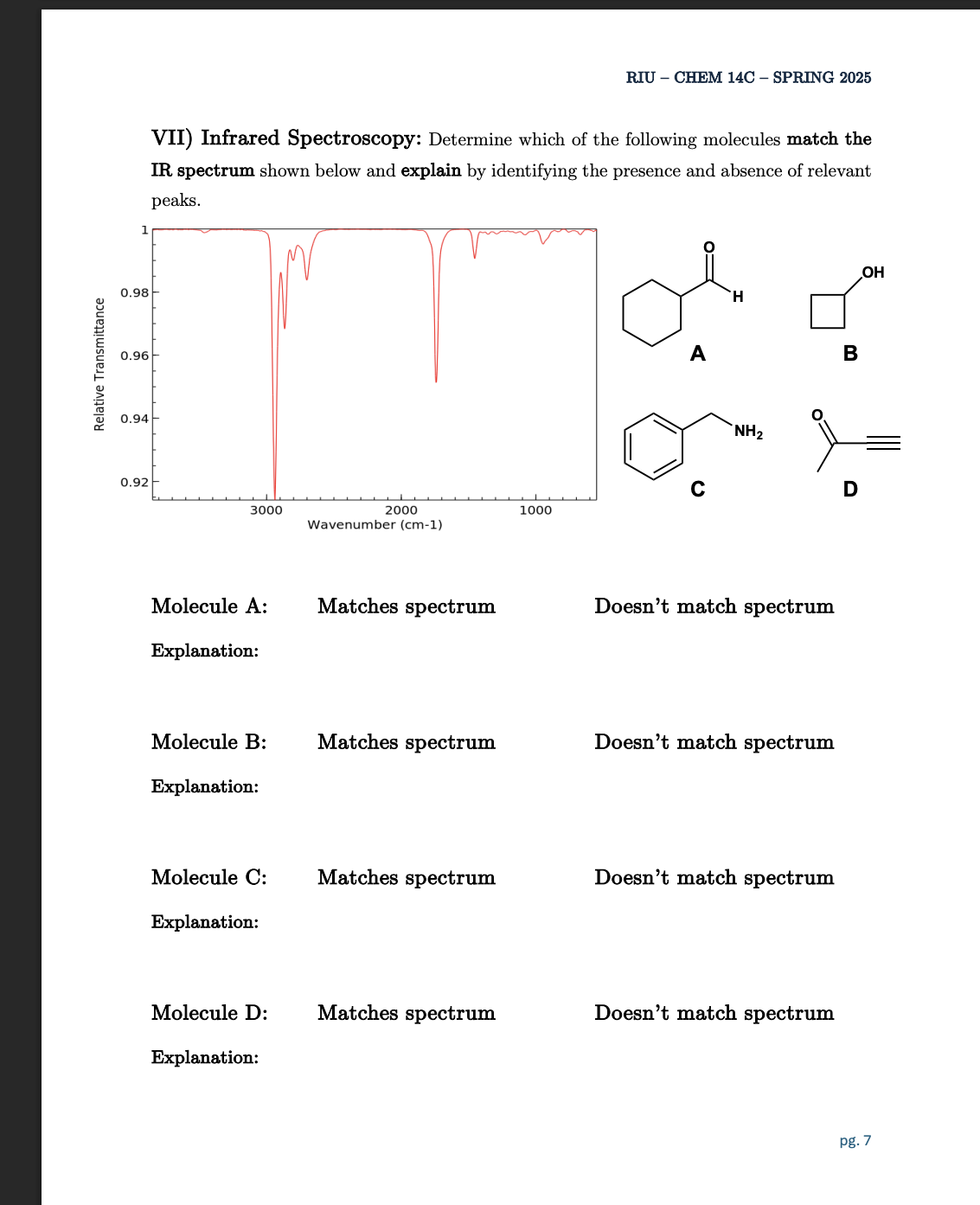
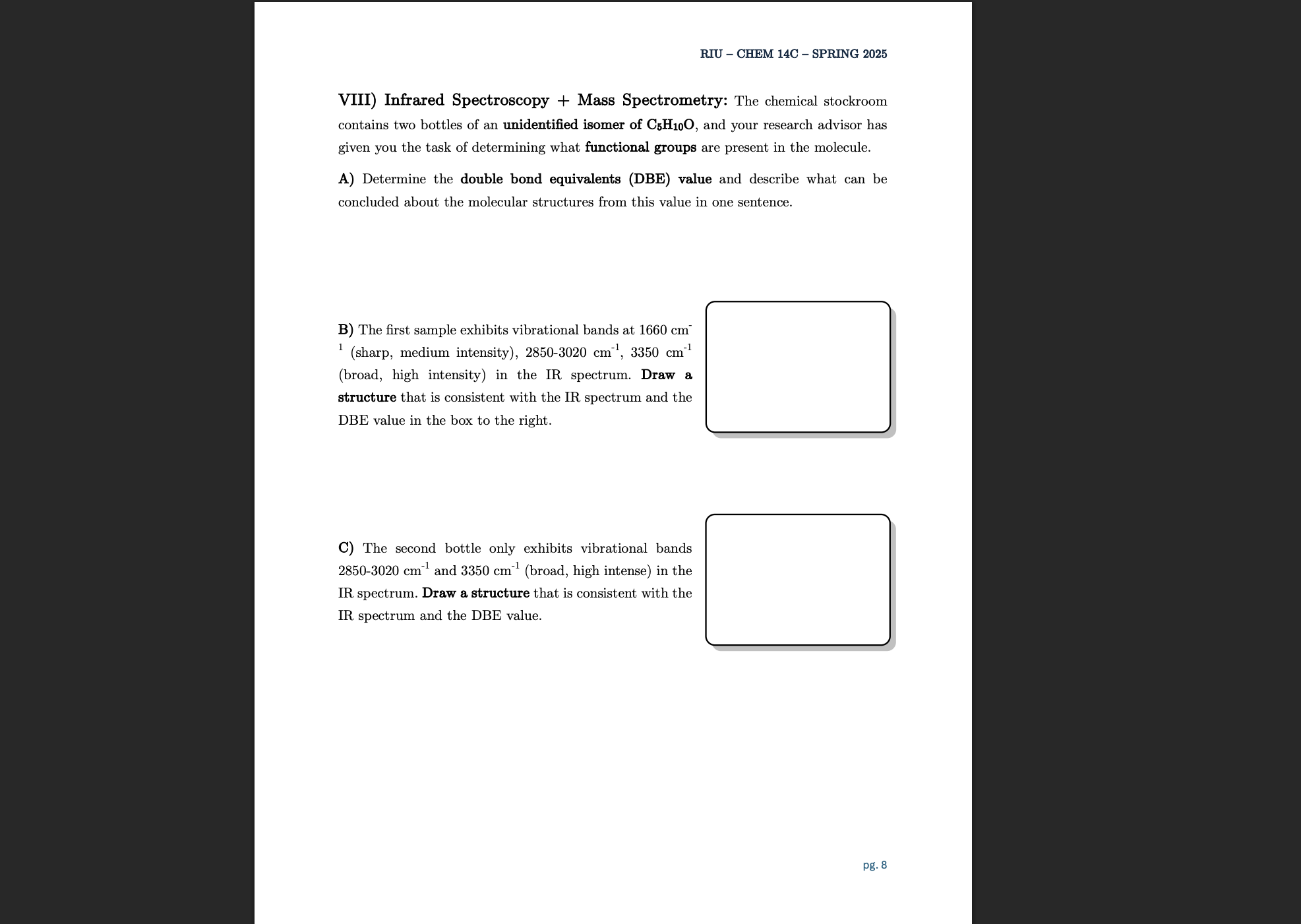
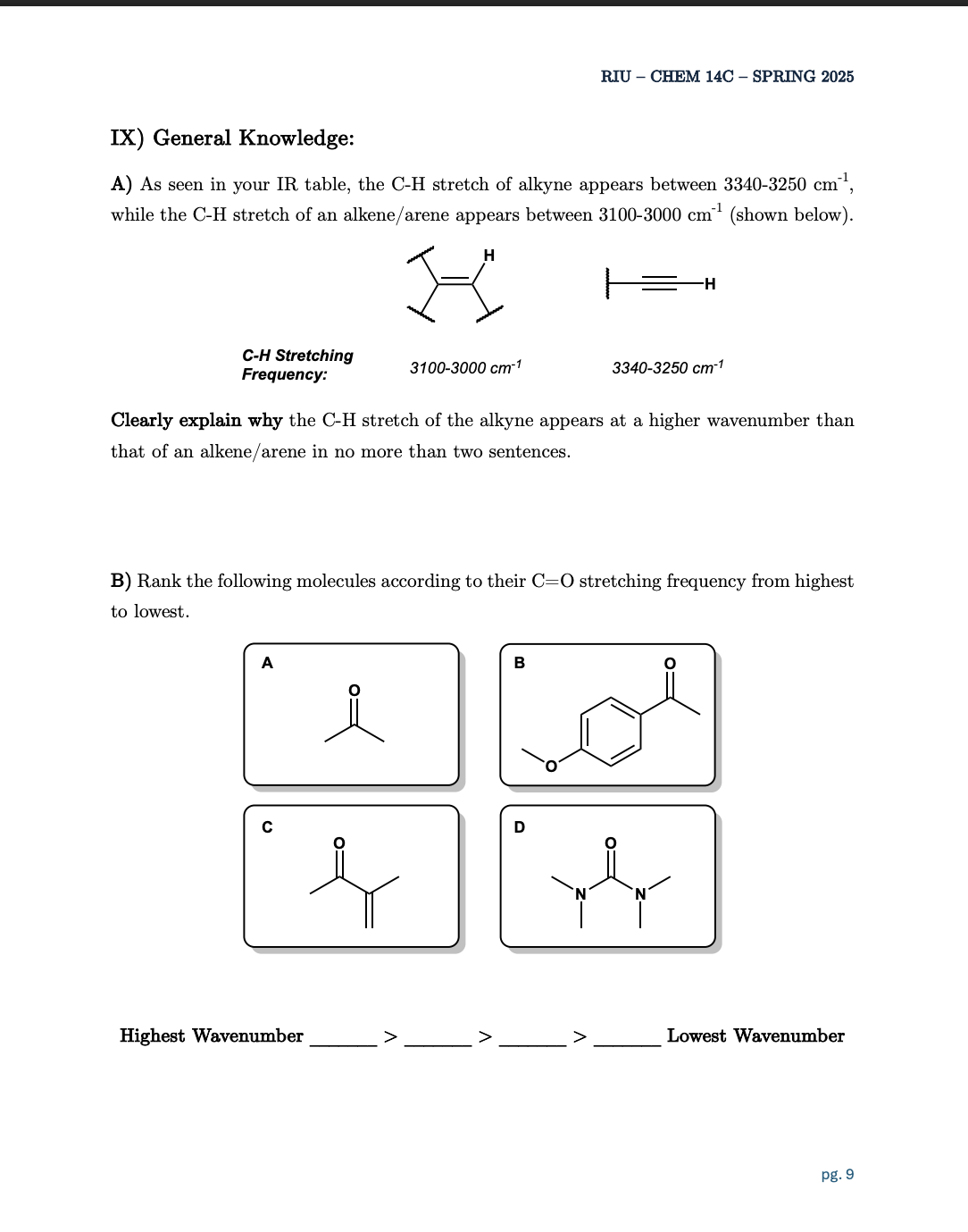
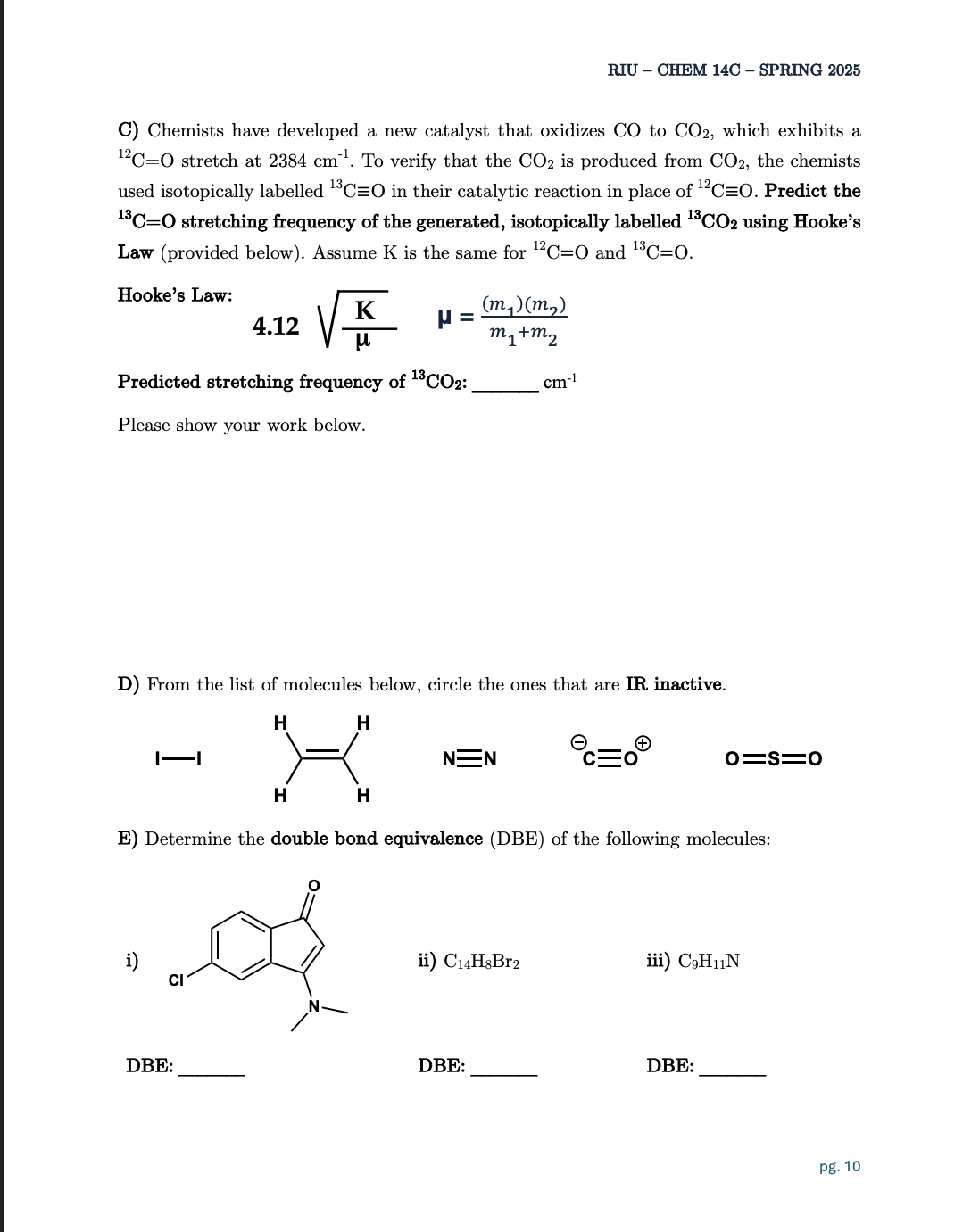
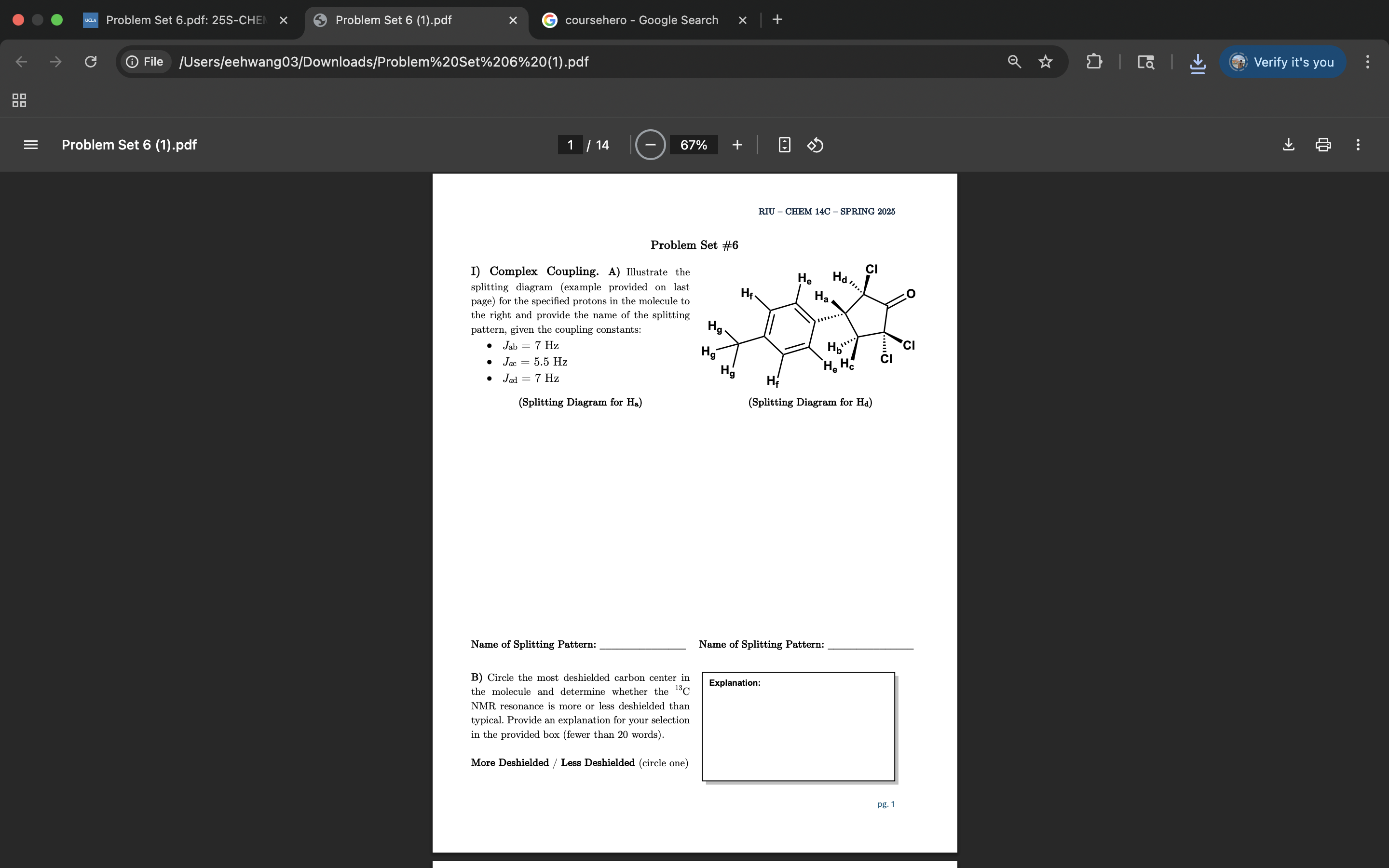
RIU - CHEM 14C - SPRING 2025 C) What term best describes the relationship D) Assign the chiral center in the molecule. between Ho and Hc? Chiral Center with Ha: R / S (circle one) a. Homotopic b. Enantiotopic Chiral Center with Ha: R / S (circle one) c. Diastereotopic E) Assign each signal in the H NMR spectrum below using the labeling scheme above. A zoomed in regions of the 'H NMR spectrum are included. Note that "roofing" of the resonances may make, for example, pairs of doublets appear as quartets. 6 5 3 2 F) In the box to the right, provide a brief Explanation: explanation (fewer than 20 words) for the chemical shift of the most deshielded protons in the H NMR spectrum above. pg. 2RIU - CHEM 14C - SPRING 2025 II) Complex Coupling A) Is the 'H NMR spectrum below consistent with Molecule A, Molecule B, or molecule C. H (Molecule A) (Molecule B) (Molecule C) J = 11 Hz J = 11 Hz, 7 Hz 6 5 W - N- III) NMR Spectroscopy. Determine the number of expected signals in the H NMR spectrum. Br Signals: Signals: Signals: pg. 3RIU CHEM 14C - SPRING 2025 IV) Mass Spectrometry. A) In the following mass spectrum, the molecular ion peak (labeled 'M') is located at m/z = 170. Circle the peak corresponding to the base peak. 100 807 e \\ 40-4 Rel. Intensity 207 0.0 40 80 120 160 200 m/z B) Which of the following formulae are possible for the above spectrum? Circle Yes or No. If a formula is not possible, provide a brief reason (fewer than 10 words). Brief Reason (if \"No\") CeHsNBr CrHsO2Br CiHln02Br CoElN2O2Br CiN0C1 | Yes/No | C) The M+1 peak is 8% the size of the M peak. Assuming the molecule does not contain N, approximately how many carbons are present in the molecule. pg. 4 RIU CHEM 14C SPRING 2025 V) Mass Spectrometry: Determine the possible molecular formula(e) from the given mass spectrum information. Consider only: C, H, N, O, Cl, and Br. M = 114; 50% M+1 = 115; 4.5% M+2 = 116; 0.4% VI) Infrared Spectroscopy: Match each molecule to its corresponding IR spectrum (on the following page) by writing the associated letter of the spectrum below the molecule. Table of functional group regions is provided at the end of the PS. ZA N Assignment: Assignment: Assignment: OH Oo ~ JO 27 ~ Assignment: Assignment: Assignment: pg.5 RIU - CHEM 14C - SPRING 2025 A B 0.8 .8 0.6 0.6 Transmitance Relative Transmittance 0.4 0.4 0.2 .2 3000 2000 1000 3000 2000 1000 Wavenumber (cm-1) Wavenumber (cm-1) C D 0.8 0.8 0.6 0.6 Transmitance Transmitance 0.4 0.4 0.2 0.2 4000 3000 2000 1000 0.0 Wavenumber (cm-1) 3000 2000 1000 Wavenumber (cm-1) E F 0.8 0.8 why 0.6- 0.6 Transmitance Transmitance 0.4 0.4 0.2 0.2 3000 2000 1000 3000 2000 1000 Wavenumber (cm-1) Wavenumber (cm-1) g. 6RIU - CHEM 14C - SPRING 2025 VII) Infrared Spectroscopy: Determine which of the following molecules match the IR spectrum shown below and explain by identifying the presence and absence of relevant peaks. OH 0.98 0.96 A B Relative Transmittance 0.94 NH 2 0.92 C D 3000 2000 1000 Wavenumber (cm-1) Molecule A: Matches spectrum Doesn't match spectrum Explanation: Molecule B: Matches spectrum Doesn't match spectrum Explanation: Molecule C: Matches spectrum Doesn't match spectrum Explanation: Molecule D: Matches spectrum Doesn't match spectrum Explanation: pg. 7RIU CHEM 14C SPRING 2025 VIII) Infrared Spectroscopy + Mass Spectrometry: The chemical stockroom contains two bottles of an unidentified isomer of CsHioO, and your research advisor has given you the task of determining what functional groups are present in the molecule. A) Determine the double bond equivalents (DBE) value and describe what can be concluded about the molecular structures from this value in one sentence. B) The first sample exhibits vibrational bands at 1660 cm\" ' (sharp, medium intensity), 2850-3020 cm'', 3350 cm (broad, high intensity) in the IR spectrum. Draw a structure that is consistent with the IR spectrum and the DBE value in the box to the right. C) The second bottle only exhibits vibrational bands 2850-3020 cm and 3350 cm\" (broad, high intense) in the IR. spectrum. Draw a structure that is consistent with the IR spectrum and the DBE value. RIU - CHEM 14C - SPRING 2025 IX) General Knowledge: A) As seen in your IR table, the C-H stretch of alkyne appears between 3340-3250 cm" while the C-H stretch of an alkene/arene appears between 3100-3000 cm" (shown below). =H C-H Stretching Frequency: 3100-3000 cm-1 3340-3250 cm-1 Clearly explain why the C-H stretch of the alkyne appears at a higher wavenumber than that of an alkene/arene in no more than two sentences. B) Rank the following molecules according to their C=O stretching frequency from highest to lowest. B C D Highest Wavenumber > > > Lowest Wavenumber pg. 9RIU - CHEM 14C - SPRING 2025 C) Chemists have developed a new catalyst that oxidizes CO to CO2, which exhibits a 12C=O stretch at 2384 cm". To verify that the CO2 is produced from CO2, the chemists used isotopically labelled CO in their catalytic reaction in place of "CO. Predict the 13C=O stretching frequency of the generated, isotopically labelled "CO2 using Hooke's Law (provided below). Assume K is the same for C=O and 13C=O. Hooke's Law: 4.12 K H = (m,)(m,) m +m2 Predicted stretching frequency of CO2: cm-1 Please show your work below. D) From the list of molecules below, circle the ones that are IR inactive. H I-1 NEN O=S=O H E) Determine the double bond equivalence (DBE) of the following molecules: i) i) C14HgBr2 iii) CoHIIN C DBE: DBE: DBE: pg. 10Ucu Problem Set 6.pdf: 25S-CHEM X Problem Set 6 (1).pdf G coursehero - Google Search X + G File /Users/eehwang03/Downloads/Problem%20Set%206%20(1).pdf Q Verify it's you . . . E Problem Set 6 (1).pdf 1 / 14 67% + V. RIU - CHEM 14C - SPRING 2025 Problem Set #6 I) Complex Coupling. A) Illustrate the CI splitting diagram (example provided on last page) for the specified protons in the molecule to Ha the right and provide the name of the splitting pattern, given the coupling constants: . Jab = 7 Hz Ho ICI Jac = 5.5 Hz CL Hg Jad = 7 Hz Splitting Diagram for Ha) Splitting Diagram for Ha) Name of Splitting Pattern: Name of Splitting Pattern: B) Circle the most deshielded carbon center in Explanation: the molecule and determine whether the 13C NMR resonance is more or less deshielded than typical. Provide an explanation for your selection in the provided box (fewer than 20 words). More Deshielded / Less Deshielded (circle one) pg. 1
Step by Step Solution
There are 3 Steps involved in it
1 Expert Approved Answer
Step: 1 Unlock
Question Has Been Solved by an Expert!
Get step-by-step solutions from verified subject matter experts
Step: 2 Unlock
Step: 3 Unlock
Students Have Also Explored These Related Accounting Questions!









 Study Help