







Question: Section A Question 2 Question 1 (a) Find the follo (i) lim cos (a) Give the definition of the Gamma function (a), for a >
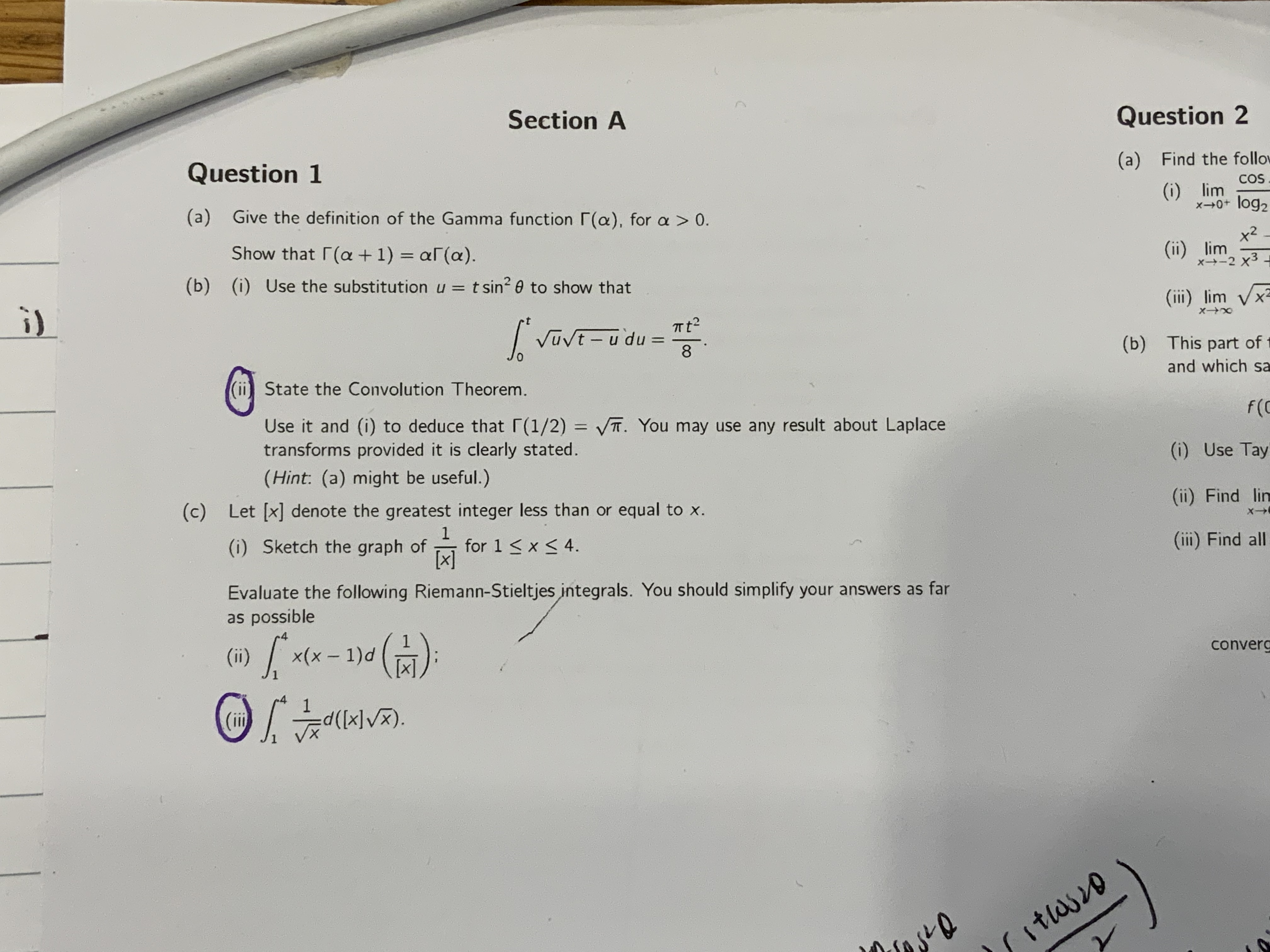
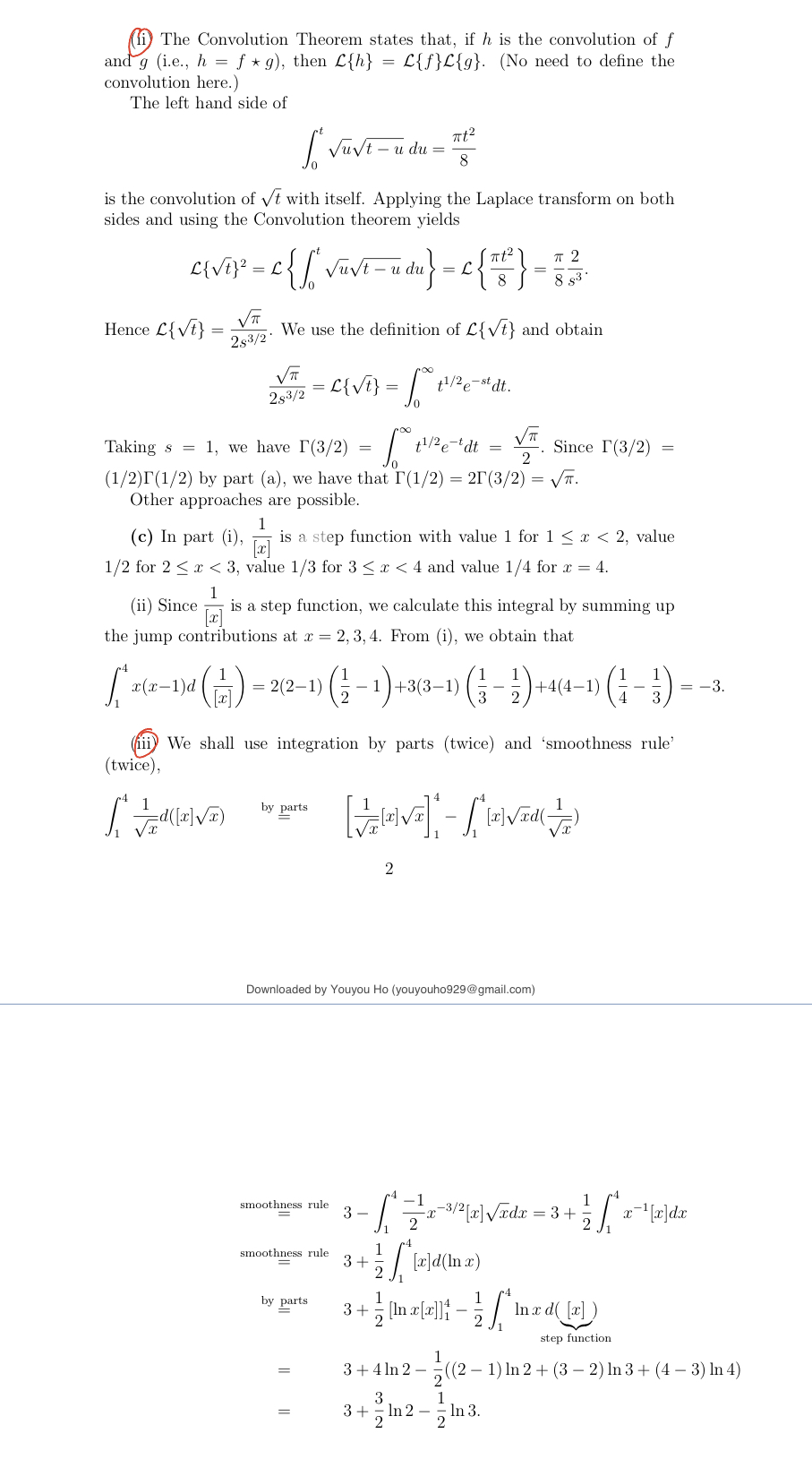
Section A Question 2 Question 1 (a) Find the follo (i) lim cos (a) Give the definition of the Gamma function (a), for a > 0. x-+0+ log Show that [(a + 1) = ar (a). (ii ) lim x - - 2x3 (b) (i) Use the substitution u = t sin 0 to show that (iii) lim vx x -+x I Vuve - udu = it? (b) This part of and which s State the Convolution Theorem. Use it and (i) to deduce that (1/2) = VT. You may use any result about Laplace F ( transforms provided it is clearly stated. (i) Use Tay (Hint: (a) might be useful.) (c) Let [x] denote the greatest integer less than or equal to x. (ii) Find lin X - (i) Sketch the graph of To for 1 S x S 4. (iii) Find all Evaluate the following Riemann-Stieltjes integrals. You should simplify your answers as far as possible conver(fi) The Convolution Theorem states that, if h is the convolution of f and g (i.e., h = f * g), then [{h} = [if}C{g). (No need to define the convolution here.) The left hand side of ( " Vuvt -udu=#5 is the convolution of vt with itself. Applying the Laplace transform on both sides and using the Convolution theorem yields IT 2 Hence C{ VD} = VT 253/2 . We use the definition of C{vt} and obtain 253/2 = [(Vt ) = [ti/ze-stat. Taking s = 1, we have (3/2) = / /2e-tat = Va. 2". Since I(3/2) = (1/2)1(1/2) by part (a), we have that I(1/2) = 21(3/2) = VT. Other approaches are possible. (c) In part (i), is a step function with value 1 for 1
Step by Step Solution
There are 3 Steps involved in it

Get step-by-step solutions from verified subject matter experts
 Study Help