



Question: see questions attached. 1) Based on gure 11, choose the correct answer. 1) WW: 4 in the United States 2) Wm: 3/2 in the United
see questions attached.
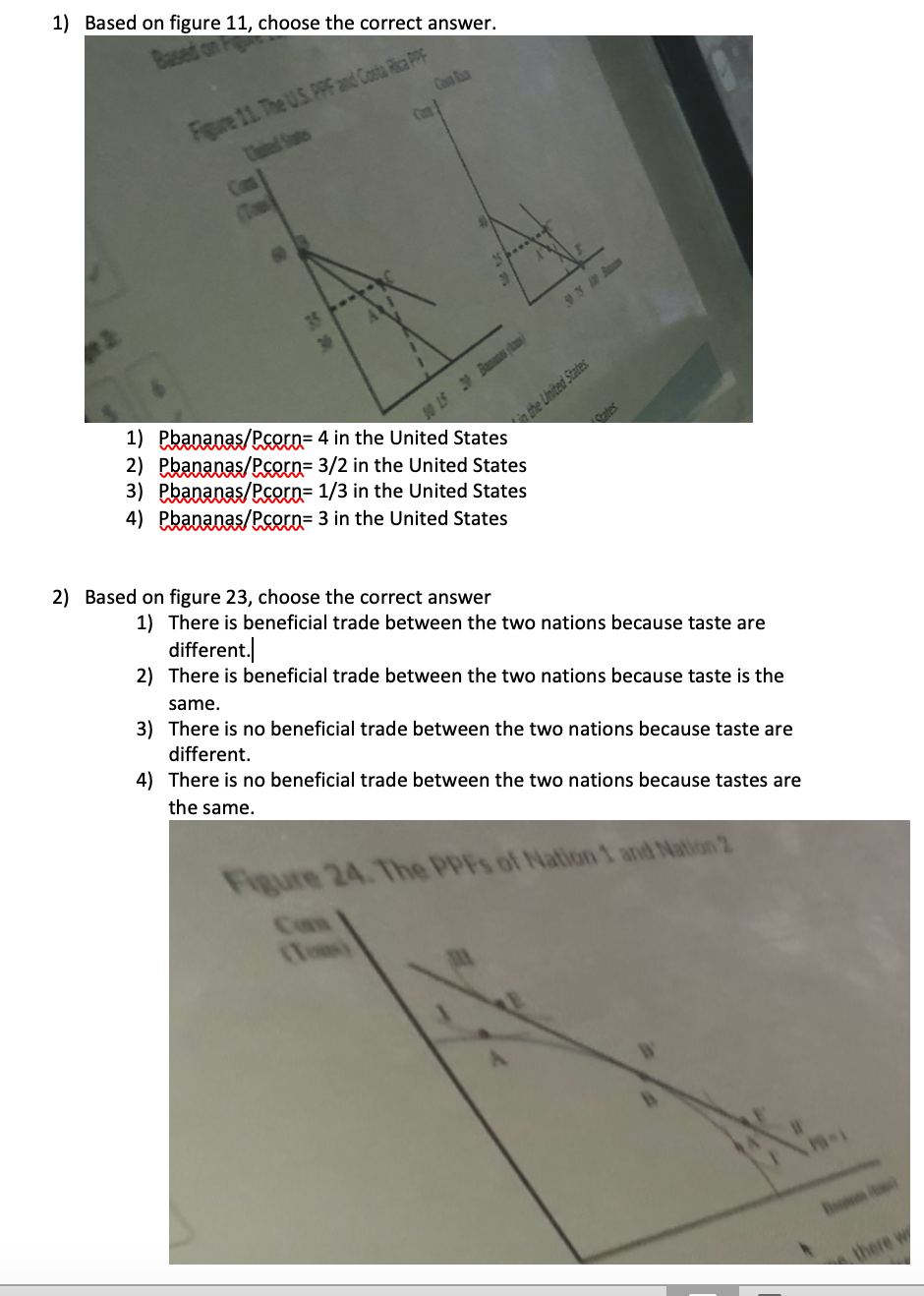
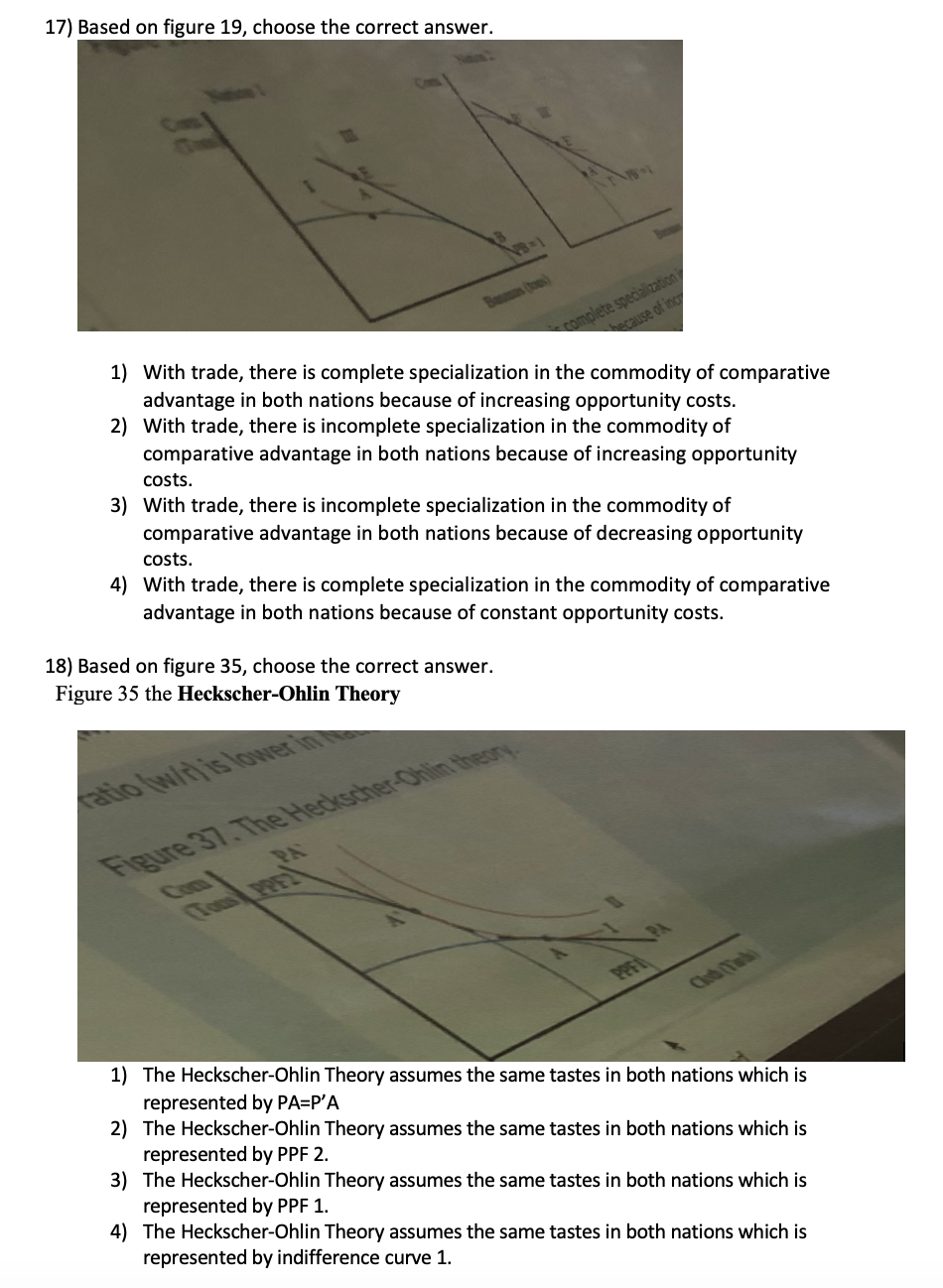
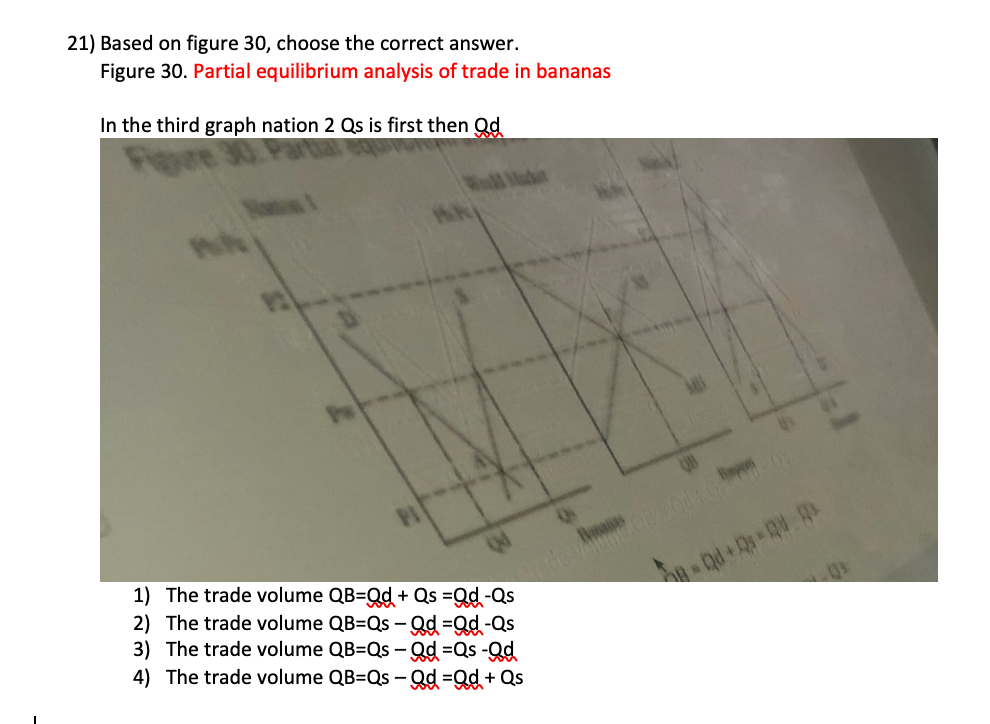
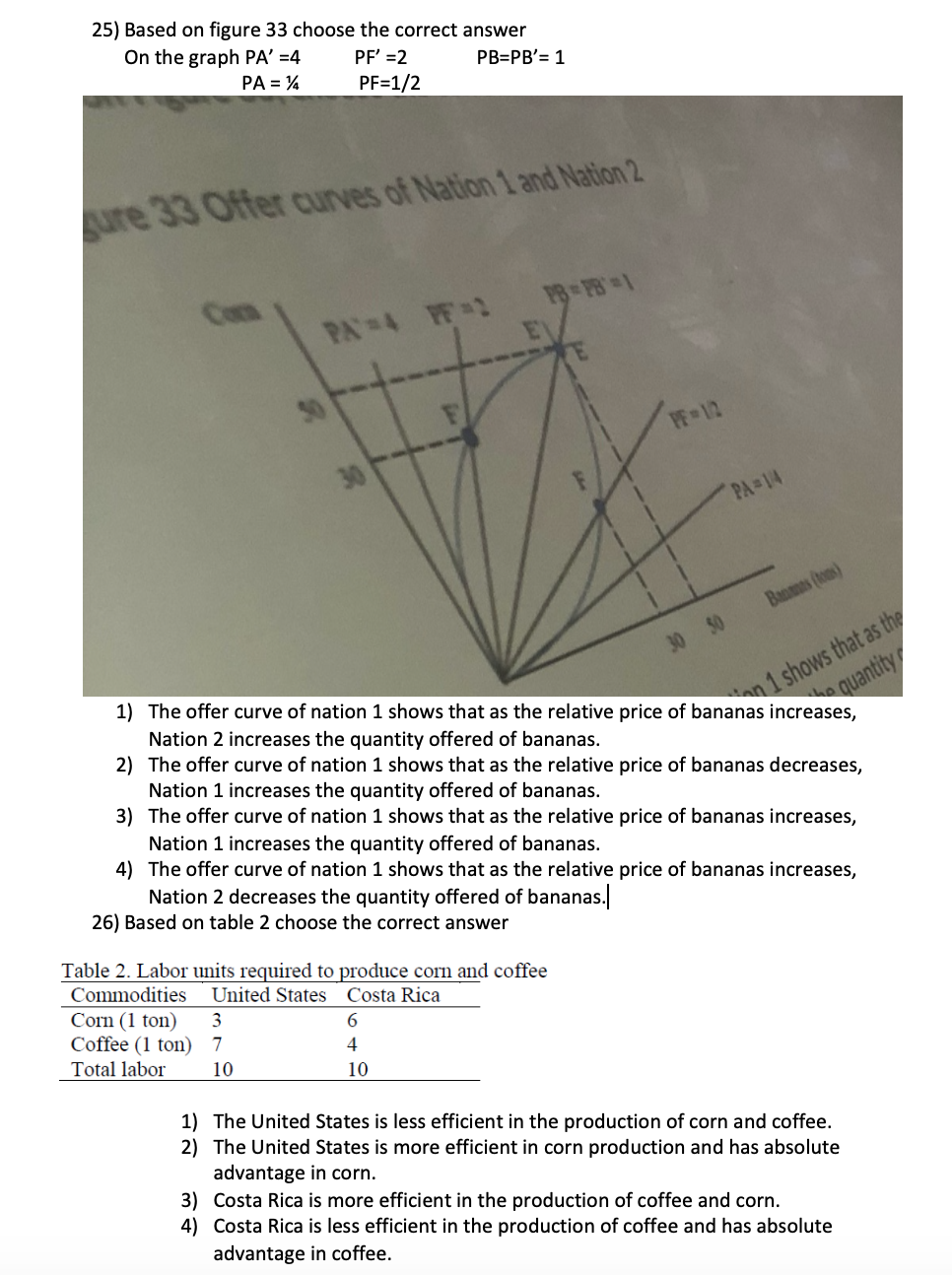
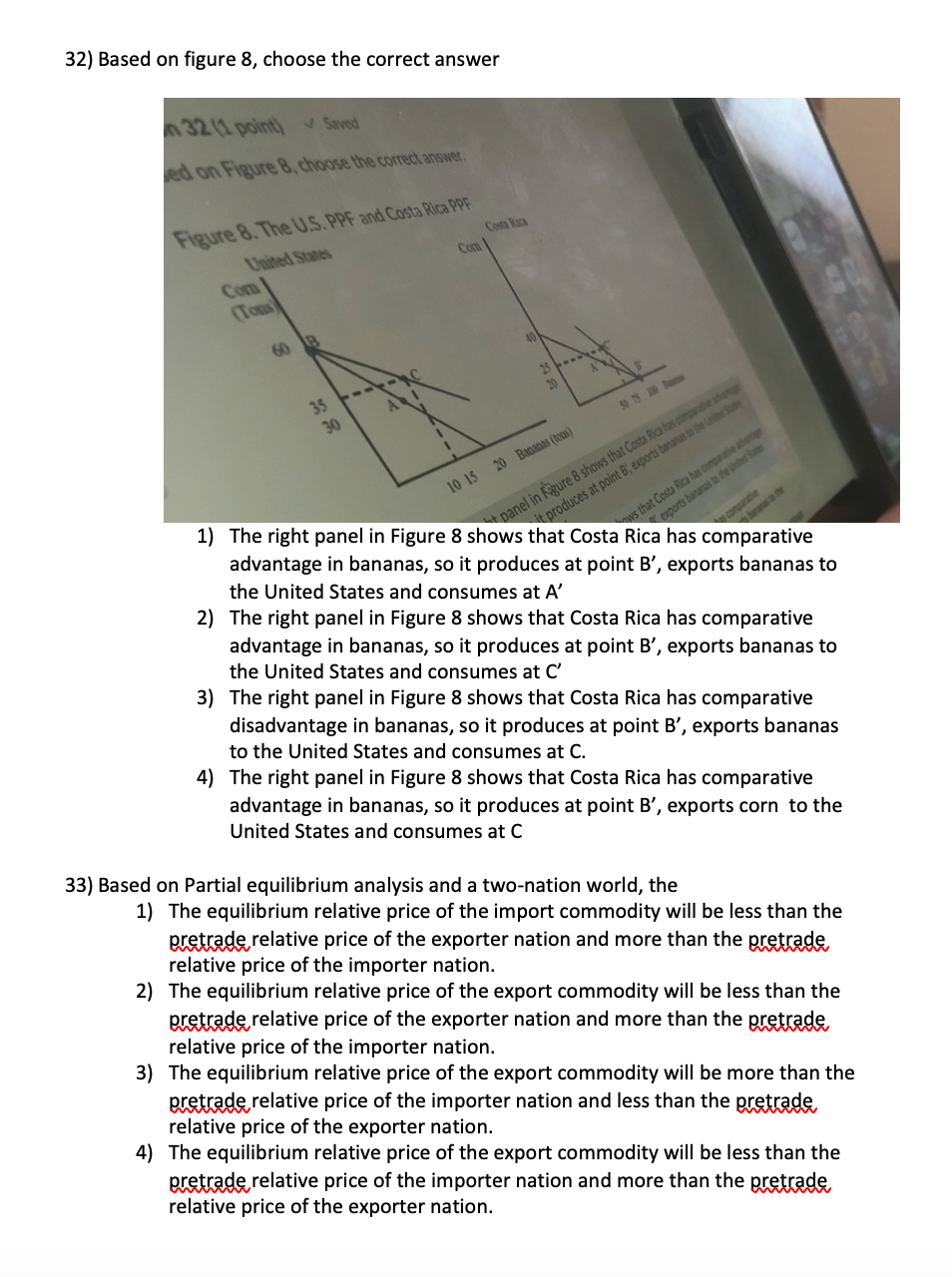
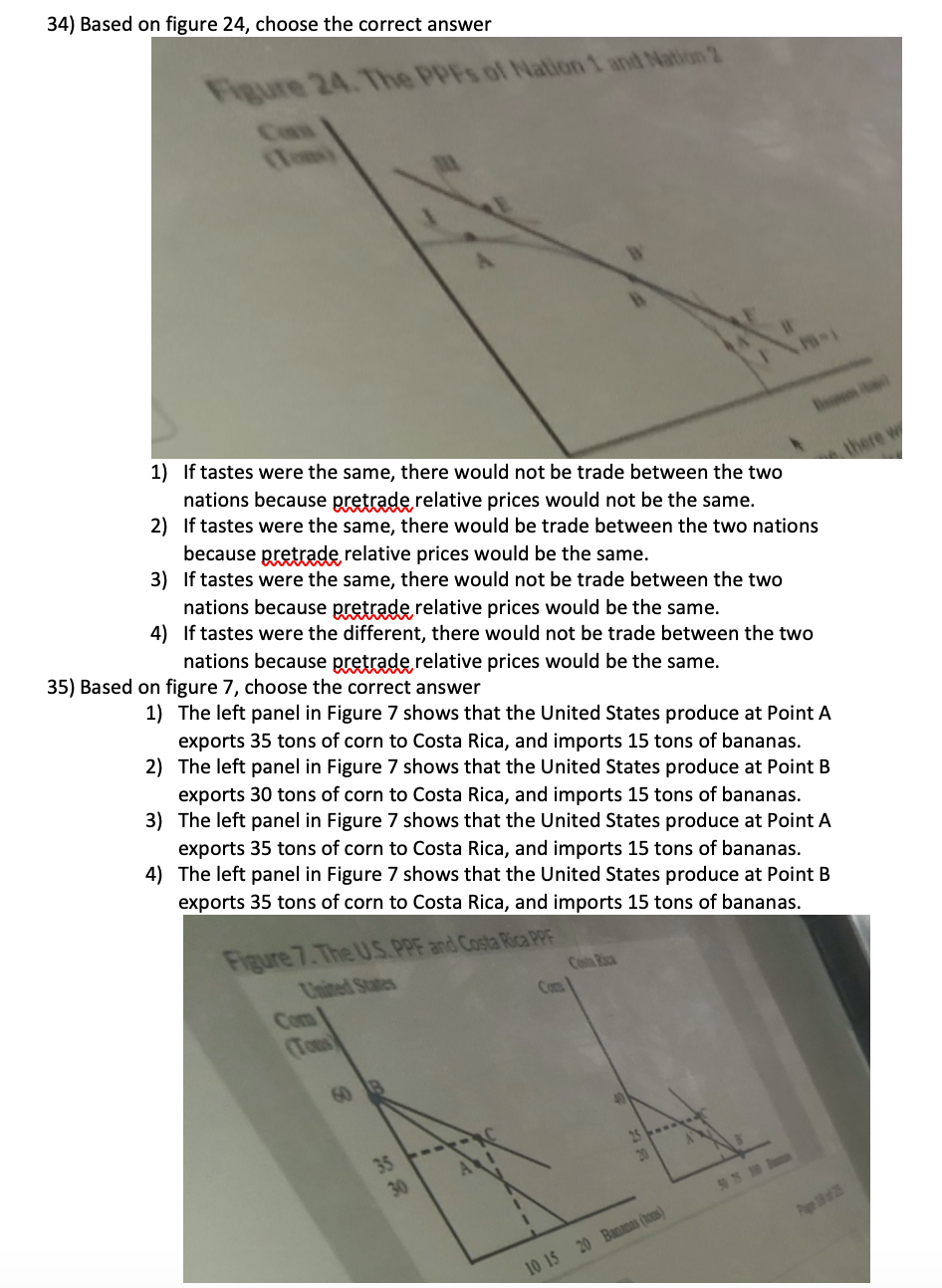
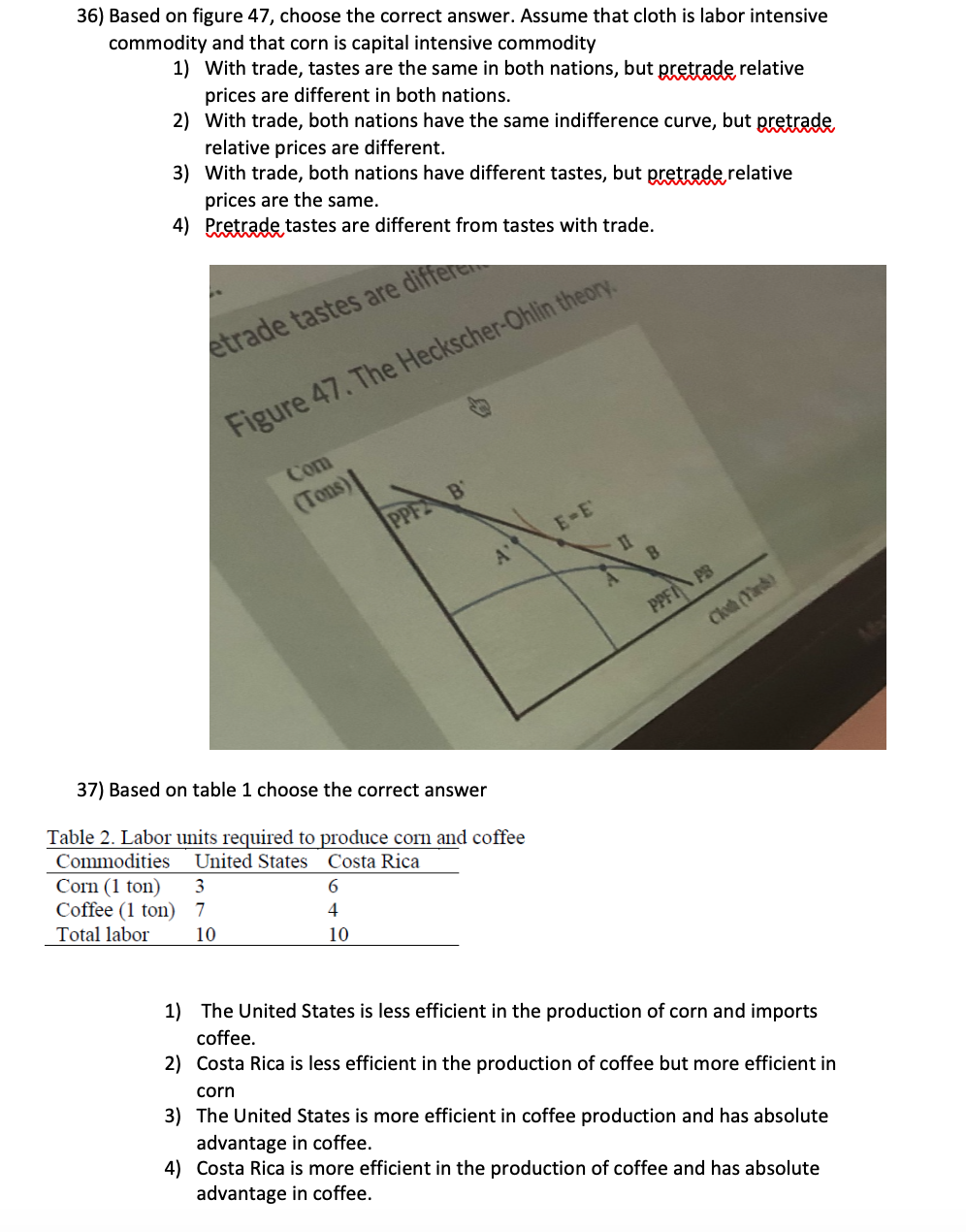
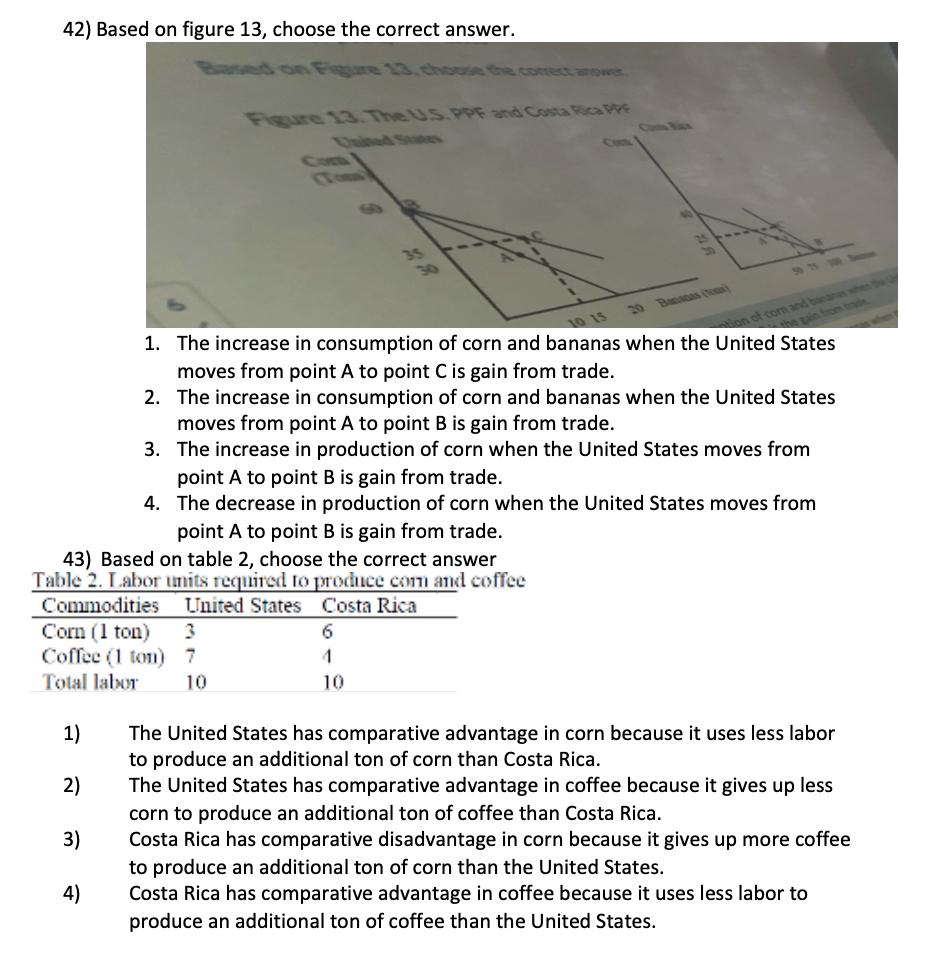
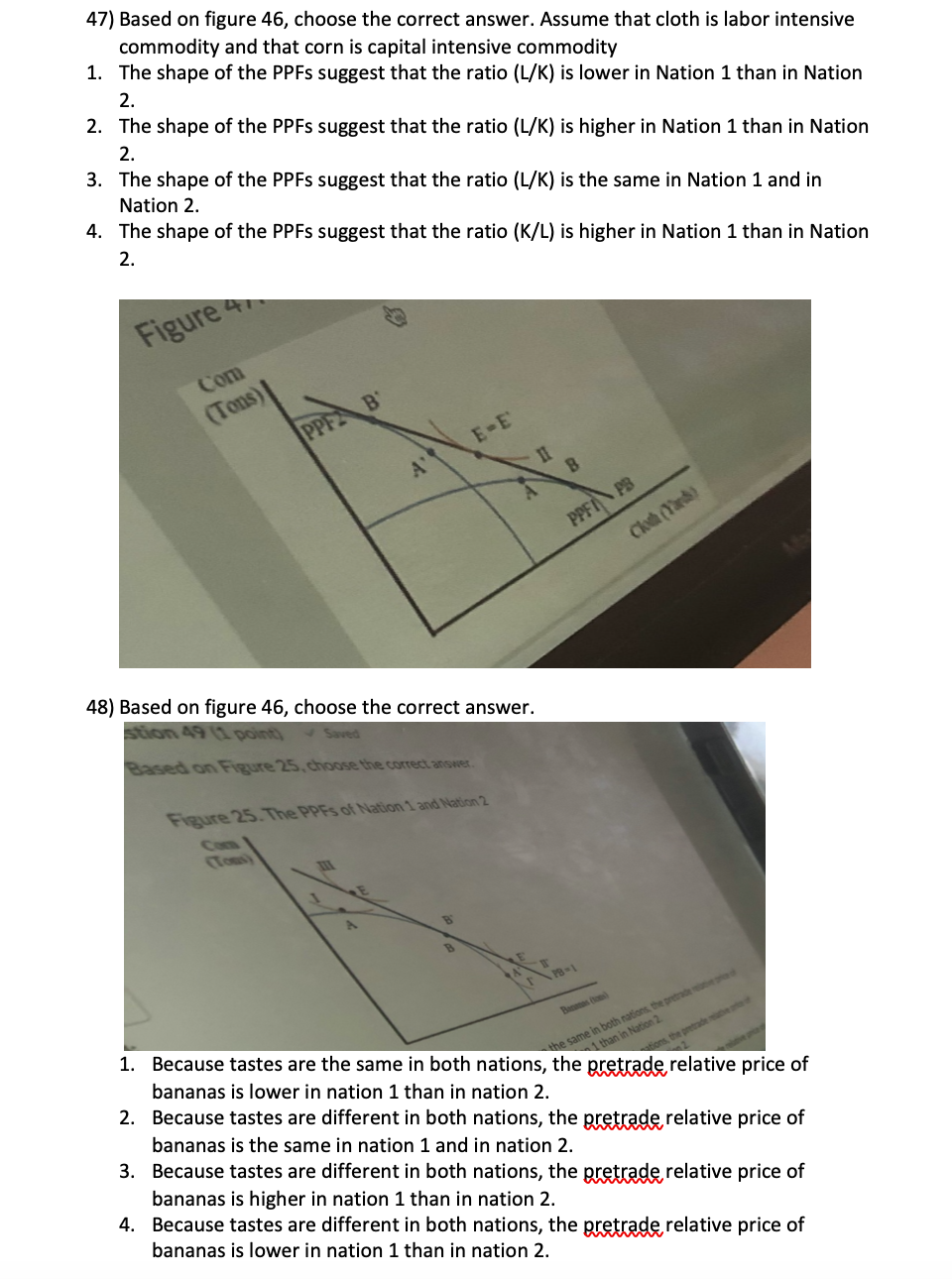
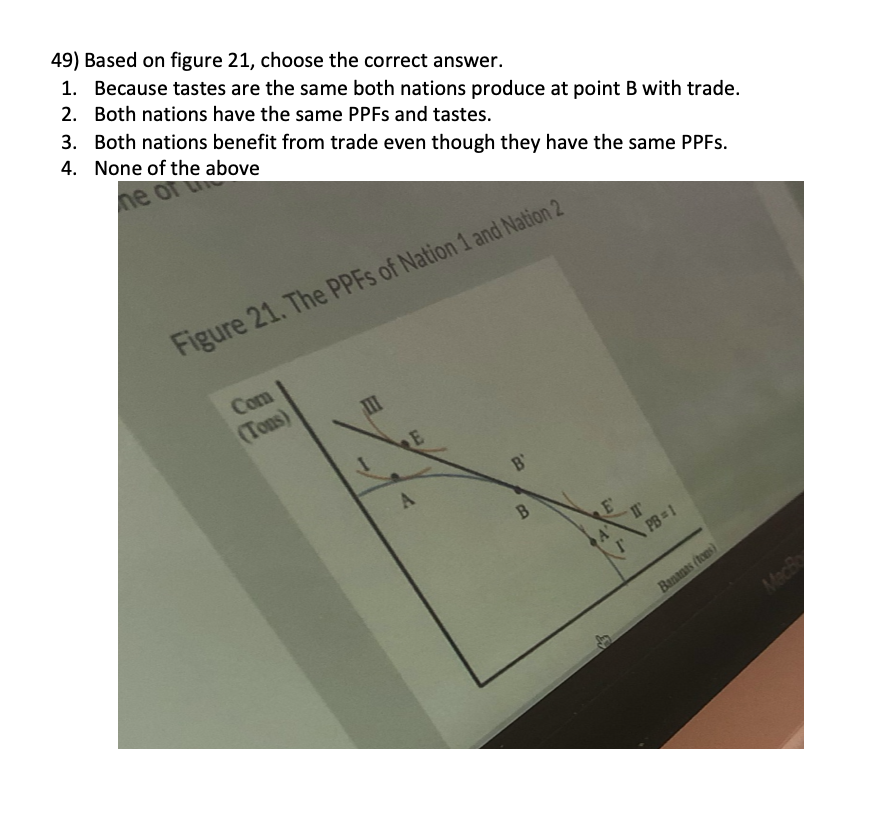
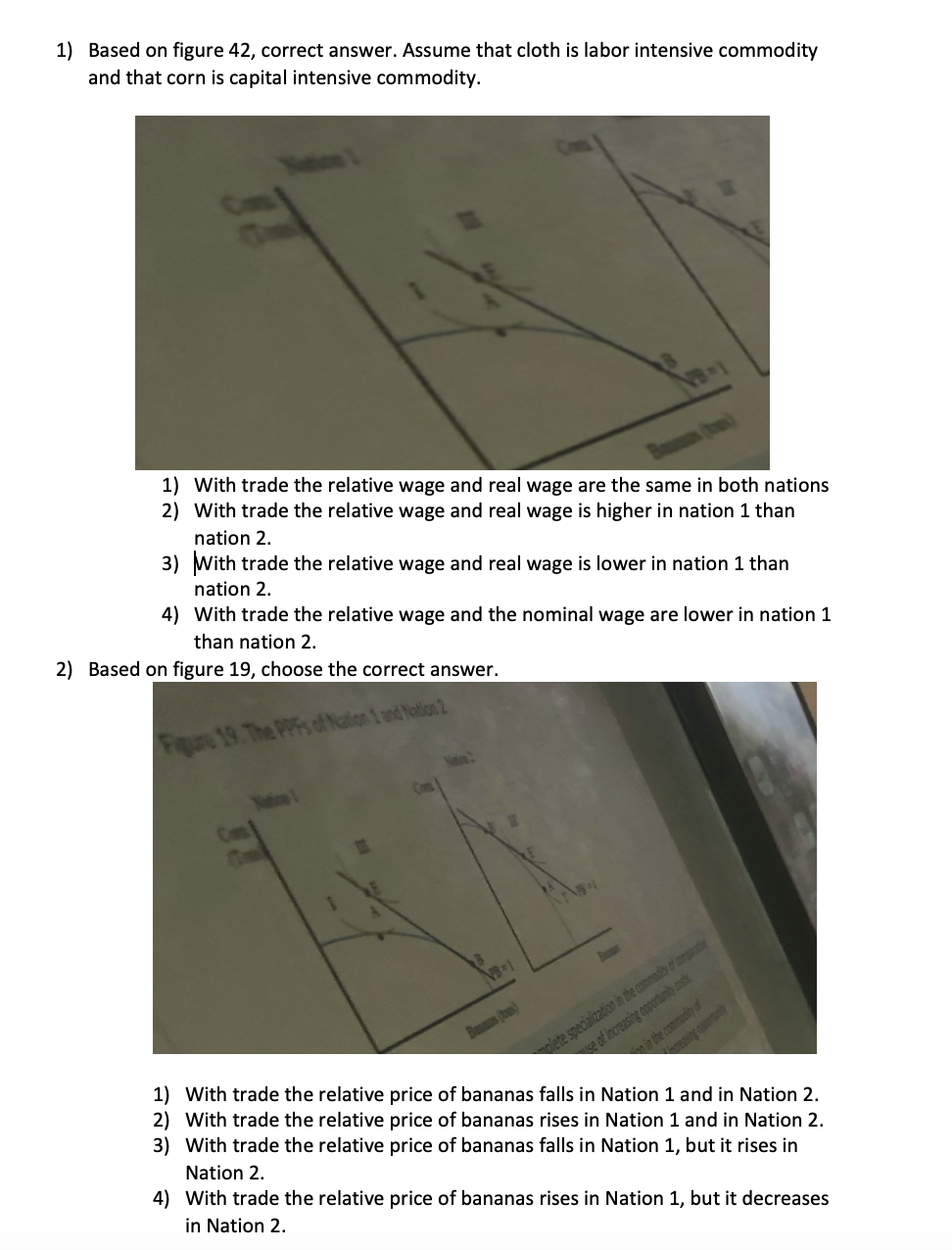
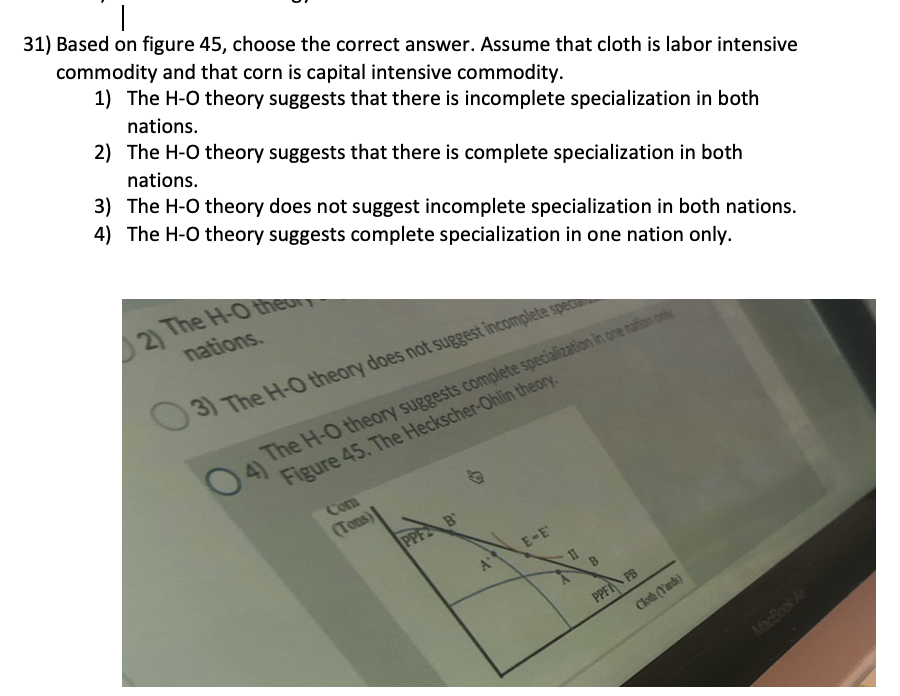
1) Based on gure 11, choose the correct answer. 1) WW: 4 in the United States 2) Wm: 3/2 in the United States 3) Wm: 1/3 in the United States 4) WW: 3 in the United States 2} Based on figure 23, choose the correct answer 1i 2i 3i 4i There is beneficial trade between the two nations because taste are different.| There is beneficial trade between the two nations because taste is the same. There is no beneficial trade between the two nations because taste are different. There is no beneficial trade between the two nations because tastes are the same. 17) Based on gure 19, choose the correct answer. 1) With trade, there is complete specialization in the commodity of comparative advantage in both nations because of increasing opportunity costs. 2} With trade, there is incomplete specialization in the commodity of comparative advantage in both nations because of increasing opportunity costs. 3} With trade, there is incomplete specialization in the commodity of comparative advantage in both nations because of decreasing opportunity costs. 4} With trade, there is complete specialization in the commodity of comparative advantage in both nations because of constant opportunity costs. 13} Based on figure 35, choose the correct answer. Figure 35 the HeckscherOhlin Theory 1) The Heckscher-Ohlin Theory assumes the same tastes in both nations which is represented by PA=P'A 2} The Heckscher-Ohlin Theory assumes the same tastes in both nations which is represented by PPF 2. 3) The Heckscher-Ohlin Theory assumes the same tastes in both nations which is represented by PPF 1. 4) The Heckscher-Ohlin Theory assumes the same tastes in both nations which is represented by indifference curve 1. 21) Based on figure 30, choose the correct answer. Figure 30. Partial equilibrium analysis of trade in bananas In the third graph nation 2 Qs is first then Qd 1) The trade volume QB=Qd + Qs =Qd -Qs 2) The trade volume QB=Qs - Qd =Qd -Qs 3) The trade volume QB=Qs - Qd =Qs -Qd 4) The trade volume QB=Qs - Qd =Qd + Qs25) Based on gure 33 choose the correct answer 0n the graph PA' =4 PF' =2 PB=PB'= 1 PA = % PF=1/2 1) The offer curve of nation 1 shows that as the relative price of bananas increases, Nation 2 increases the quantity offered of bananas. 2) The offer curve of nation 1 shows that as the relative price of bananas decreases, Nation 1 increases the quantity offered of bananas. 3) The offer curve of nation 1 shows that as the relative price of bananas increases, Nation 1 increases the quantity offered of bananas. 4) The offer curve of nation 1 shows that as the relative price of bananas increases, Nation 2 decreases the quantity offered of bananas.| 26) Based on table 2 choose the correct answer Table 2. Labor units re_quired to moduce com and co'ee Commodities Corn (1 ton) Coffee (1 ton) Total labor United States Costa Rica 3 6 7 4 10 10 1) 2i 3i 4i The United States is less efficient in the production of corn and coffee. The United States is more efficient in corn production and has absolute advantage in corn. Costa Rica is more efficient in the production of coffee and corn. Costa Rica is less efficient in the production of coffee and has absolute advantage in coffee. 32) Based on figure 8, choose the correct answer n 32 (1 point) Saved ed on Figure 8, choose the correct answer. Figure 8. The U.S. PPF and Costa Rica PPF Costa Rica United States Com Com (Tous 40 60 50 75 100 Bumson 35 30 nel in Figure 8 shows that Costa Rica has comparative sturgis 10 15 20 Bananas (tos) produces at point B', exports bananas to the United States ports bananas to the United S that Costa Rica has comparat 1) The right panel in Figure 8 shows that Costa Rica has comparative advantage in bananas, so it produces at point B', exports bananas to the United States and consumes at A' 2) The right panel in Figure 8 shows that Costa Rica has comparative advantage in bananas, so it produces at point B', exports bananas to the United States and consumes at C' 3) The right panel in Figure 8 shows that Costa Rica has comparative disadvantage in bananas, so it produces at point B', exports bananas to the United States and consumes at C. 4) The right panel in Figure 8 shows that Costa Rica has comparative advantage in bananas, so it produces at point B', exports corn to the United States and consumes at C 33) Based on Partial equilibrium analysis and a two-nation world, the 1) The equilibrium relative price of the import commodity will be less than the pretrade relative price of the exporter nation and more than the pretrade, relative price of the importer nation. 2) The equilibrium relative price of the export commodity will be less than the pretrade relative price of the exporter nation and more than the pretrade, relative price of the importer nation. 3) The equilibrium relative price of the export commodity will be more than the pretrade relative price of the importer nation and less than the pretrade, relative price of the exporter nation. 4) The equilibrium relative price of the export commodity will be less than the pretrade relative price of the importer nation and more than the pretrade relative price of the exporter nation.34) Based on gure 24, choose the correct answer 1) If tastes were the same, there would not be trade between the two nations because Wrelative prices would not be the same. 2) If tastes were the same, there would be trade between the two nations because Wrelative prices would be the same. 3) If tastes were the same, there would not be trade between the two nations because Wrelative prices would be the sam e. 4) If tastes were the different, there would not be trade between the two nations because Wrelative prices would be the same. 35) Based on gure 7, choose the correct answer 1) The left panel in Figure 7 shows that the United States produce at Point A exports 35 tons of corn to Costa Rica, and imports 15 tons of bananas. 2} The left panel in Figure 7 shows that the United States produce at Point B exports 30 tons of corn to Costa Rica, and imports 15 tons of bananas. 3} The left panel in Figure 7 shows that the United States produce at Point A exports 35 tons of corn to Costa Rica, and imports 15 tons of bananas. 4) The left panel in Figure 7 shows that the United States produce at Point B exports 35 tons of corn to Costa Rica, and imports 15 tons of bananas. 36) Based on figure 47, choose the correct answer. Assume that cloth is labor intensive commodity and that corn is capital intensive commodity 1) With trade, tastes are the same in both nations, butmrelative prices are different in both nations. 2) With trade, both nations have the same indifference curve, but am relative prices are different. 3) With trade, both nations have different tastes, but Wrelative prices are the same. 4) Wtastes are different from tastes with trade. 37) Based on table 1 choose the correct answer Table 2. Labor units required to produce com and coffee Commodities United States Costa Rica C0111 (1 ton) 3 6 Coffee (1 ton) 7 4 Total labor 10 10 1) The United States is less efficient in the production of corn and imports coffee. 2) Costa Rica is less efficient in the production of coffee but more efficient in corn 3) The United States is more efficient in coffee production and has absolute advantage in coffee. 4) Costa Rica is more efficient in the production of coffee and has absolute advantage in coffee. 42) Based on figure 13, choose the correct answer. 1. The increase in consumption of corn and bananas when the United States moves from point A to point C is gain from trade. 2. The increase in consumption of corn and bananas when the United States moves from point A to point B is gain from trade. 3. The increase in production of corn when the United States moves from point A to point Bis gain from trade. 4. The decrease in production of corn when the United States moves from point A to point B is gain from trade. 43) Based on table 2, choose the correct answer Table 2. Labor units lLllJl'I'ul Io produce com and coffee Commodities United States Costa Rica Corn (1 too) 3 6 Comm {1 Inn) 7' -1 Total labor 10 10 1) The United States has comparative advantage in corn because it uses less labor to produce an additional ton of corn than Costa Rica. 2) The United States has comparative advantage in coffee because it gives up less corn to produce an additional ton of coffee than Costa Rica. 3) Costa Rica has comparative disadvantage in corn because it gives up more coffee to produce an additional ton of corn than the United States. 4) Costa Rica has comparative advantage in coffee because it uses less labor to produce an additional ton of coffee than the United States. 47} Based on gure 46, choose the correct answer. Assume that cloth is labor intensive commodity and that corn is capital intensive commodity 1. The shape of the PPFs suggest that the ratio {L/K} is lower in Nation 1 than in Nation 2. 2. The shape of the PPFs suggest that the ratio {UK} is higher in Nation 1 than in Nation 2 3. The shape of the PPFs suggest that the ratio [L/K} is the same in Nation 1 and in Nation 2. 4. The shape of the PPFs suggest that the ratio {K/L} is higher in Nation 1 than in Nation 2. 48} Based on figure 46, choose the correct answer. 1. Because tastes are the same in both nations, the Wrelative price of bananas is lower in nation 1 than in nation 2. 2. Because tastes are different in both nations, the Wrelative price of bananas is the same in nation 1 and in nation 2. 3. Because tastes are different in both nations, the Wrelative price of bananas is higher in nation 1 than in nation 2. 4. Because tastes are different in both nations, the Wrelative price of bananas is lower in nation 1 than in nation 2. 49) Based on gure 21, choose the correct answer. 1. Because tastes are the same both nations produce at point B with trade. Both nations have the same PPFs and tastes. 2 3. Both nations benefit from trade even though theyI have the same PPFs. 4 None of the above 1) Based on gure 42, correct answer. Assume that cloth is labor intensive commodity and that corn is capital intensive commodity. 1) 2) 3i 4) With trade the relative wage and real wage are the same in both nations With trade the relative wage and real wage is higher in nation 1 than nation 2. With trade the relative wage and real wage is lower in nation 1 than nation 2. With trade the relative wage and the nominal wage are lower in nation 1 than nation 2. 2} Based on gure 19, choose the correct answer. 1} 2} 3} With trade the relative price of bananas falls in Nation 1 and in Nation 2. With trade the relative price of bananas rises in Nation 1 and in Nation 2. With trade the relative price of bananas falls in Nation 1, but it rises in Nation 2. With trade the relative price of bananas rises in Nation 1, but it decreases in Nation 2. 31) Based on figure 45, choose the correct answer. Assume that cloth is labor intensive commodity and that corn is capital intensive commodity. 1) The H-O theory suggests that there is incomplete specialization in both nations. 2) The H-O theory suggests that there is complete specialization in both nations. 3) The H-O theory does not suggest incomplete specialization in both nations. 4) The H-O theory suggests complete specialization in one nation only
Step by Step Solution
There are 3 Steps involved in it

Get step-by-step solutions from verified subject matter experts