







Question: slove by using Excel and show steps clearly use these as a reference for the solution table 29 show the formulas An office building in
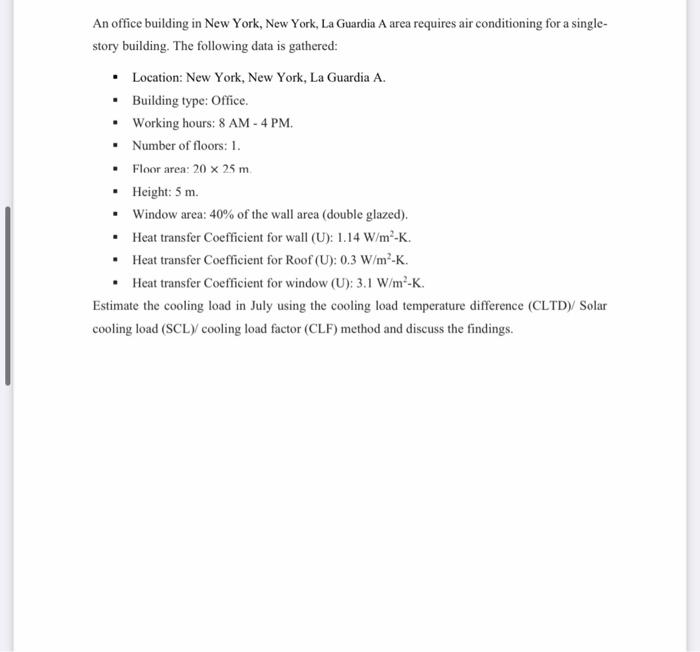
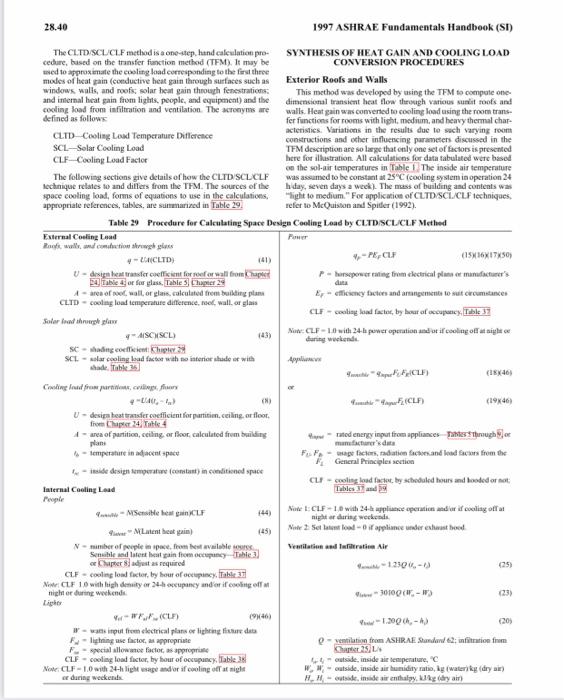
An office building in New York, New York, La Guardia A area requires air conditioning for a singlestory building. The following data is gathered: - Location: New York, New York, La Guardia A. - Building type: Office. - Working hours: 8 AM - 4 PM. - Number of floors: 1. - Floor area: 2025m. - Height: 5m. - Window area: 40% of the wall area (double glazed). - Heat transfer Coefficient for wall (U): 1.14W/m2K. - Heat transfer Coefficient for Roof (U): 0.3W/m2K. - Heat transfer Coefficient for window (U): 3.1W/m2K. Estimate the cooling load in July using the cooling load temperature difference (CLTD)/ Solar cooling load (SCL)/ cooling load factor (CLF) method and discuss the findings. 28.40 1997 ASHRAE Fundamentals Handbeok (SI) The CLTDSCLCLF method is a one-utep, hand ealealation pro- SVNTHESIS OF IEAT GAIN AND COOL.ING LOAD cedure, bused on the transfer fiontion method (TFM). It may be CONVERSION PROCEDURES ased to abproximate the cooling taad corresponding to the first throe modes of heat gain (coeductive heat gain through surfaces such as Exterior Reofs and Walls windows. walis, and roofs: solar heal gain thoouch fenestraticons: and imernal beat eain ftom ligits. people. and squipeneat) and the This method was developed by asing the TFM to compote one: and imernal beat gan from lights, people, and eqgipencat) and the dimensional transient heat flow throvgh various sualit soofs and cooling load from infiltration and ventilation. The scronyms are walls. Heat gain war converied to cooling load using the room transdefined as followk: fer functions for rooms with light, modium, and heavy thermal char- CLID - Cooling Lod Temperature Ditleretce acteristics. Variations in the fesults due to sach varying reont SCL-Selar Cooling Load constractions and echer influencing parameens discussed in the CLF-Cooling Load Facter here for illistration. All calculations for data tabulated wert based The followizg sections give details of how the CLTDSCLCLF_ we the sol-air tenperatures in Table I. The inside air tempenature ipace cooling load, forms of equations to use in the calculations, "light to medium." For application of CLTD SCL./CL.F technigues. appropriate relerences, tables, are suinmarized in Table 29. Iefer to McQuishon and Spiter (1992). Table 29 Procedure for Calculating Space Design Cooling Load by CLTDSCLCLE Mothed Ashrae-HVAC-1997-Fundamentals-Handbook Av Ashrae-HVAC-2001-Fundamentals-Handbook Ventilation-for-Acceptable-Indoor-Air-Quality Av
Step by Step Solution
There are 3 Steps involved in it

Get step-by-step solutions from verified subject matter experts
 Study Help