







Question: Solve all parts Question:- Given the random processes S(t) and N(t), with the following statistics : E[s(t)] = E[N(t)] = 0, Rss(T) = e 47,
Solve all parts
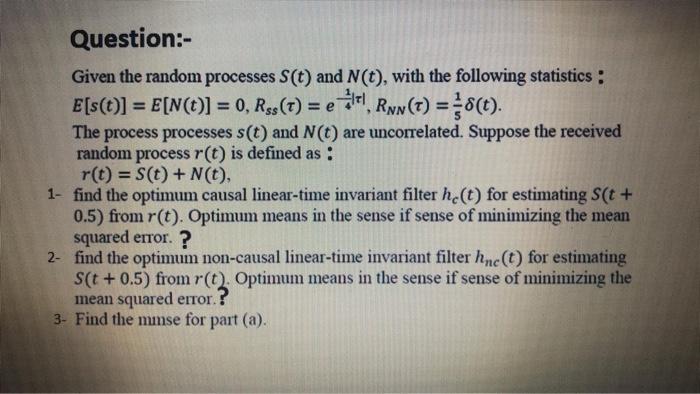
Question:- Given the random processes S(t) and N(t), with the following statistics : E[s(t)] = E[N(t)] = 0, Rss(T) = e 47, RNN(T) = = : 18(t). The process processes s(t) and N(t) are uncorrelated. Suppose the received random process r(t) is defined as : r(t) = S(t) + N(t). 1- find the optimum causal linear-time invariant filter he(t) for estimating S(t + 0.5) from r(t). Optimum means in the sense if sense of minimizing the mean squared error. ? 2- find the optimum non-causal linear-time invariant filter hne(t) for estimating S(t + 0.5) from r(t). Optimum means in the sense if sense of minimizing the mean squared error.? 3- Find the nunse for part (a)
Step by Step Solution
There are 3 Steps involved in it

Get step-by-step solutions from verified subject matter experts
 Study Help