







Question: Solve the following recurrence relations using master theorem: 1. T(n) = 2T(n/4)+ n^0.57 2. T(n) = 3T(n/3)+ n^0.5 3. T(n) = 2T(n/4)+ n^0.5 Master
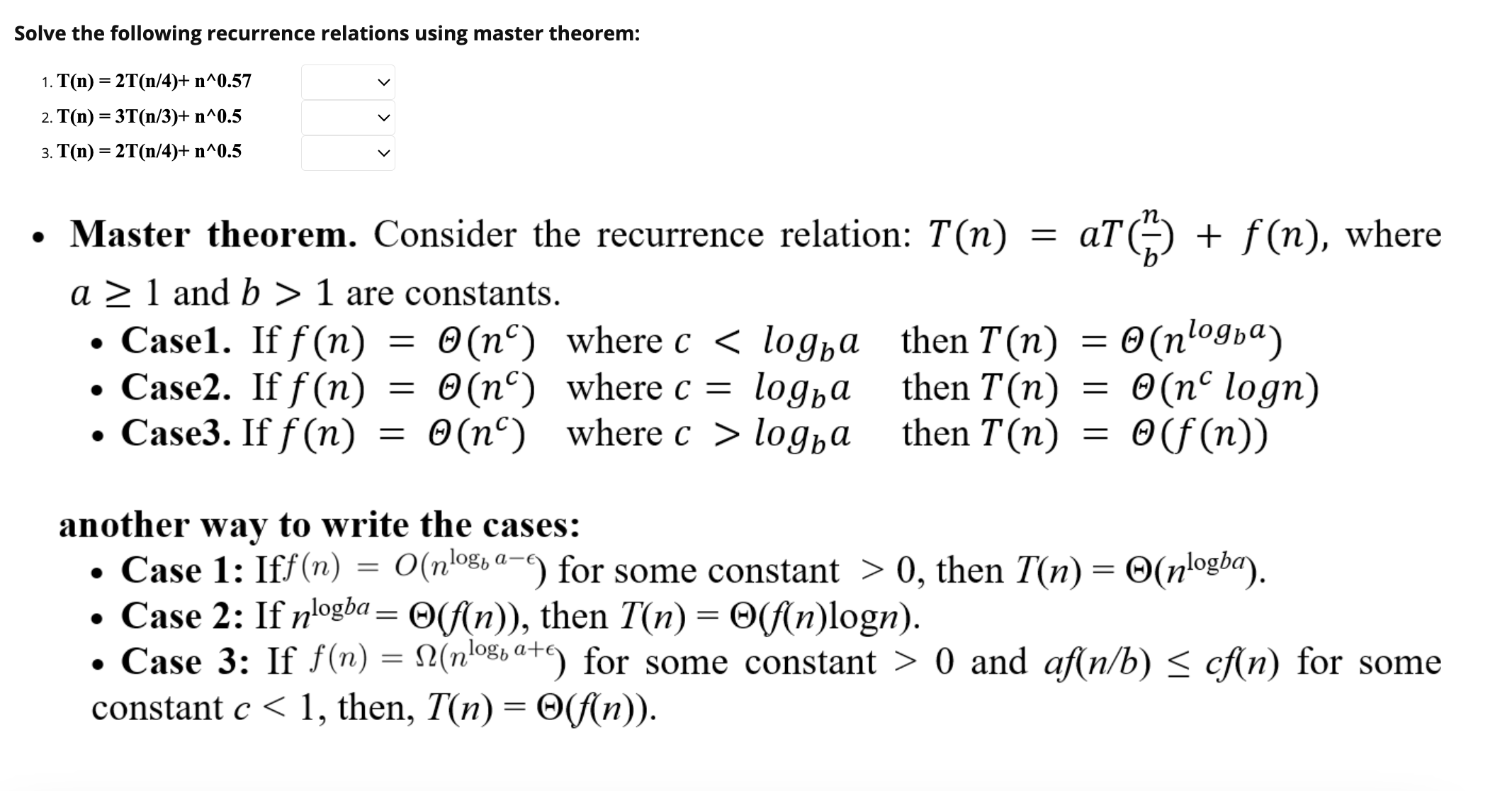
Solve the following recurrence relations using master theorem: 1. T(n) = 2T(n/4)+ n^0.57 2. T(n) = 3T(n/3)+ n^0.5 3. T(n) = 2T(n/4)+ n^0.5 Master theorem. Consider the recurrence relation: T(n) = aT() + f(n), where a> 1 and b > 1 are constants. Casel. If f(n) Case2. If f(n) Case3. If f(n) = = = = (n) (n) where c (n) where c < loga loga where > loga = then T (n) then T(n) then T(n) = 0 (noga) = 0 (n logn) = 0 (f(n)) = another way to write the cases: Case 1: Iff(n) Case 2: If nlogba = O(f(n)), then T(n) = O(f(n)logn). Case 3: If f(n) = N(na+) for some constant > 0 and af(n/b) cf(n) for some constant c < 1, then, T(n) = O(f(n)). O(na-) for some constant > 0, then T(n) = O(nlogba). Solve the following recurrence relations using master theorem: 1. T(n) = 2T(n/4)+ n^0.57 2. T(n) = 3T(n/3)+ n^0.5 3. T(n) = 2T(n/4)+ n^0.5 Master theorem. Consider the recurrence relation: T(n) = aT() + f(n), where a> 1 and b > 1 are constants. Casel. If f(n) Case2. If f(n) Case3. If f(n) = = = = (n) (n) where c (n) where c < loga loga where > loga = then T (n) then T(n) then T(n) = 0 (noga) = 0 (n logn) = 0 (f(n)) = another way to write the cases: Case 1: Iff(n) Case 2: If nlogba = O(f(n)), then T(n) = O(f(n)logn). Case 3: If f(n) = N(na+) for some constant > 0 and af(n/b) cf(n) for some constant c < 1, then, T(n) = O(f(n)). O(na-) for some constant > 0, then T(n) = O(nlogba).
Step by Step Solution
There are 3 Steps involved in it
Lets solve each of the recurrence relations using the Master Theorem which provides a way to find th... View full answer

Get step-by-step solutions from verified subject matter experts
 Study Help