







Question: SSD in abrasive machining a . refers to micro cracks in ductile workpieces. b . refers to dislocation in brittle workpieces. c . is pore
SSD in abrasive machining
a refers to micro cracks in ductile workpieces.
b refers to dislocation in brittle workpieces.
c is pore and impurity.
d mainly refers to micro cracks in brittle workpieces.
Use system approach and use tribology terms and methods to deal with abrasive
machining processes are due to
a challenges of elastic and plastic deformation in high precision.
b challenges of micro cutting of HSS abrasive cutter.
c challenges of multiple cutting edges of elastic and plastic high precision
diamond grains.
d challenges of elastic and plastic deformation, micro cutting, and multiple
cutting edges of abrasive grains.
Ductile mode machining
a is possible for brittle materials if depth of cut is extremely small.
b is possible for brittle materials if depth of cut is extremely large and ductile.
c is possible for brittle materials if material is controlled at high precision.
d is possible for brittle materials if form error is controlled at high precision.
Abrasive machining
a has one cutting edge of high precision.
b is the same or similar to diamond turning for nano precision machining.
c has many cutting edges due to many cutting grains.
d has one cutting edge due to number of cutting grains being limited to one.
Truing
a is the same as dressing.
b is to get true shape of micro cutter to produce precision parts.
c is to get correct profile of tool and concentricity of profile to rotational axis.
d is to get sharpness of abrasive grains for effective machining.
Uncut chip thickness model
a shows tool is infinitely soft and workpiece is infinitely hard.
b indicates we have in total possible ways to improve abrasive machining's
precision.
c depends on contact length to achieve high precision.
d shows a small uncut chip aspect ratio of abrasive ductile elastic grain of
precision. Best most suitable choice:
Uncut chip aspect ratio hcumax in surface grinding
a is typically
b is typically
c is typically
d is typically
Centerless grinding means
a cylindrical workpiece being machined has no center.
b cylindrical tool being used has no center.
c cylindrical workpiece being machined is not supported through center.
d cylindrical tool being used is not supported through center.
Abrasive machining
a typically has a big normal cutting force as workpiece material is brittle.
b typically has a big normal cutting force as tool material is brittle.
c typically has a small normal cutting force as workpiece material is brittle.
d typically has a small normal cutting force as tool material is brittle.
Contact length
a will be smaller when contact force induced workpiece deformation grows.
b will be smaller when contact force induced tool deformation grows.
c will be bigger when contact force induced tool deformation grows.
d will be bigger when contact force induced workpiece deformation grows.
Workpiece surface precision
a becomes better when workpiece speed is increased.
b becomes better when tool speed is decreased.
c becomes worse when depth of cut is increased.
d becomes worse when depth of cut is decreased.
A tool of mesh count
a will lead to better workpiece surface finish than a tool of mesh count
b will lead to worse workpiece surface finish than a tool of mesh count
c will lead to better tool surface finish than a workpiece of mesh count
d will lead to worse tool surface finish than a workpiece of mesh count Best most suitable choice:
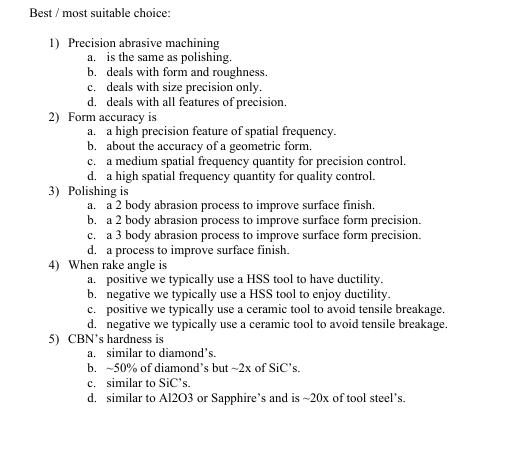
Precision abrasive machining
a is the same as polishing.
b deals with form and roughness.
c deals with size precision only.
d deals with all features of precision.
Form accuracy is
a a high precision feature of spatial frequency.
b about the accuracy of a geometric form.
c a medium spatial frequency quantity for precision control.
d a high spatial frequency quantity for quality control.
Step by Step Solution
There are 3 Steps involved in it
1 Expert Approved Answer
Step: 1 Unlock

Question Has Been Solved by an Expert!
Get step-by-step solutions from verified subject matter experts
Step: 2 Unlock
Step: 3 Unlock
 Study Help