







Question: For two spin-1/2 particles you can construct symmetric and antisymmetric spin states (the triplet and singlet combinations, respectively). For three spin-1/2 parti- cles you
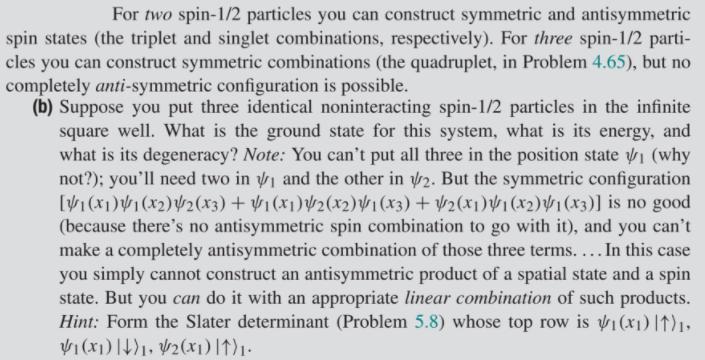
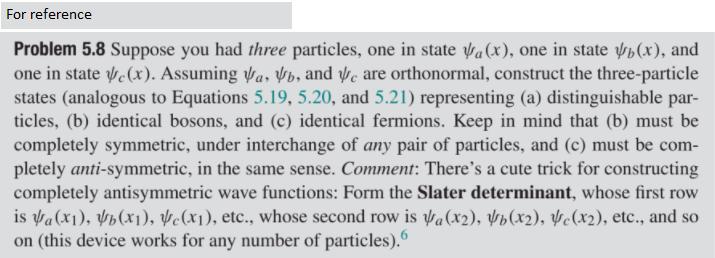
For two spin-1/2 particles you can construct symmetric and antisymmetric spin states (the triplet and singlet combinations, respectively). For three spin-1/2 parti- cles you can construct symmetric combinations (the quadruplet, in Problem 4.65), but no completely anti-symmetric configuration is possible. (b) Suppose you put three identical noninteracting spin-1/2 particles in the infinite square well. What is the ground state for this system, what is its energy, and what is its degeneracy? Note: You can't put all three in the position state 1 (why not?); you'll need two in and the other in 2. But the symmetric configuration [V1(x1)V1(x2)2(x3) + 1(x1)V2(x2)V1(x3) + V2(*DV1(2)(3)] is no good (because there's no antisymmetric spin combination to go with it), and you can't make a completely antisymmetric combination of those three terms.... In this case you simply cannot construct an antisymmetric product of a spatial state and a spin state. But you can do it with an appropriate linear combination of such products. Hint: Form the Slater determinant (Problem 5.8) whose top row is 1(x1) |t VI(x1))1, V2(x) It)1- For reference Problem 5.8 Suppose you had three particles, one in state va(x), one in state p(x), and one in state y.(x). Assuming a, Vb, and e are orthonormal, construct the three-particle states (analogous to Equations 5.19, 5.20, and 5.21) representing (a) distinguishable par- ticles, (b) identical bosons, and (c) identical fermions. Keep in mind that (b) must be completely symmetric, under interchange of any pair of particles, and (c) must be com- pletely anti-symmetric, in the same sense. Comment: There's a cute trick for constructing completely antisymmetric wave functions: Form the Slater determinant, whose first row is va(x1), yb(x1), ye(x1), etc., whose second row is a(x2), yb(x2), ye(x2), etc., and so on (this device works for any number of particles).
Step by Step Solution
3.41 Rating (151 Votes )
There are 3 Steps involved in it

Get step-by-step solutions from verified subject matter experts
 Study Help