Question: thats the case , please do as the assingment says Assignment Question(s): (Marks 15) Part-I Read the article titled as Drive Innovation with Better Decision-Making.
thats the case , please do as the assingment says
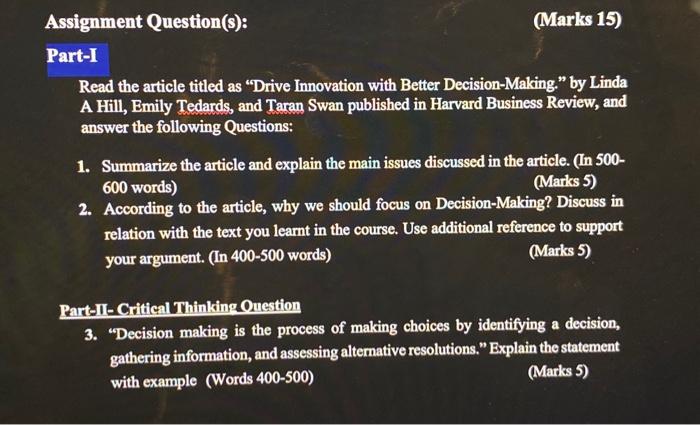
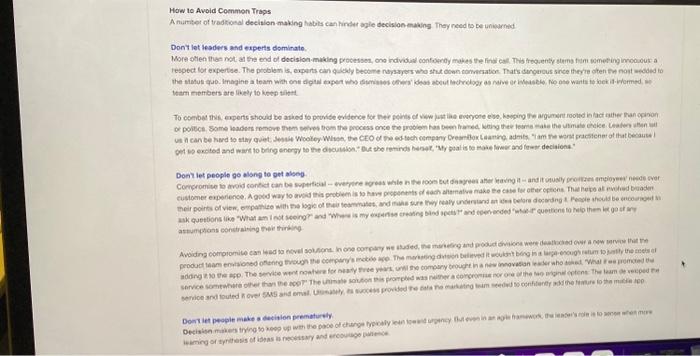
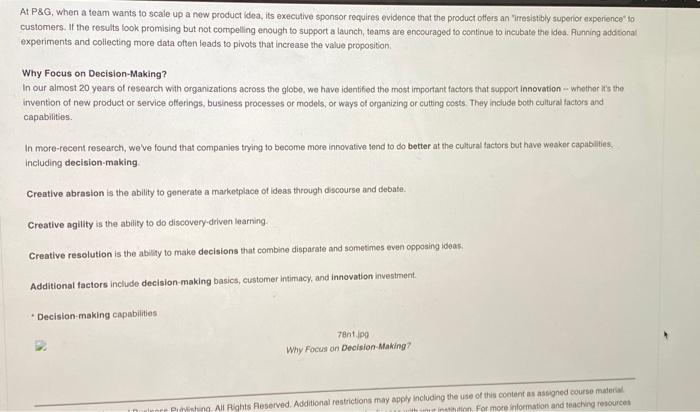
Assignment Question(s): (Marks 15) Part-I Read the article titled as "Drive Innovation with Better Decision-Making." by Linda A Hill, Emily Tedards, and Taran Swan published in Harvard Business Review, and answer the following Questions: 1. Summarize the article and explain the main issues discussed in the article. (In 500600 words) (Marks 5) 2. According to the article, why we should focus on Decision-Making? Discuss in relation with the text you learnt in the course. Use additional reference to support your argument. (In 400-500 words) (Marks 5) Part-1-Critical Thinking_Onestion 3. "Decision making is the process of making choices by identifying a decision, gathering information, and assessing alternative resolutions." Explain the statement with example (Words 400-500) (Marks 5) to thoutands of cinical stes in poet 70 cowthes each you. Domg so atile maintaning cirieal trlal integrify is a complex task ATy potentaly ilesaving treaiments. By 2018, GCS had made sighticart progest with its dotal intracips. But with naw redical and digital technologies on the horizon, Plizer's strategy changed to focus exelusively on breaktheovgh drups and vaseines. GCS needed to become tver moce agle. inncvative. and patient focused so that it coud adagt so mpiad cinical-she and patent needs. Finsngs from a cutural survey, however, undericond that the organizaton was strocoleg fo rake good, timely decislons about systems, processes, and capabaify innovationa. DIVERSE PERSPECTIVES Research has long shown that diverse teams are better at identifying opportunities and risks in any problem-solving situation. But in organizations that are leaming to experiment, four perspectives tend to be underrepresented in decision-making: The customer perspective. It's hardiy a surprise that the customer needs to be at the heart of all decisions, whether theyre about new products, business models, or internal processes. But we find that customer intimacy is all too rare. Because of that, firms end up chasing problems that dont really matter to customers and miss opportunities to address their unarticulated pain points and desires. The solution here is to include in your decision-making processes the people who are most closely connected with end customers: frontine operations statt, customer service employees, salespeople, and the customers themsetves. Organizations that are good at this also tend to work closely wath user experience or user interface teams, ethnographic researchers, or experts in hurnan-centric design. And if you're developing a new business process or a digital fool for employees. remember that their voices need to be heard in this case they are the customers who will use it. To represent the voices of patients in clinical trials and the health care professionais working directly with them. Plizer's GCS unit created a new function, Carical Pesearch. Pharmacy, and recruited pharmacists (who had prior experience administering the treatments) to join it. Over time, the CAP came fo play an integral role in decision-making at GCS. lis pharmacists" insights have led to innovations ranging from user-triend-y package designs to virtual-reality training for health care providers. The local perspective. Too often decisions in global companies are made at headquarters wathout adequatey taking into account perspectives trom different. geographies. Yet pecple at headquarters rarely have the contextual intelligence required to judge which new business modeis, secvices, of operakons are best suited to a local economy and regulatory environment. Getting local input can make a big ditterence. At GCS. strategio decisions, even those that affected reglonal operations, had been made principaly by U.S. teams. But once the unit began deliberately soliciting ideas from local managers, empowering them to innowate, it saw impresshe improvements. For instance, when a new Latin America.based team was nstablished, it used its expertise to cut the time it took to get trial medicines to local health care providers and patients from 55 to 20 days. Even more prevalent is the talkre to transfer local insights back to a business's core processes and products. Often smail divisions in small markets can be qucket and more innovative than their larger counterparts in home markets For example, eBay's successful Buy it Now button, which revolutioniznd e-comnerce and The data-intormed perspective. Especially in yoars like the past one, when the business environment was in constant flux, relying on past exper iunce toryuict innovation etlonts may lead a company astray. Lean methods call for testing ideas and using near-real-time quantitative and qualtative data fo decide next steps. The challenge lies in making that information accessible to every decision-maket, Data visualization provides a solution: It can allow timely, complex information to be interpreted by people from a variety of functional backgrounds. leveling the playing field so that those who are less data savyy can fully engage when making decisions: A GCS, a new digital-business-operations group created visual dashboards that superimposed iniocmation about events such as weather, fight, and shipping route dissuptions over supply chain data to predict risks to operations in real time. These dashboards, which were accessiale to all team members, proved invaluable at the daily "light speed" meetings held to respond to the Covid crisis as it upended supply chains, shut down borders, and overwheimed the hospitals nunning Plizer's clinical trials. GCS teams were able to make critical decisions about the processes for supplying ongoing trials across the globe, including those for the new Covid vaccine candidates and antivirais. Desplte the logistical chalienges brought on by the pandemic and natural disasters from wildires to hurricanes, the organization didnt miss a single delivery to trial patients. The outside perspective. Even the best-intentioned innovators can get mirod in their companies' dominant logic. Leadets of incumbent firms, especially ones that are still growing, albeit slowly, tend to reject bold ideas ideas that present high risk as weil as high reward, require new resources or capabilities, or threaten to cannibalize the core business. An outside view can help organizations contemplate those moves more seriously. That outside view can come from wihin the compary, however. GCS invited high-potential talent from other parts of Plizer to join its leadership team permanently. increasing the group from six to 16 members. Many leaders at oher firms ask less-experienced, recenty hired employens to attend C-sune meetings. Because these people arent steeped in the company's inner workings, they ask questions that challenge core assumptons and heip reframe strategic choices: An outside perspective can also come from beyond the company's walls or even its indusiry. GCS. for example, invited people from Delta Ar Lines' innovation lab to participase in a design workshop on the cinical trial experience for patients. Deltas boarding-pass scanner and bag-tracking capabwities sparked ideas for new Ways that GCS could enhance as own shipment-Aracking capabilitiess, ensuring that more patients got the right dose of the right drug at the right time CLEAR DECISION RIGHTS As they recognize the need to bring togather many points of vow, a iot of oeganizatons are relying more on decentraized networks of cross-tunctional teami, both permanent and ad hoc, to increase their aginy. But this can have a downside: Involing more voices in a decision can mean less clarify about who uitimaiely owne. it, slowing the innovation process and ofien prompting frustration and disengagement. For examplo, when oxocutives at a financial services firm asked their high-potential team leaders to identy and pursue new business modeis, the results were disappointing. Tho leam leaders didnt understand that they'd been ghen the authorily to make decisions themselves and often came back to the execueves and suggested options to choose from, rather than proposing an intended plan of action. The team leaders also had a miced experience, At first they were honored and Energized by being selected fot an innovative project. But later they became discouraged by the disconcect between their reccmmendations and the docisions of the executves + who'd falen buck inta theirhabit of calling the shots - and ulimately, by the ambiguity about decision-making rights: To elfectively enpower decision-makers, leaders must be explicit in every case about who will be respons ble for exectaing the decision. who wil be accouratile for making it, who will be consulted, and who will be informed. (Creafing and sharing a tradional RACt chart can do the trick here.) if leaders are delegating decisions to a group, they should specify the process to be used and the parameters of the group's authonity for evecyone involved. GCS transterred ownership of the imvestigatwe drug supply from a single leader to cross-functional teams of four knoien as "letrads." Each tetrad tecame responsible for one therapeuts area. The members were collectively accountable for decisions, and they had clear guidelines about when they should escalara a decision to the terrad's expcutive sponsors. It look some months for everyone involved to teel confident about the new struclure and to tefine the guidelnes. but uitimately the tetrads helped GCS kill less-premising ideas faster, without having to push those cheices up to senior leadecthp. Wits their enterprisewide view, the teams were also able to begin proposing more-innovative ideas for optimizing the whole clincal supply chain, buct as hon fo pieneer deivery of highy personal zed gone-therapy drugs. THE RIGHT CADENCE Established companies fend to mave innovation decisions on a foed schedule, through quaferly or anmai revewt at which seniot leans step back assess past pians, and make new ones. But in agle companies, innovation is based on discovery-driven laarring Wth esch expeimenc, data and iasights energe that ahouid bo taken into consideration in soiting up the next one. Lesders rivist encourage decisione to be made at a pace algned win the leaming cycie. To gauge the right cadence for your meetings, think about how long it will eave bo-gather enough data to valicate (or deprovo) your hypotheses. It youre leaning quckly or contronting rapid change, you may need to male decisions more trequently During the psndemic, for exarele, mest leaderthip feame at corpanies we obsefved naturaby increased the cadence of medings. Given the untoling nafure of the crisis, every decision had 10 be conildereg a "sorking tivpothesis," so But longer timelines can still be needed to create the space necessary for coliaboration and information gathering, espocially if youre contemplating big bets. When Kathy Fish, P8G's former chief research, development, and innovation ofticer, introduced the lean start-up model to her organization, the business units supplemented their annual planning processes with a review of innovation portfolios every 90 days in order to issue metered funding to the initiatives in them. That gave teams enough time to conduct experiments and consolidate findings while preserving their momentum. GOOD FIGHTS Inviting diverse sets of participants to well-timed decision-making forums doesn't automatically lead to the thorough vetting of ideas. This is where so mary organizations got stucki They fall to create a compotitive marketplace of ideas, where genuine debate increases the odds that risks are identffied and the mostpromising projects are pursued. In some dystunctional teams, productive discourse is stymied by political infighting, defonsive behavior, or hidden agondas. Ceitiques of ideas often become critiques of personaities, and employees dont trust that their idoas will be taken seriously. Often any real conversations and decisions happen "outaide the room." so members of the group feel disontranchised even though theyve been asked to participate. Yot an even more common cause of unproductive debate is a culture of politeness. Many poople try to minimize differences as cpposed to arrplitying them, in an offort to avoid conflict. The effect is that those with minority views dont speak up or compromise too quicky when theyre chalknged. As a resut bossos of experts tend to dominate the decialon-making process no matior how diverse the assembled group is. in both kinas of situations, leaders must stop worying about whether peoplo can collaborate and instead worry about whether they know how to argue. Leaders can encourage the psychological sately that promotos good fight in three ways: Ask questions. Leaders need to avoid shitting down the convernation with solutions trom the outset. Instead, they shouid be transparent about what they don? know. A P8G (which has also hired Ha as an adviset in the past), leaden are encouraged to ask these four quastons in response to every experiment. What did you learn? How do you know? What do you need to loarn next? How can I help? By demonstrating that they dont have an the answers, leacers hels ser the expectabien that all present shouid share their opinions and that anyone can be wrong. They also create an emirorment in which peopla feei more combriable challenging one another. At Pizer, team rembers were initialy resuctant to disagree with vice president Michael Ku whon he became the head of GCS. But as he leamed to admit what he Focus on the data. Data can provide a solid foundation for productive debate. Team members who have the same data visualizations in front of them aro likelier to develop a shared understanding of problems common ground on which they can add their unique perspectives. Ku ensured that al decisions made at GCS's monthly operational review were informed by data. When things had to move quickly during Covid, this kept the team from making cholces based on emotion or past experiences that were no longer relevant. Articulate a shared purpose. Aligning the whole organization around a common, meaningful purpose (why we exist and whom we serve) gives pecple permission to fight about now ideas, bocause they all agree about what they're fighting for, Ideally the purpose will serve as a tramework that ensures that decisions benefit the end user or customer. A shared ambition can keep debates from getting personal. At one retail company we studied, a team created avatars for key customer segments. "Ali" was the avatar for urban Millennials, for instance. Whenever a discussion started to get more personal than substantive. someone would intervene and ask, "What does Ali need from us alt right now? That encouraged the team to focus on a joint concern for customers instead of doscending into- a winner-takes-all argument: A purpose can also encourage criticism rather than silent politeness. A real challenge in companies learning to be agle is killing "walking zombies" - projects without enough value to justity their continuation. To meet it, leaders should remind teams of their purpose. When Ku first took the reins at GCS, most people were reluctant to criticize others' ideas. Decisionmakers interpreted silence as agreement that an idea was worth pursuing. so the number of projects underway became overwheiming. Ku's tirst priority was to align the entire toam around a shared purpose: "Patients First." In debates about which initiatives to pursue, people learned to ask. "Is that the best solution for the patient? rather than staying silent. The team soon found itself rejecting more ideas and able to focus more effort on those that enhanced the patient experience. A common purpose heips decision-makers focus on solving problems rather than fulilling personal agendas. In the midst of Covid, while everyone was woeking 24/7, Ku observed with pride that leaders in GCS were advocating for deciaions that were in the best interests of the patient even when doing so meant more work for their own functional areas: LEADERSHIP MATTERS Organizations and teams must adopt now behaviors to make informed decislons more quichly, but managers need to change, too. Too many leaders act unilaterally, swooping in to save the day with the "right" answers - especially during a crisis. But when innovation is called for, leaders need to create envitonments In which their people can find answers on their own. it takes courage and practice to step back and let othere make decisions and especially to avoid taking the bait When teams naturally try to delegate up the chain. But until you adopt this new way of working yourselt, your organization will never be as innovative as it could be. THE PAOBLEM Despite their embrace of agile and lean methodologios, many organizations looking to become more innovative are st:il atruggling to move quickly on new ideas. That's often because of their outdated, inefficient approach to decision-making. THE RESEARCH Over the past two decades the authors have worked with innovalive companios across the globe, most rocently focusing on incumbent firris that were transforming themselves into nimbler businesses, to leam what key challengos they faced and how they addressed them. THE SOLUTION Businesses need to strengthen and speed up their creative decisionmaking processes by including diverse perspectives, clarifying decision rights, matching the cadence of deciaions to the pace of loaming, and encouraging candid, robust oonflict in sarvice of a better experience for the end customer, Ony then will all that rapid exporimentation pay off. How to Avold Coenmon Traps Dony let leadees and experts dominate. Wam methoers are like? 10 keto tilest. Don' let people go alsng to ont asen. attumptons condrairing Fiekt tiriting. Doar iet people meke a detition prematureify. At P\&G, when a team wants to scale up a now product idea, its executive sponsor requires evidence that the product otfers an "irresistbly superior axperience" to customers. If the results fook promising but not compelling enough to support a taunch, teams are encouraged to continue to incubate the idea. Aunning addtonal experiments and collecting more data often leads to pivots that increase the value proposition: Why Focus on Decision-Making? In our almost 20 years of research with organizations across the globe, we have identified tho most important factors that support innovation - whother its the invention of new product or service offerings, business processes or modets, or ways of organizing or cutting costs. They include both cultural lactors and capabilities. In more-recent research, we've found that companies trying to become more innowative tond to do better at the cultural tactors but have weaker capabilies. including decision-making Creative abrasion is the ability to generate a markepplace of ideas through diecourse and sebate. Creative agility is the ability to do discovery-driven learning. Creative resolution is the ability to make decisions that combine disparate and sometimes even opposing ideas: Additional factors include decision-making basics, customer intimacy, and innovation investment. - Decision-making capabilities 7 7ent.jpg Why Focus on Decision-Making









 Study Help