Question: The following conversation will be used to answer questions 7, 8 & 9: MAUREEN: How did your meeting go with Mr. Devon yesterday? LANCE: Well,
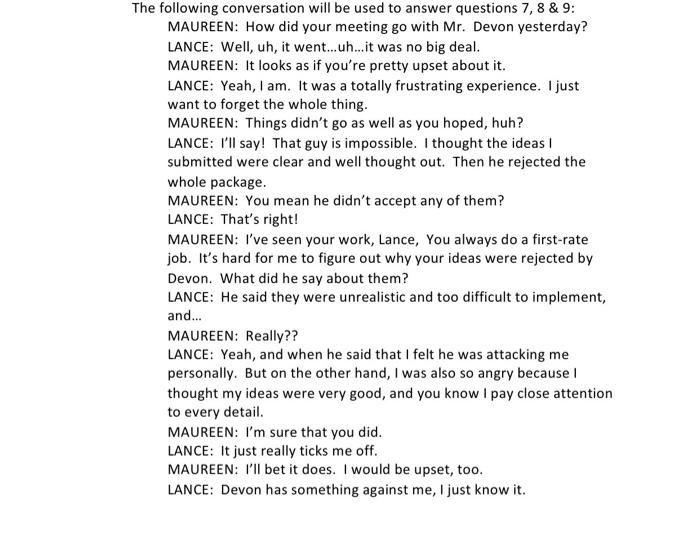
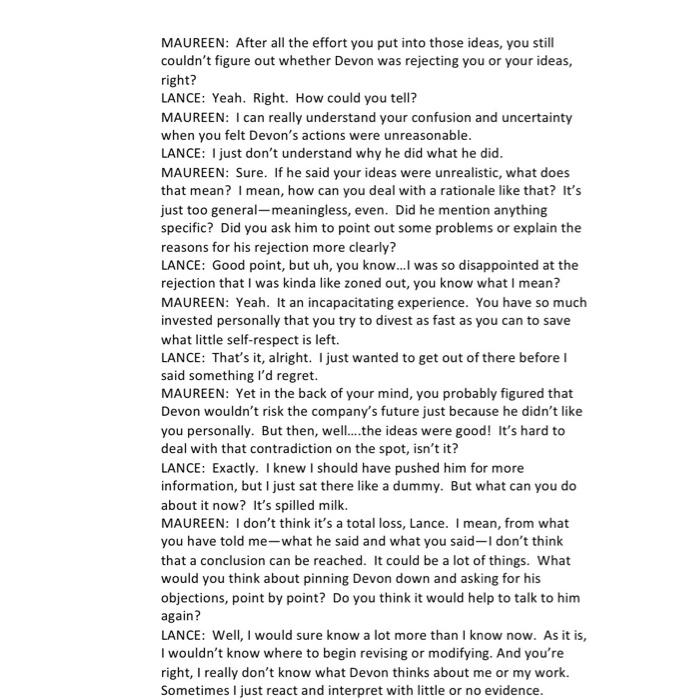
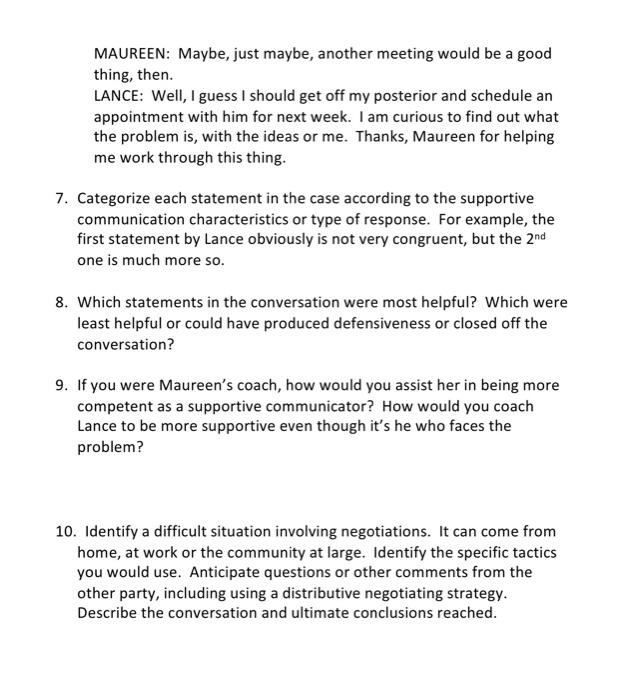
The following conversation will be used to answer questions 7, 8 & 9: MAUREEN: How did your meeting go with Mr. Devon yesterday? LANCE: Well, uh, it went...uh...it was no big deal. MAUREEN: It looks as if you're pretty upset about it. LANCE: Yeah, I am. It was a totally frustrating experience. I just want to forget the whole thing. MAUREEN: Things didn't go as well as you hoped, huh? LANCE: I'll say! That guy is impossible. I thought the ideas! submitted were clear and well thought out. Then he rejected the whole package. MAUREEN: You mean he didn't accept any of them? LANCE: That's right! MAUREEN: I've seen your work, Lance, You always do a first-rate job. It's hard for me to figure out why your ideas were rejected by Devon. What did he say about them? LANCE: He said they were unrealistic and too difficult to implement, and... MAUREEN: Really?? LANCE: Yeah, and when he said that I felt he was attacking me personally. But on the other hand, I was also so angry because I thought my ideas were very good, and you know I pay close attention to every detail. MAUREEN: I'm sure that you did. LANCE: It just really ticks me off. MAUREEN: I'll bet it does. I would be upset, too. LANCE: Devon has something against me, I just know it. MAUREEN: After all the effort you put into those ideas, you still couldn't figure out whether Devon was rejecting you or your ideas, right? LANCE: Yeah. Right. How could you tell? MAUREEN: I can really understand your confusion and uncertainty when you felt Devon's actions were unreasonable. LANCE: I just don't understand why he did what he did. MAUREEN: Sure. If he said your ideas were unrealistic, what does that mean? I mean, how can you deal with a rationale like that? It's just too general-meaningless, even. Did he mention anything specific? Did you ask him to point out some problems or explain the reasons for his rejection more clearly? LANCE: Good point, but uh, you know...I was so disappointed at the rejection that I was kinda like zoned out, you know what I mean? MAUREEN: Yeah. It an incapacitating experience. You have so much invested personally that you try to divest as fast as you can to save what little self-respect is left. LANCE: That's it, alright. I just wanted to get out of there before ! said something I'd regret. MAUREEN: Yet in the back of your mind, you probably figured that Devon wouldn't risk the company's future just because he didn't like you personally. But then, well...the ideas were good! It's hard to deal with that contradiction on the spot, isn't it? LANCE: Exactly. I knew I should have pushed him for more information, but I just sat there like a dummy. But what can you do about it now? It's spilled milk. MAUREEN: I don't think it's a total loss, Lance. I mean, from what you have told me-what he said and what you said I don't think that a conclusion can be reached. It could be a lot of things. What would you think about pinning Devon down and asking for his objections, point by point? Do you think it would help to talk to him again? LANCE: Well, I would sure know a lot more than I know now. As it is, I wouldn't know where to begin revising or modifying. And you're right, I really don't know what Devon thinks about me or my work. Sometimes I just react and interpret with little or no evidence. MAUREEN: Maybe, just maybe, another meeting would be a good thing, then. LANCE: Well, I guess I should get off my posterior and schedule an appointment with him for next week. I am curious to find out what the problem is, with the ideas or me. Thanks, Maureen for helping me work through this thing. 7. Categorize each statement in the case according to the supportive communication characteristics or type of response. For example, the first statement by Lance obviously is not very congruent, but the 2nd one is much more so. 8. Which statements in the conversation were most helpful? Which were least helpful or could have produced defensiveness or closed off the conversation? 9. If you were Maureen's coach, how would you assist her in being more competent as a supportive communicator? How would you coach Lance to be more supportive even though it's he who faces the problem? 10. Identify a difficult situation involving negotiations. It can come from home, at work or the community at large. Identify the specific tactics you would use. Anticipate questions or other comments from the other party, including using a distributive negotiating strategy. Describe the conversation and ultimate conclusions reached