







Question: The P-an incentive for a two-followed test dependent on a similar example would be P=0.084 b) The P-an incentive for a left-followed test dependent on
The P-an incentive for a two-followed test dependent on a similar example would be P=0.084
b) The P-an incentive for a left-followed test dependent on a similar example would be P=-0.042
c) The z-score test measurement is roughly z=1.73
d) We would dismiss H0 at "=0.05, however not at "=0.01
e) We would dismiss H0 at "=0.1, however not at "=0.04
33. To look at the normal measure of time that Canadians and Americans spend driving, a
scientist gathers an example of 50 Canadians and 60 Americans. The Canadians spend an
normal of 4.6 hours seven days driving, with standard deviation 2.9 hours. The mean and
standard deviation for the example of Americans is 5.2 hours and 1.3 hours, separately.
The standard mistake of the distinction of test implies is
a) 2.314
b) 1.023
c) 0.443
d) 0.196
e) Cannot be processed as the example sizes are unique.
34. Which of the accompanying assertions about theory tests is INCORRECT?
a) H0 should consistently incorporate equity.
b) In a one-followed test, H1 includes either ">" or "
c) If the test measurement lies in the dismissal locale, we reject the case.
d) The case can be either H0 or H1.
e) The basic worth shows the beginning of the dismissal area.
35. A specialist wishes to look at the extent of people who casted a ballot in the last
government political decision. Which of the accompanying end couldn't be drawn as the consequence of
any speculation test. "At the given degree of importance, we have evidence..."
a) "... that the extent of men who casted a ballot is bigger than the extent of ladies who
casted a ballot."
b) "... that the extent of men who casted a ballot contrasts from the extent of ladies who
casted a ballot."
c) "... that the extent of men who casted a ballot doesn't contrast from the extent of ladies
who casted a ballot."
d) "... that the extent of men who casted a ballot is more modest than the extent of ladies who
casted a ballot."
e) None of the abovementioned (every assertion a-d is a potential end).


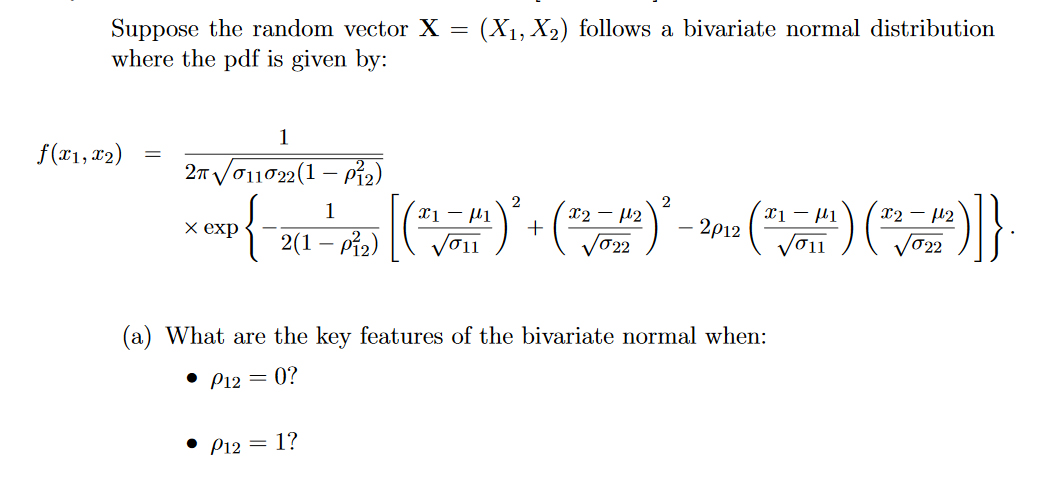
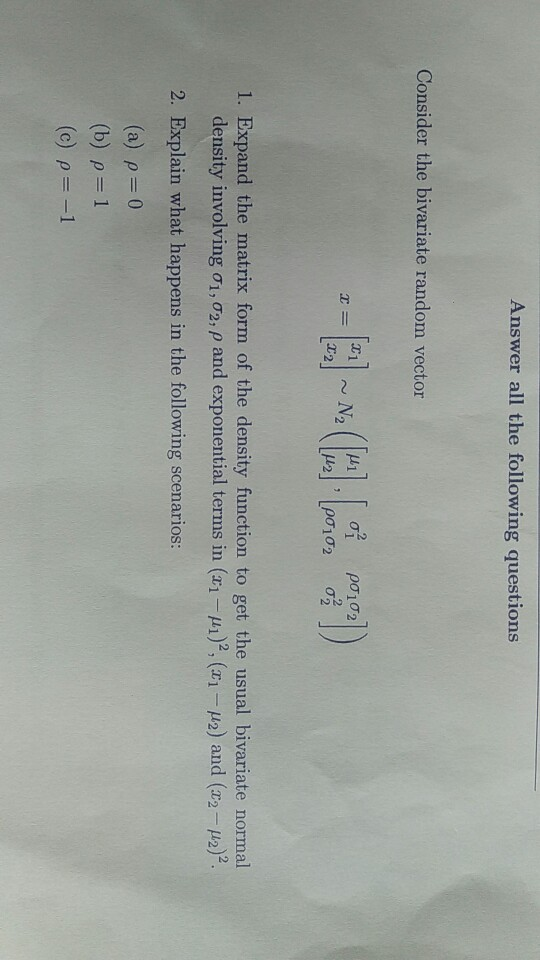
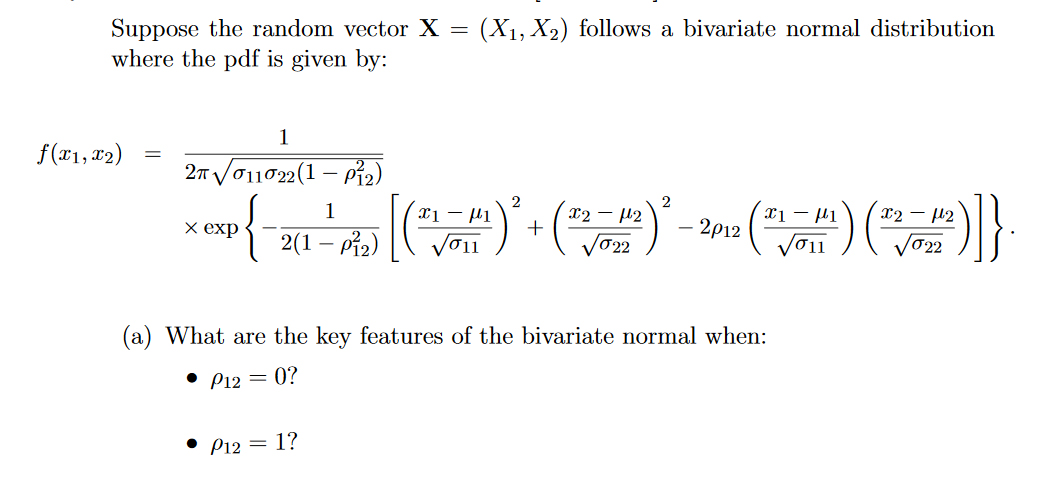
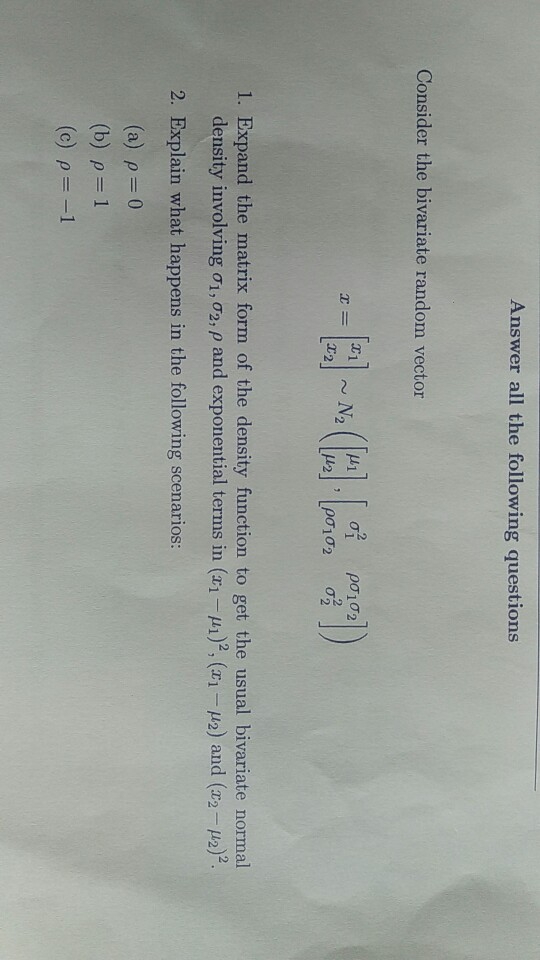
Question 3: [10 Marks] For STAT2001 Students Let the joint probability density function of random variables X and Y be bivariate normal. Show that X and Y are independent if and only if they are uncorrelated. Is this result true if X and Y are not necessarily bivariate normal? Justify your answer by appropriate reasoning.4.10 Suppose you are given random variables x and y such that I ~ Nut 63) Nb\" '\" Nbn +1313\": 0'2} so you have the marginal distribution of x and the conditional distribution of y given 3:. The joint distribution of (x, y) is bivariate normal. Find the 5 parameters \"'1'\"? \"3* \"i919 of the bivariate normal. Suppose the random vector X = (X1, X2) follows a bivariate normal distribution where the pdf is given by: f(x1, 12) = 27 011022 (1 - P12) 2 2 1 22 - /2 x exp + - 2p12 2(1 - P12) /011 1022 011 022 (a) What are the key features of the bivariate normal when: . P12 = 0? . P12 = 1?Answer all the following questions Consider the bivariate random vector 1. Expand the matrix form of the density function to get the usual bivariate normal density involving 01, 02, p and exponential terms in (21 - (1)2, (11 -(2) and (12 -(2)2. 2. Explain what happens in the following scenarios: (a) p=0 (b) p = 1 (c) p= -1
Step by Step Solution
There are 3 Steps involved in it

Get step-by-step solutions from verified subject matter experts
 Study Help