







Question: The pencil Problem: Predict mass combinations that place the center of mass in a desired location for a three-object system. 1. Your rst task is
The pencil Problem:
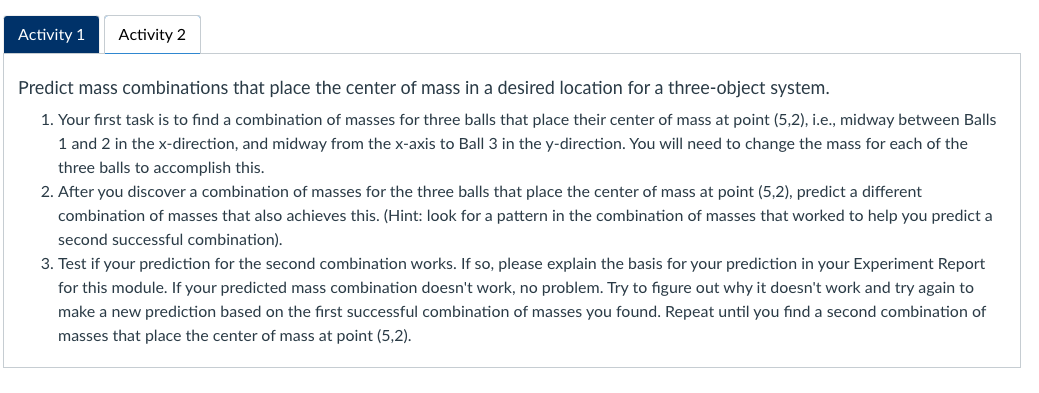
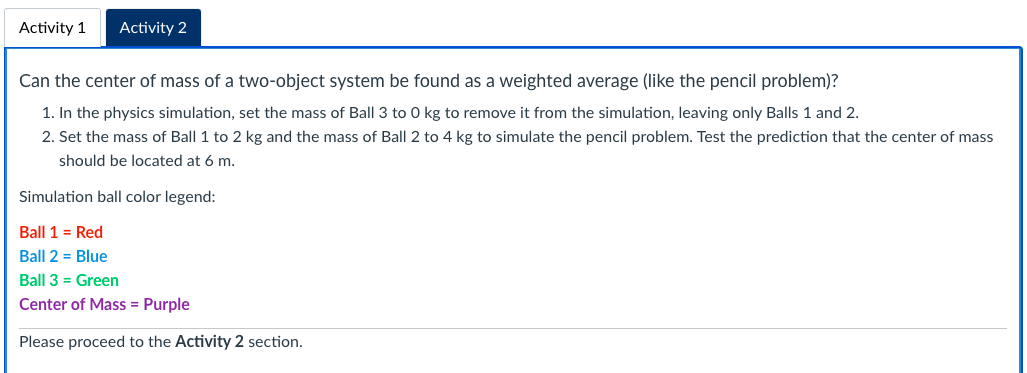
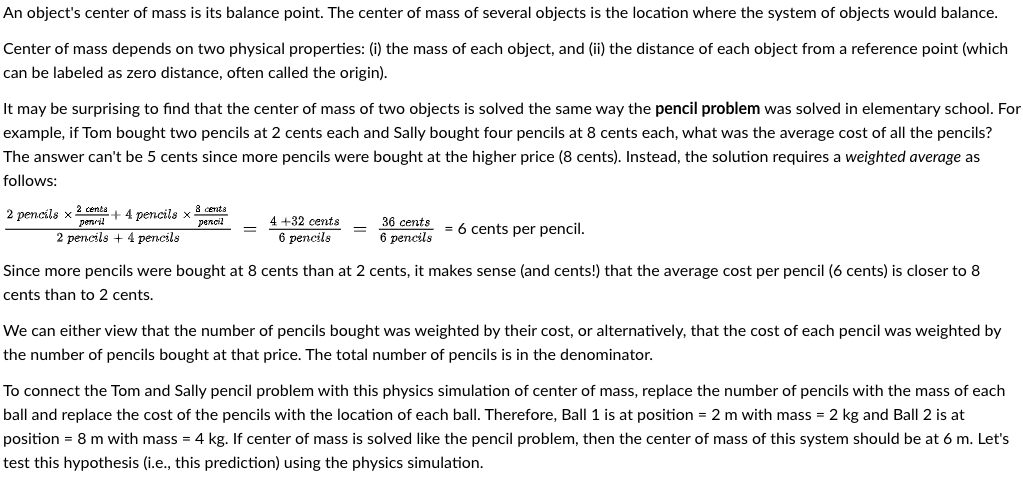
Predict mass combinations that place the center of mass in a desired location for a three-object system. 1. Your rst task is to nd a combination of masses for three balls that place their center of mass at point {5,2}, i.e., midway between Balls 1 and 2 in the x-direction. and midway from the x-axis to Ball 3 in the y-direction. You will need to change the mass for each of the three balls to accomplish this. 2. After you discover a combination of masses for the three balls that place the center of mass at point {5.2}. predict a different combination of masses that also achieves this. (Hint: look for a pattern in the combination of masses that worked to help you predict a second successful combination]. 3. Test if your prediction for the second combination works. If so, please explain the basis for your prediction in your Experiment Report for this module. If your predicted mass combination doesn't work, no problem. Try to gure out why it doesn't work and try again to make a new prediction based on the rst successful combination of masses you found. Repeat until you nd a second combination of masses that place the center of mass at point {5,2}. Activity 1 Can the center of mass of a two-object system be found as a weighted average [like the pencil problem]? 1. In the physics simulation, set the mass of Ball 3 to 0 kg to remove it from the simulation, leaving only Balls 1 and 2. 2. Set the mass of Ball 1 to 2 kg and the mass of Ball 2 to 4 kg to simulate the pencil problem. Test the prediction that the center of mass should be located at 6 m. Simulation ball color legend: Ball 1 = Red Ball 2 = Blue Ball 3 = Green Center of Mass = Purple Please proceed to the Activity 2 section. An object's center of mass is its balance point. The center of mass of several objects is the location where the system of objects would balance. Center of mass depends on two physical properties: til the mass of each object, and iii] the distance of each object from a reference point [which can be labeled as zero distance, often called the origin]. It may be surprising to nd that the center of mass of two objects is solved the same way the pencil problem was solved in elementary school. For example, if Torn bought two pencils at 2 cents each and Sally bought four pencils at 3 cents each, what was the average cost of all the pencils? The answer can't be 5 cents since more pencils were bought at the higher price (8 cents]. Instead, the solution requires a weighted average as follows: . 2 males . S m Spa-nests x wild! + 4315mm x was = 4+32 cents = 36 cents = 6 cents er encil 2Wla+4pencla pencs'ls Gm p p ' Sinoe more pencils were bought at 8 cents than at 2 cents, it makes sense [and cents!) that the average cost per pencil (6 cents] is closer to 3 cents than to 2 cents. We can either view that the number of pencils bought was weighted by their cost. or alternatively. that the cost of each pencil was weighted by the number of pencils bought at that price. The total number of pencils is in the denominator. To connect the Tom and Sally pencil problem with this physics simulation of center of mass, replace the number of pencils with the mass of each ball and replace the cost of the pencils with the location of each ball. Therefore, Ball 1 is at position = 2 m with mass = 2 kg and Ball 2 is at position = B m with mass = 4 kg. If center of mass is solved like the pencil problem, then the center of mass of this system should be at 6 m. Let's test this hypothesis [i.e., this prediction] using the physics simulation
Step by Step Solution
There are 3 Steps involved in it

Get step-by-step solutions from verified subject matter experts
 Study Help