







Question: the strain gauge B is NOT in same direction to force F, rather it is perpendicular to force F (transversal strain), so you have longitudinal
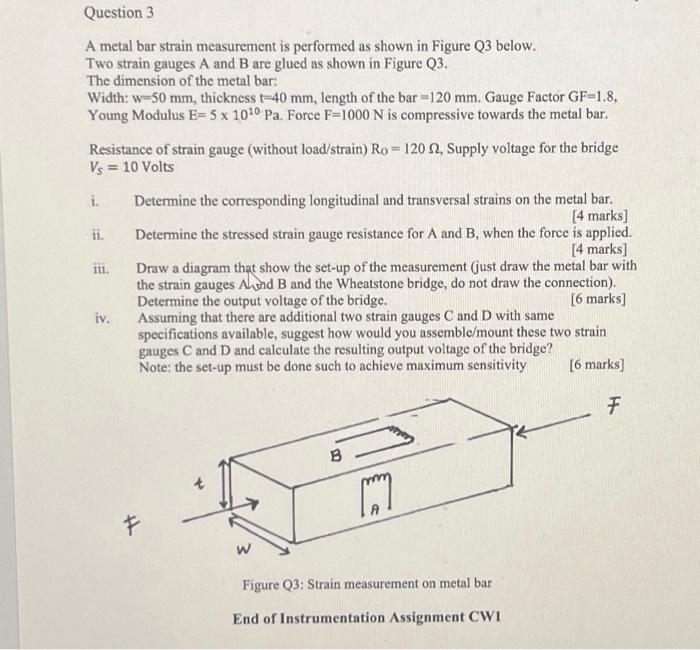
A metal bar strain measurement is performed as shown in Figure Q3 below. Two strain gauges A and B are glued as shown in Figure Q3. The dimension of the metal bar: Width: w=50mm, thickness t=40mm, length of the bar =120mm. Gauge Factor GF=1.8, Young Modulus E=51010Pa. Force F=1000N is compressive towards the metal bar. Resistance of strain gauge (without load/strain) R0=120, Supply voltage for the bridge VS=10 Volts i. Determine the corresponding longitudinal and transversal strains on the metal bar. [4 marks] ii. Determine the stressed strain gauge resistance for A and B, when the force is applied. [4 marks] iii. Draw a diagram that show the set-up of the measurement (just draw the metal bar with the strain gauges A ind B and the Wheatstone bridge, do not draw the connection). Determine the output voltage of the bridge. [6 marks] iv. Assuming that there are additional two strain gauges C and D with same specifications available, suggest how would you assemble/mount these two strain gauges C and D and calculate the resulting output voltage of the bridge? Note: the set-up must be done such to achieve maximum sensitivity [6 marks] Figure Q3: Strain measurement on metal bar End of Instrumentation Assignment CW1
Step by Step Solution
There are 3 Steps involved in it

Get step-by-step solutions from verified subject matter experts
 Study Help