







Question: There is a water system, with 2 lakes and 7 rivers, that is polluted with two non- conservative pollutants, Pollutants A and B. Pollutant A
There is a water system, with 2 lakes and 7 rivers, that is polluted with two non- conservative pollutants, Pollutants A and B. Pollutant A has a first order decay rate of 0.02 s-1, determine the first order decay rate of Pollutant B.... (see image for full question).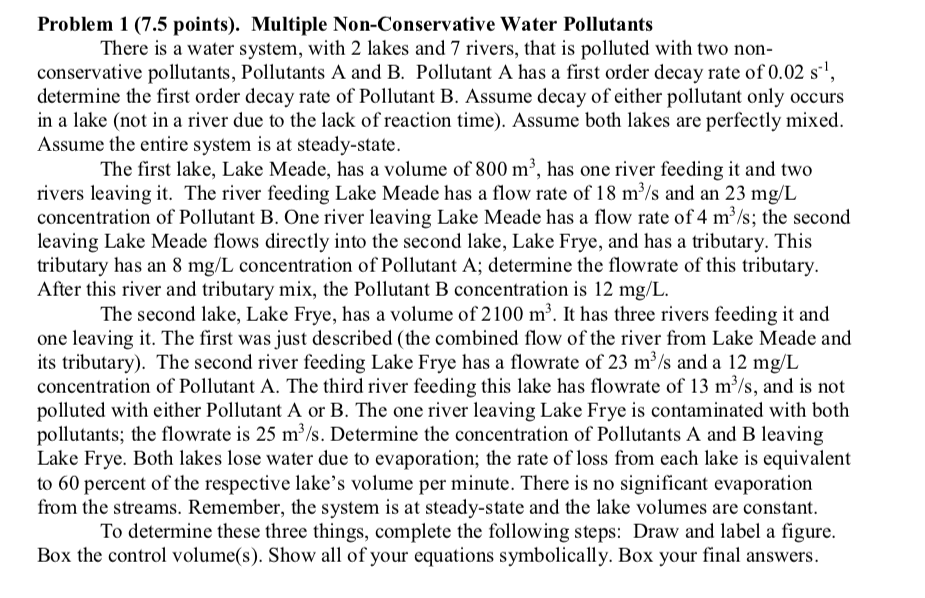
Problem 1 (7.5 points). Multiple Non-Conservative Water Pollutants There is a water system, with 2 lakes and 7 rivers, that is polluted with two non- conservative pollutants, Pollutants A and B. Pollutant A has a first order decay rate of 0.02 s1 determine the first order decay rate of Pollutant B. Assume decay of either pollutant only occurs in a lake (not in a river due to the lack of reaction time). Assume both lakes are perfectly mixed Assume the entire system is at steady-state. The first lake, Lake Meade, has a volume of 800 m3, has one river feeding it and two rivers leaving it. The river feeding Lake Meade has a flow rate of 18 m'/s and an 23 mg/L concentration of Pollutant B. One river leaving Lake Meade has a flow rate of 4 m3/s; the second leaving Lake Meade flows directly into the second lake, Lake Frye, and has a tributary. This tributary has an 8 mg/L concentration of Pollutant A; determine the flowrate of this tributary After this river and tributary mix, the Pollutant B concentration is 12 mg/L. The second lake, Lake Frye, has a volume of 2100 m3. It has three rivers feeding it and one leaving it. The first was just described (the combined flow of the river from Lake Meade and its tributary). The second river feeding Lake Frye has a flowrate of 23 m/s and a 12 mg/L concentration of Pollutant A. The third river feeding this lake has flowrate of 13 m'/s, and is not polluted with either Pollutant A or B. The one river leaving Lake Frye is contaminated with both pollutants; the flowrate is 25 m'/s. Determine the concentration of Pollutants A and B leaving Lake Frye. Both lakes lose water due to evaporation; the rate of loss from each lake is equivalent to 60 percent of the respective lake's volume per minute. There is no significant evaporation from the streams. Remember, the system is at steady-state and the lake volumes are constant. To determine these three things, complete the following steps: Draw and label a figure. Box the control volume(s). Show all of your equations symbolically. Box your final answers. Problem 1 (7.5 points). Multiple Non-Conservative Water Pollutants There is a water system, with 2 lakes and 7 rivers, that is polluted with two non- conservative pollutants, Pollutants A and B. Pollutant A has a first order decay rate of 0.02 s1 determine the first order decay rate of Pollutant B. Assume decay of either pollutant only occurs in a lake (not in a river due to the lack of reaction time). Assume both lakes are perfectly mixed Assume the entire system is at steady-state. The first lake, Lake Meade, has a volume of 800 m3, has one river feeding it and two rivers leaving it. The river feeding Lake Meade has a flow rate of 18 m'/s and an 23 mg/L concentration of Pollutant B. One river leaving Lake Meade has a flow rate of 4 m3/s; the second leaving Lake Meade flows directly into the second lake, Lake Frye, and has a tributary. This tributary has an 8 mg/L concentration of Pollutant A; determine the flowrate of this tributary After this river and tributary mix, the Pollutant B concentration is 12 mg/L. The second lake, Lake Frye, has a volume of 2100 m3. It has three rivers feeding it and one leaving it. The first was just described (the combined flow of the river from Lake Meade and its tributary). The second river feeding Lake Frye has a flowrate of 23 m/s and a 12 mg/L concentration of Pollutant A. The third river feeding this lake has flowrate of 13 m'/s, and is not polluted with either Pollutant A or B. The one river leaving Lake Frye is contaminated with both pollutants; the flowrate is 25 m'/s. Determine the concentration of Pollutants A and B leaving Lake Frye. Both lakes lose water due to evaporation; the rate of loss from each lake is equivalent to 60 percent of the respective lake's volume per minute. There is no significant evaporation from the streams. Remember, the system is at steady-state and the lake volumes are constant. To determine these three things, complete the following steps: Draw and label a figure. Box the control volume(s). Show all of your equations symbolically. Box your final answers
Step by Step Solution
There are 3 Steps involved in it

Get step-by-step solutions from verified subject matter experts
 Study Help