







Question: This question calls for a straightforward application of definitions introduced in the Week 6 lecture. Consider the MDP shown in the figure below. It
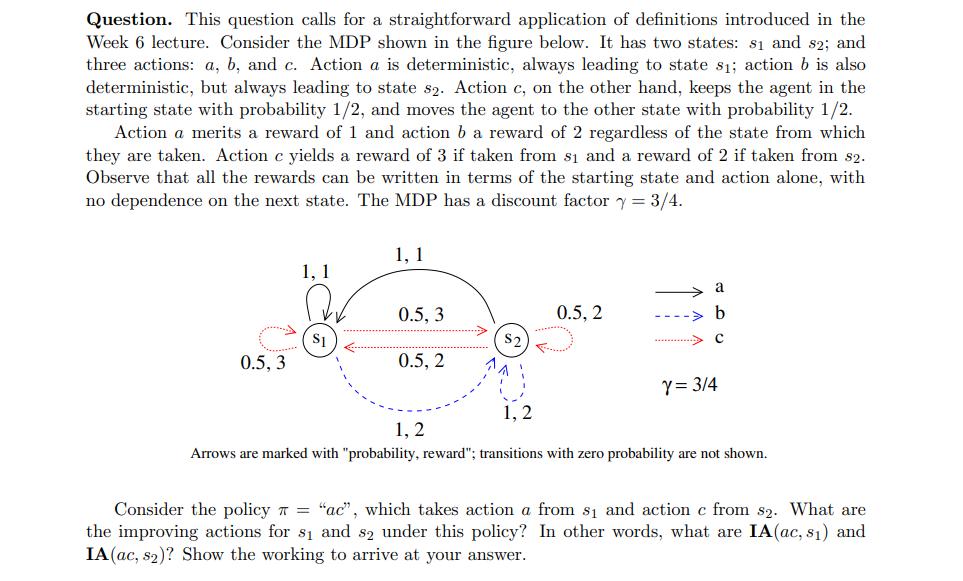
This question calls for a straightforward application of definitions introduced in the Week 6 lecture. Consider the MDP shown in the figure below. It has two states: s1 and s2; and three actions: a, b, and c. Action a is deterministic, always leading to state s; action b is also deterministic, but always leading to state s2. Action c, on the other hand, keeps the agent in the starting state with probability 1/2, and moves the agent to the other state with probability 1/2. Action a merits a reward of 1 and action b a reward of 2 regardless of the state from which they are taken. Action c yields a reward of 3 if taken from s and a reward of 2 if taken from 82. Observe that all the rewards can be written in terms of the starting state and action alone, with no dependence on the next state. The MDP has a discount factor y = 3/4. 0.5, 3 1, 1 S1 1, 1 0.5, 3 0.5, 2 $2 1, 2 0.5, 2 a b C Y = 3/4 1, 2 Arrows are marked with "probability, reward"; transitions with zero probability are not shown. Consider the policy = "ac", which takes action a from s and action c from s2. What are the improving actions for s and 82 under this policy? In other words, what are IA(ac, s) and IA (ac, s2)? Show the working to arrive at your answer.
Step by Step Solution
3.47 Rating (167 Votes )
There are 3 Steps involved in it
The detailed ... View full answer

Get step-by-step solutions from verified subject matter experts
 Study Help