







Question: This question contains multiple parts. Make sure to read all the instructions and answer each part. A bow slides across a violin string that has
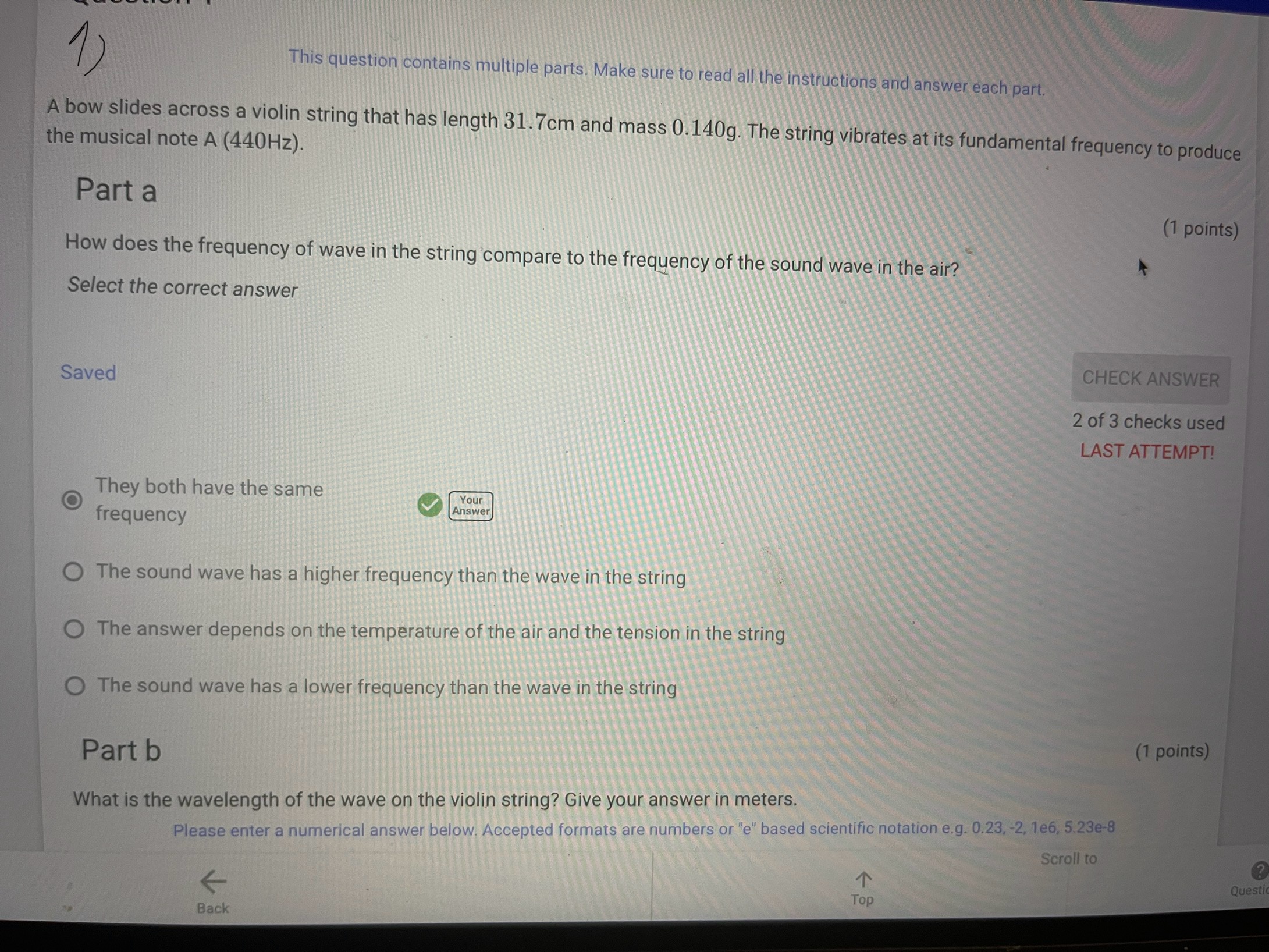
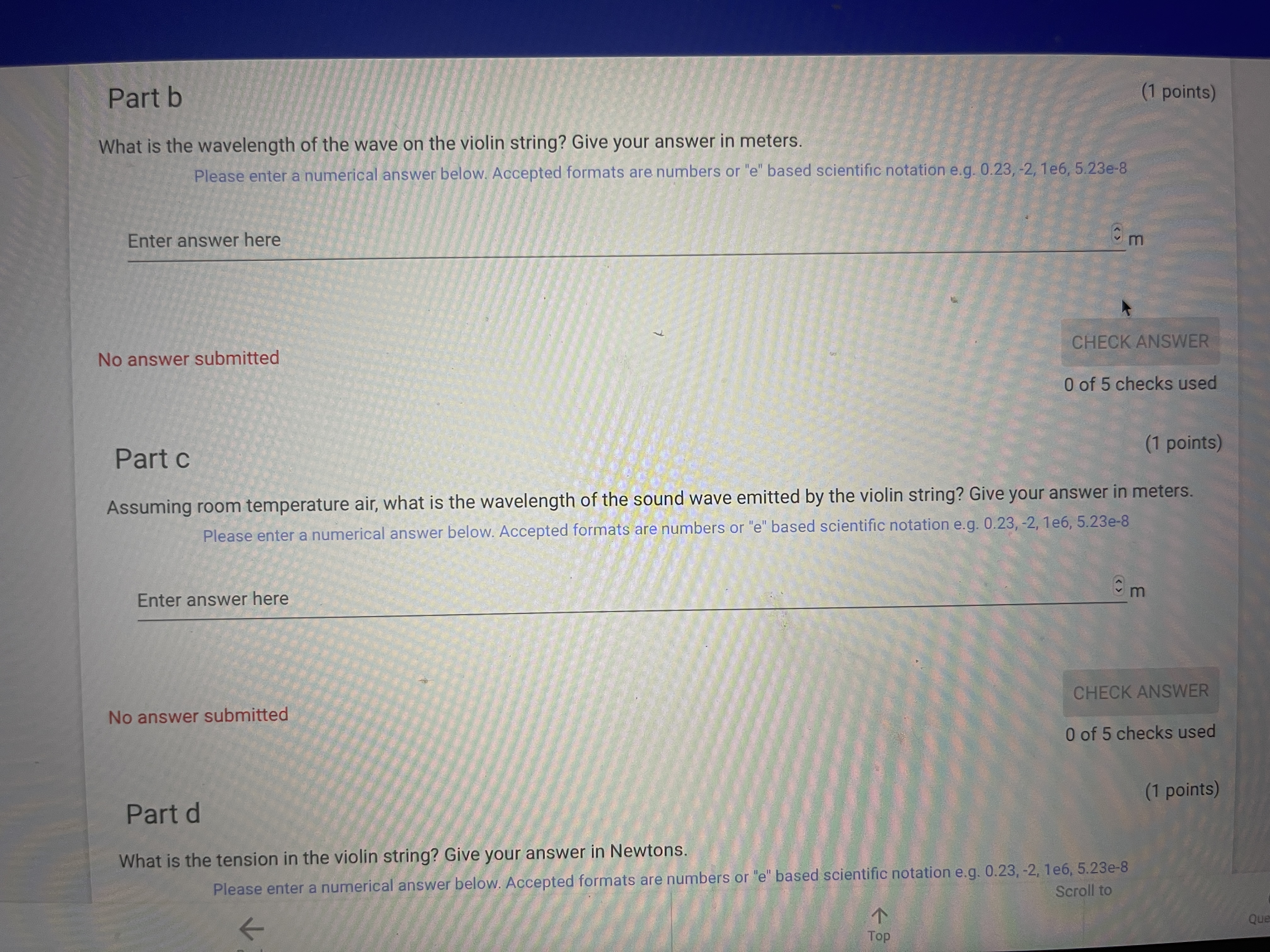
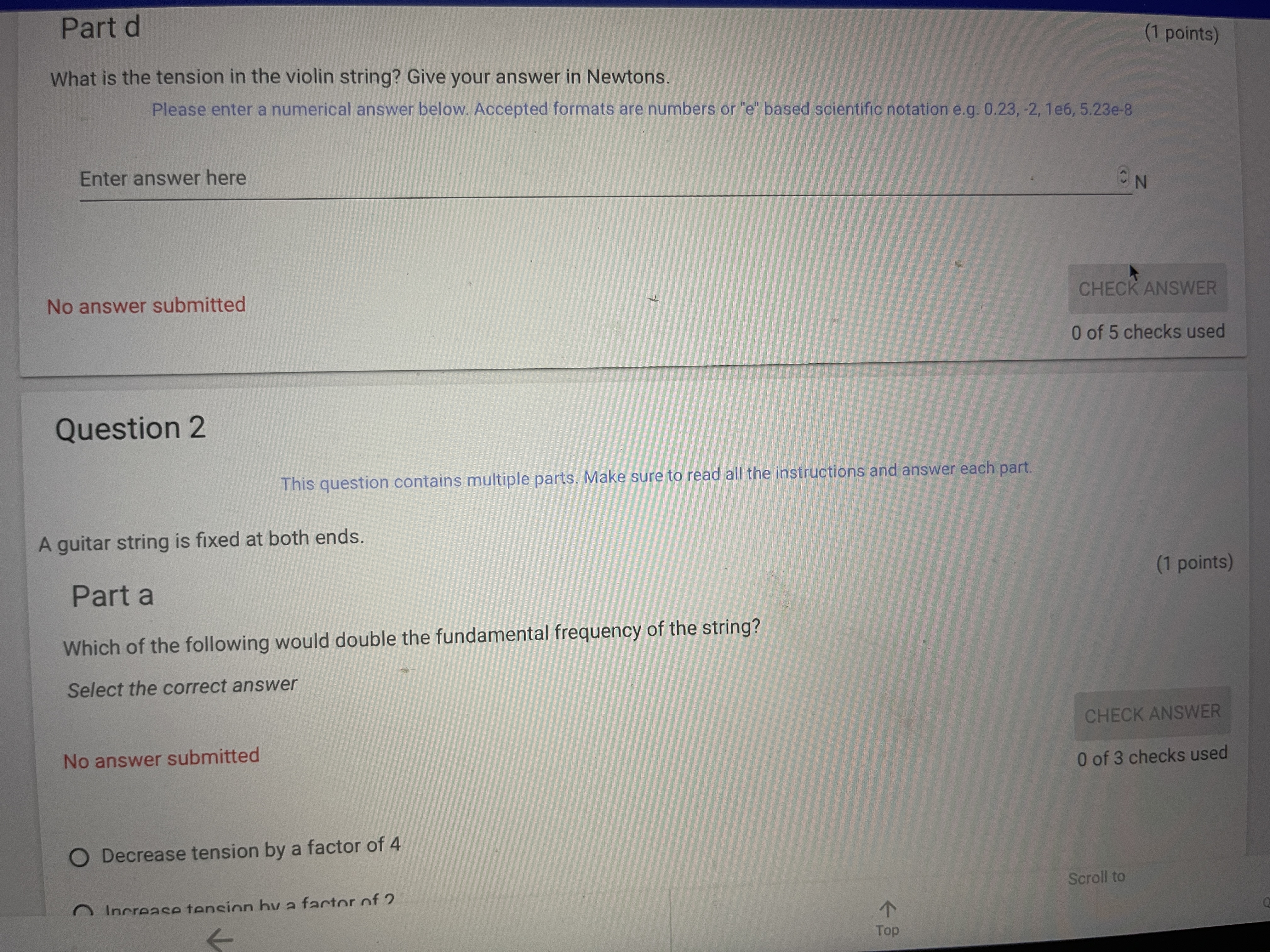
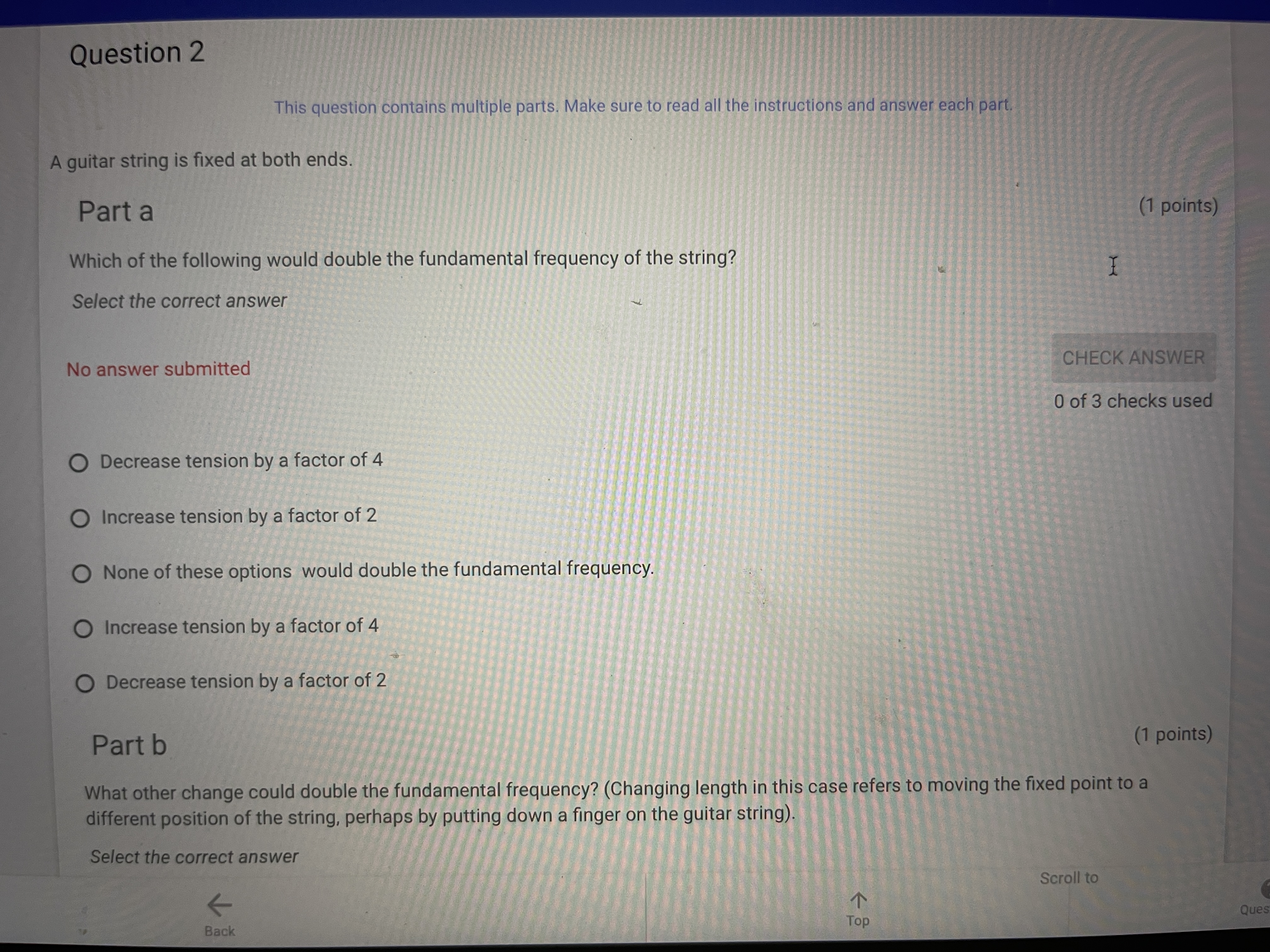
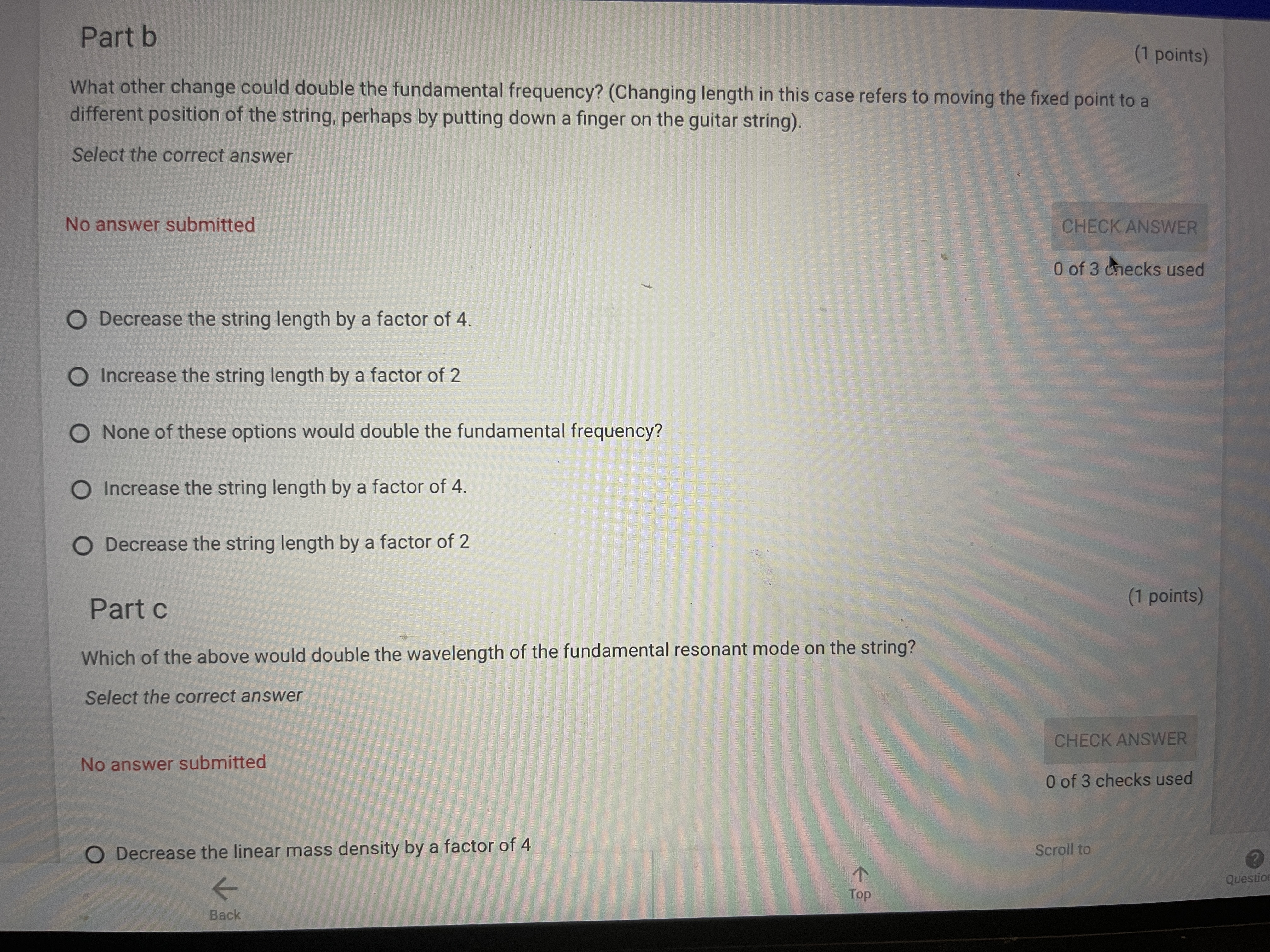
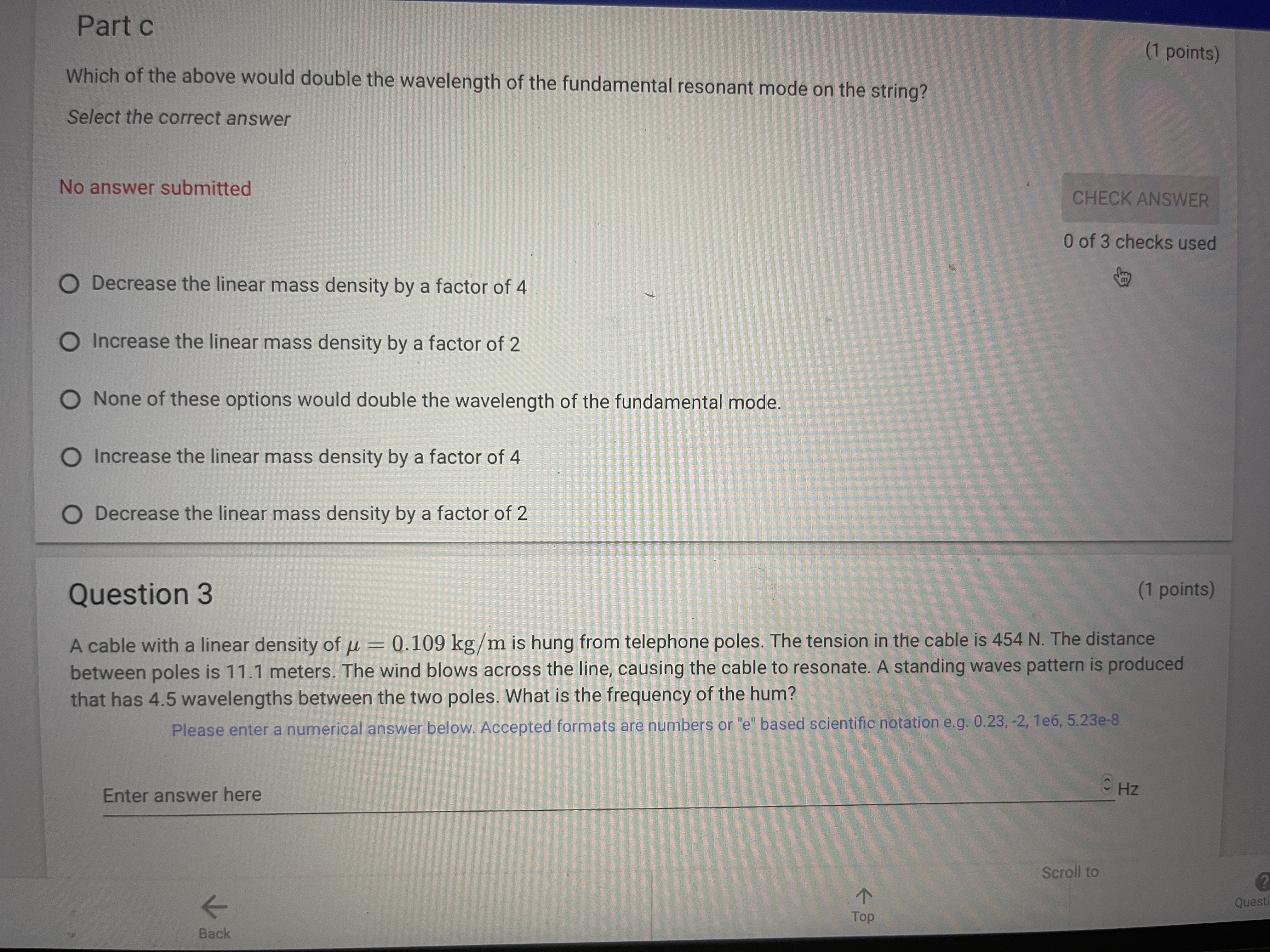
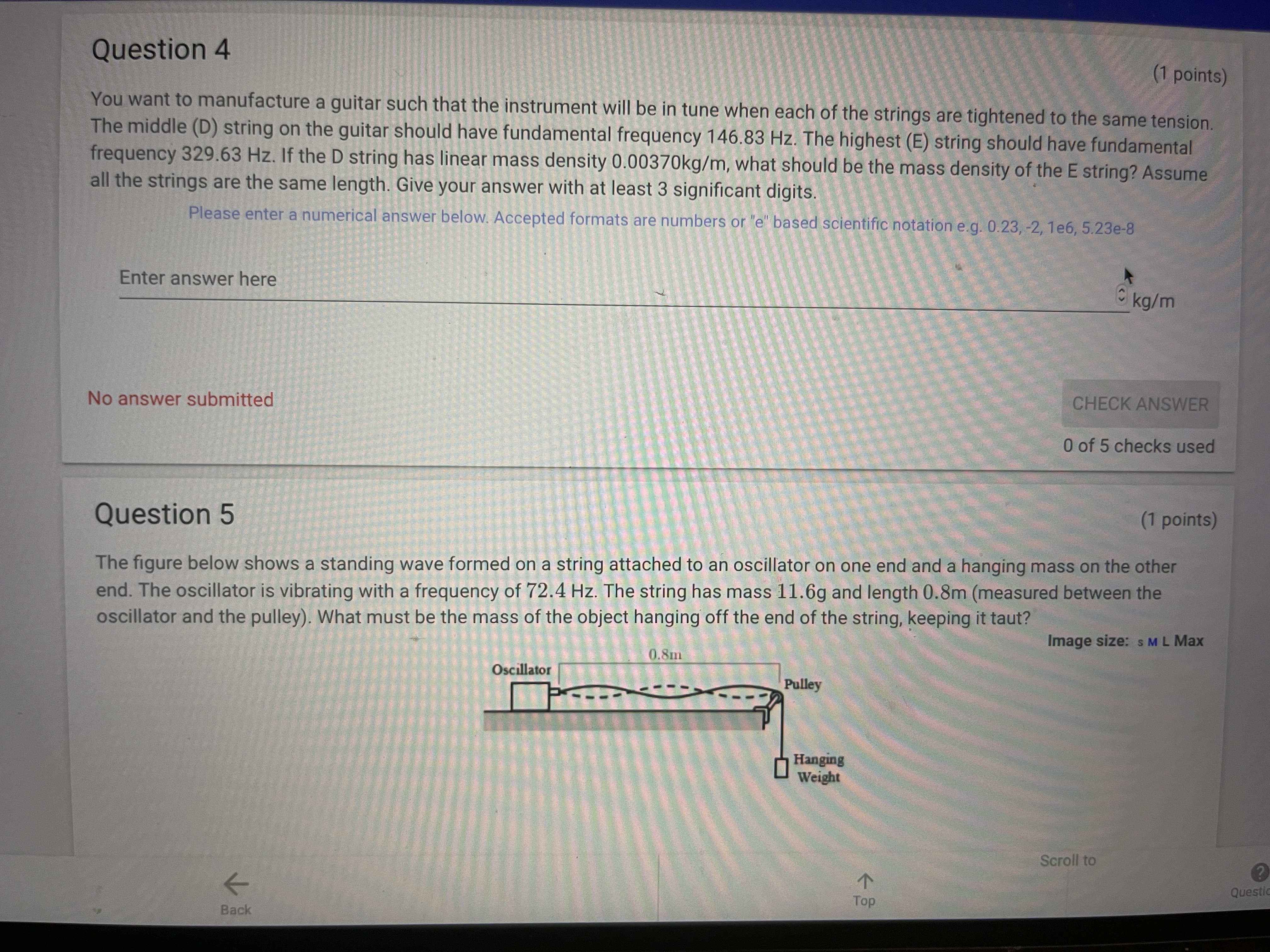
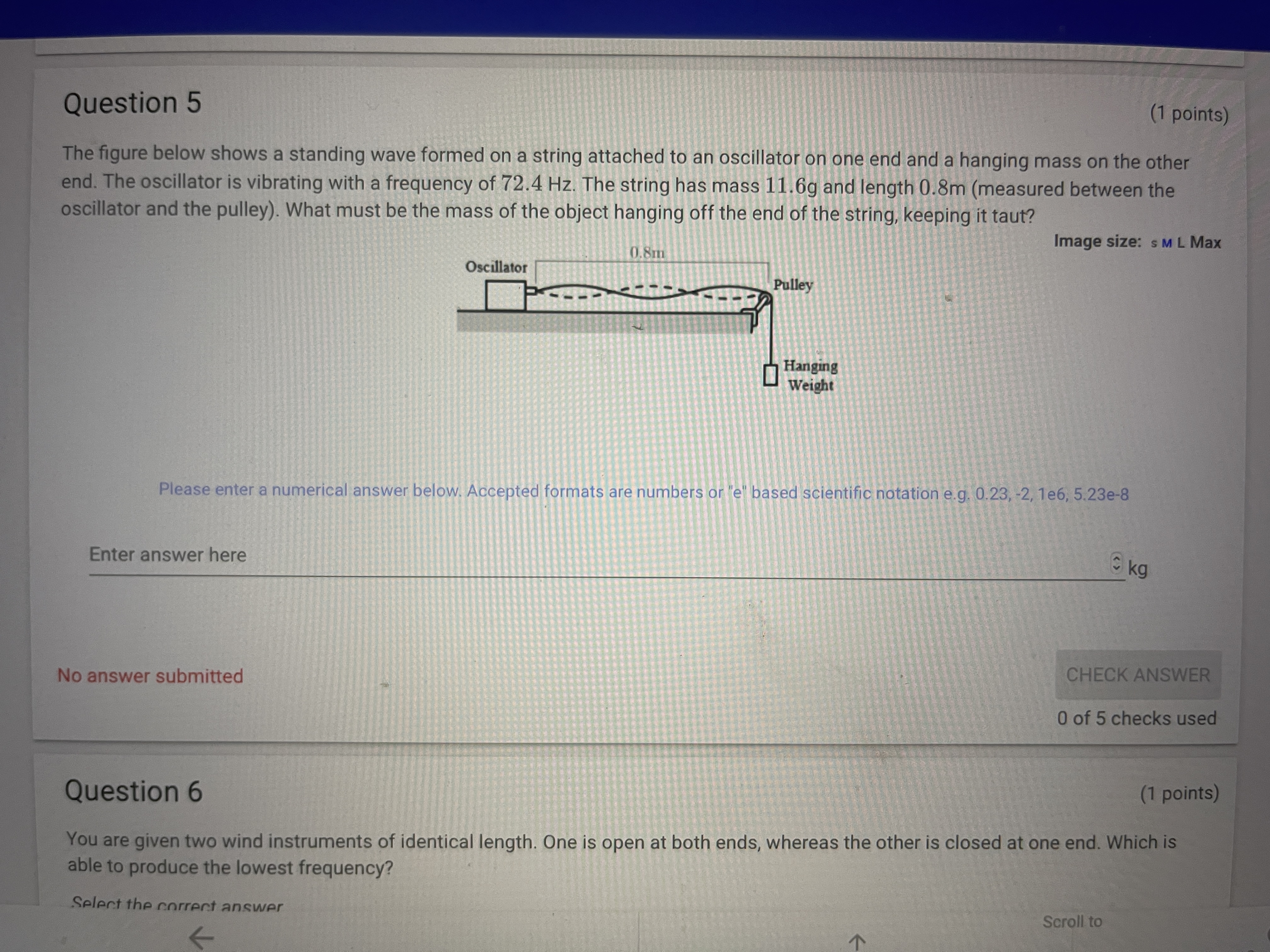
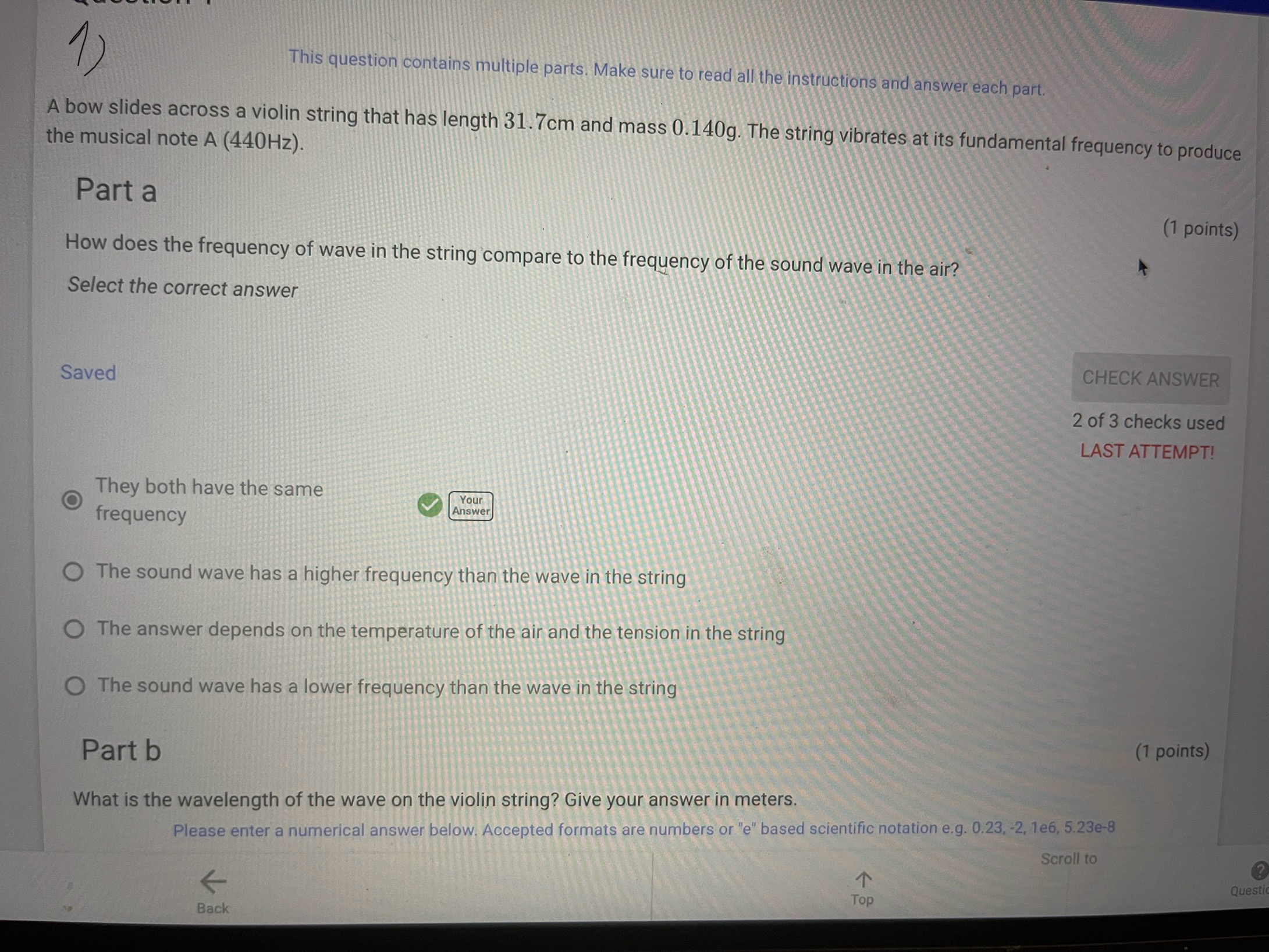
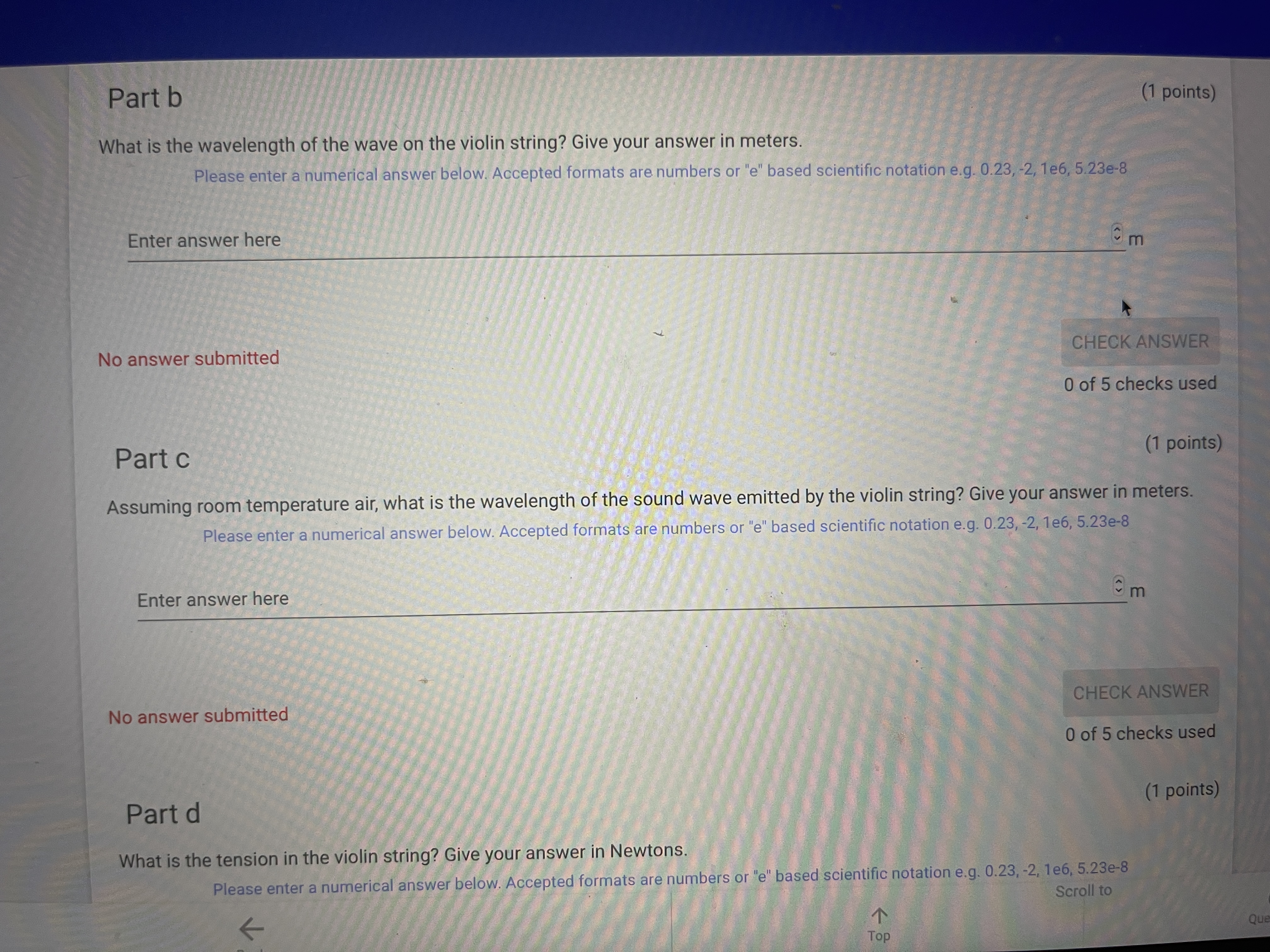
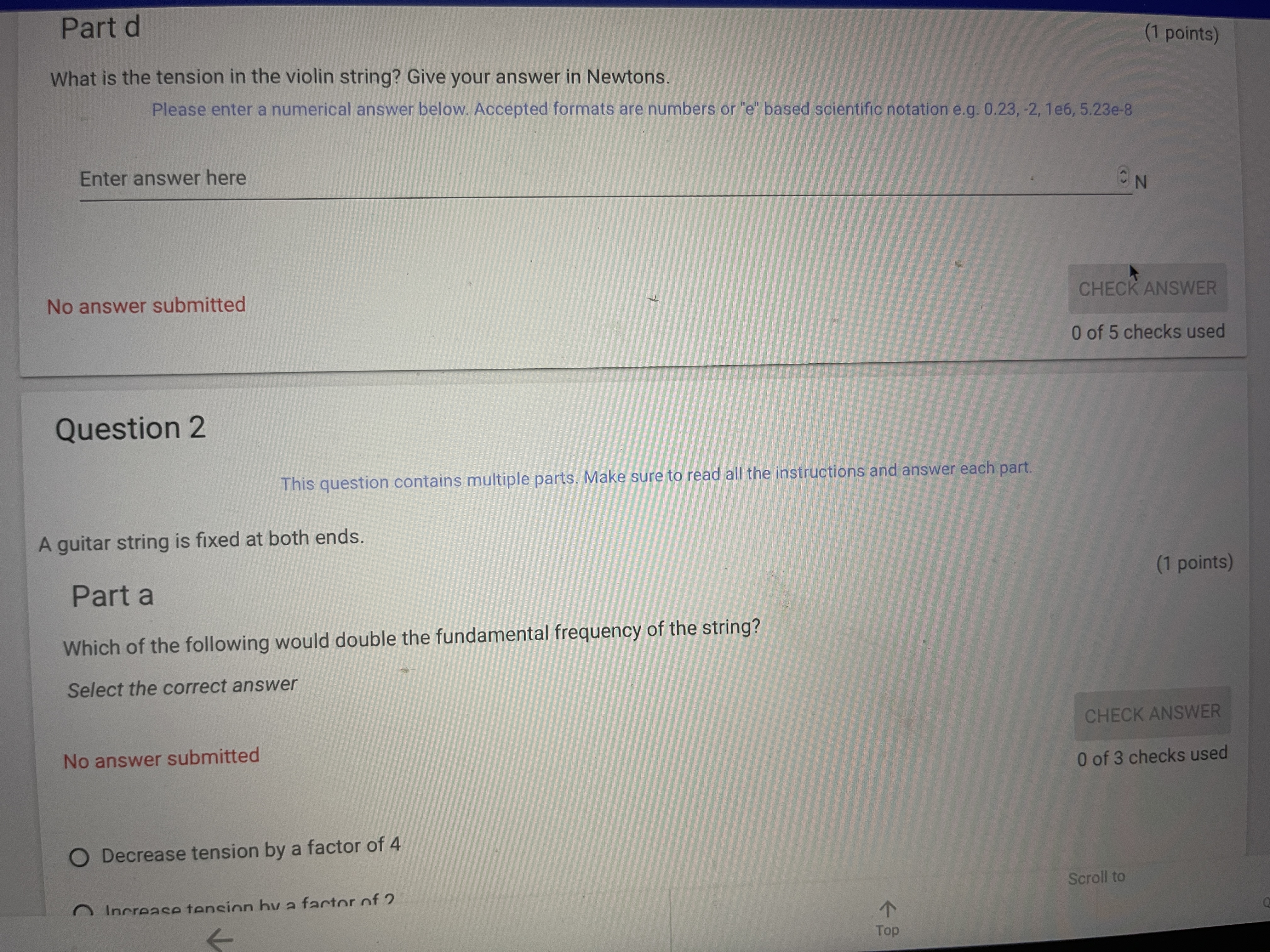
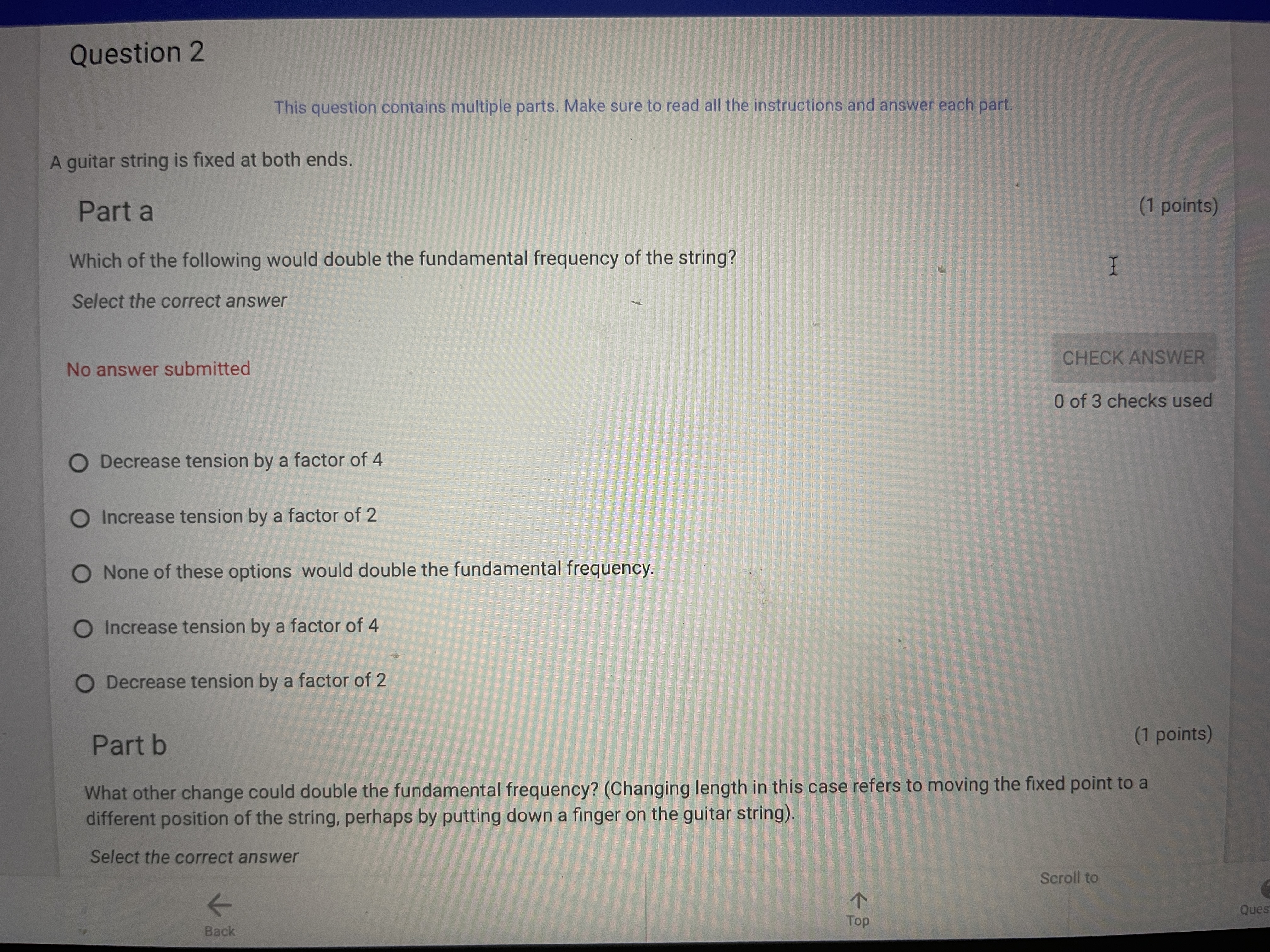
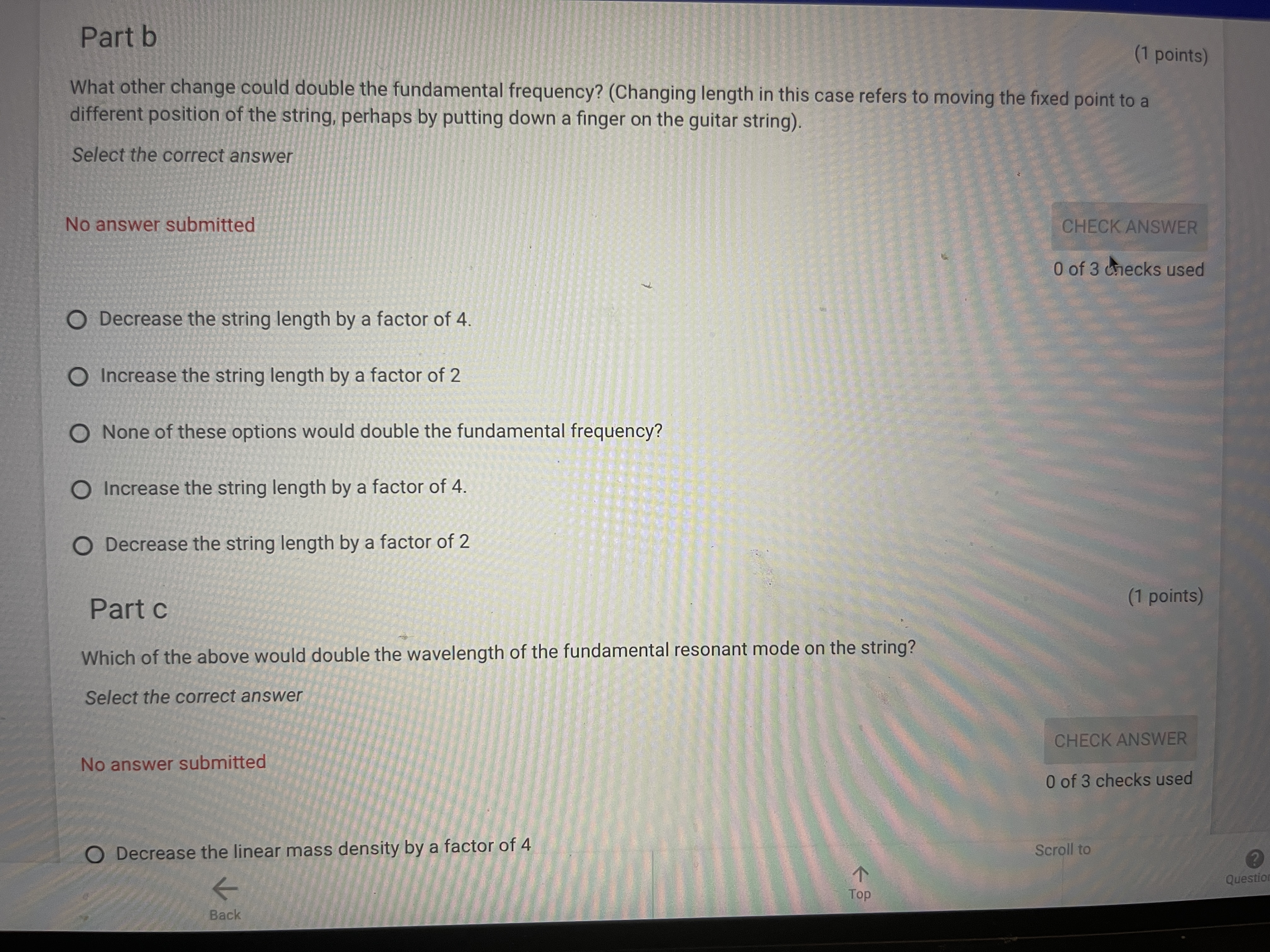
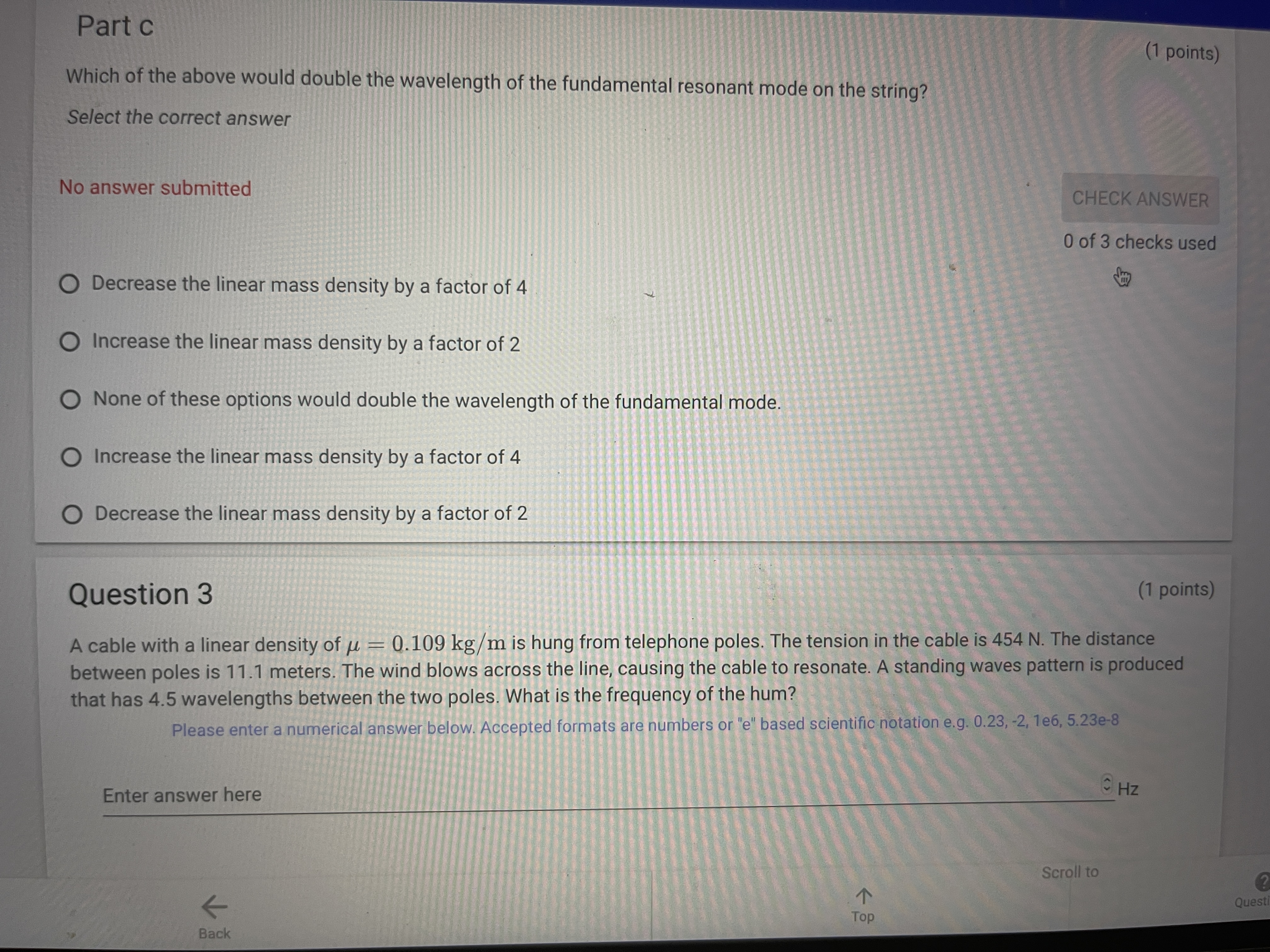
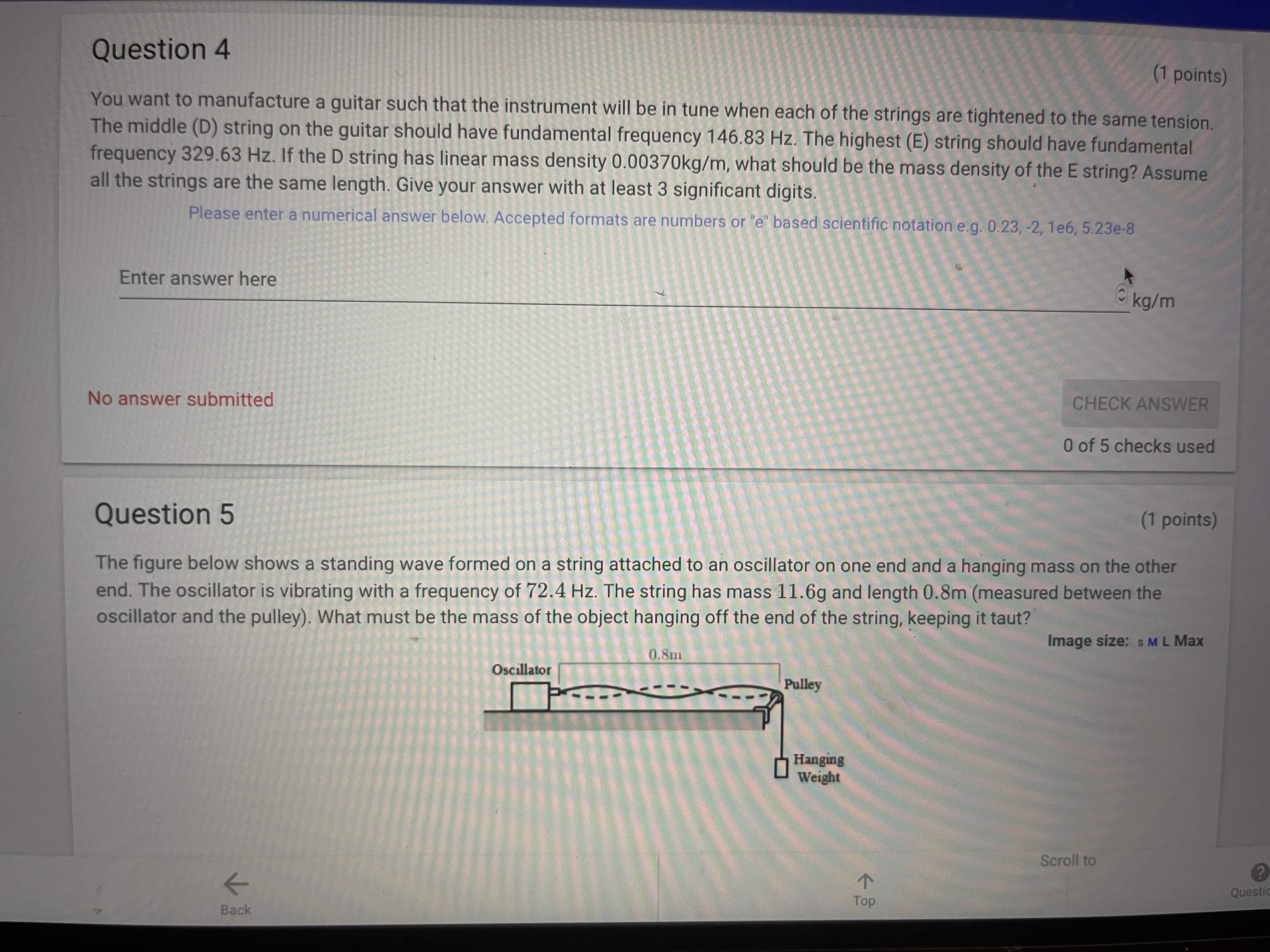
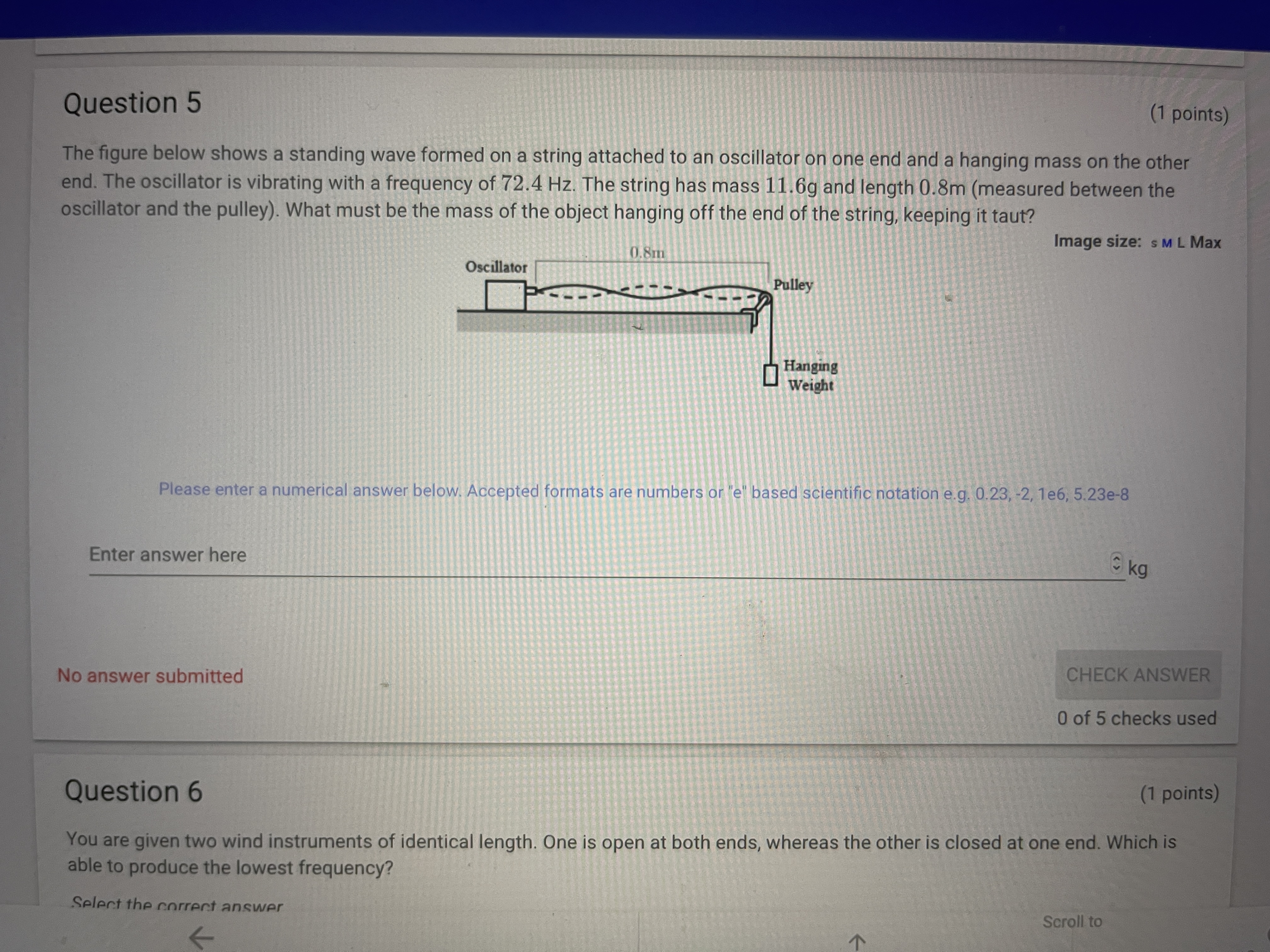
This question contains multiple parts. Make sure to read all the instructions and answer each part. A bow slides across a violin string that has length 31.7cm and mass 0.140g. The string vibrates at its fundamental frequency to produce the musical note A (440Hz) Part a (1 points) How does the frequency of wave in the string compare to the frequency of the sound wave in the air? Select the correct answer CHECK ANSWER Saved 2 of 3 checks used LAST ATTEMPT! O They both have the same Your frequency Answer The sound wave has a higher frequency than the wave in the string The answer depends on the temperature of the air and the tension in the string The sound wave has a lower frequency than the wave in the string (1 points) Part b What is the wavelength of the wave on the violin string? Give your answer in meters. Please enter a numerical answer below. Accepted formats are numbers or "e" based scientific notation e.g. 0.23, -2, 1e6, 5.23e-8 Scroll to Questi Top BackPart b (1 points) What is the wavelength of the wave on the violin string? Give your answer in meters. Please enter a numerical answer below. Accepted formats are numbers or "e" based scientific notation e.g. 0.23, -2, 1e6, 5.23e-8 Enter answer here No answer submitted CHECK ANSWER 0 of 5 checks used Part c (1 points) Assuming room temperature air, what is the wavelength of the sound wave emitted by the violin string? Give your answer in meters. Please enter a numerical answer below. Accepted formats are numbers or "e" based scientific notation e.g. 0.23, -2, 1e6, 5.23e-8 Enter answer here m No answer submitted CHECK ANSWER 0 of 5 checks used Part d (1 points) What is the tension in the violin string? Give your answer in Newtons. Please enter a numerical answer below. Accepted formats are numbers or "e" based scientific notation e.g. 0.23, -2, 1e6, 5.23e-8 Scroll to TopPart d (1 points) What is the tension in the violin string? Give your answer in Newtons. Please enter a numerical answer below. Accepted formats are numbers or"e" based scientific notation e.g. 0.23, -2, 1e6, 5.23e-8 Enter answer here No answer submitted CHECK ANSWER 0 of 5 checks used Question 2 This question contains multiple parts. Make sure to read all the instructions and answer each part. A guitar string is fixed at both ends. Part a (1 points) Which of the following would double the fundamental frequency of the string? Select the correct answer CHECK ANSWER No answer submitted 0 of 3 checks used Decrease tension by a factor of 4 Increase tensinn hy a fartor of ? Scroll to T TopQuestion 2 This question contains multiple parts. Make sure to read all the instructions and answer each part. A guitar string is fixed at both ends. Part a (1 points) Which of the following would double the fundamental frequency of the string? I Select the correct answer No answer submitted CHECK ANSWER 0 of 3 checks used Decrease tension by a factor of 4 Increase tension by a factor of 2 None of these options would double the fundamental frequency. Increase tension by a factor of 4 Decrease tension by a factor of 2 Part b (1 points) What other change could double the fundamental frequency? (Changing length in this case refers to moving the fixed point to a different position of the string, perhaps by putting down a finger on the guitar string). Select the correct answer Scroll to Back TopPart b (1 points) What other change could double the fundamental frequency? (Changing length in this case refers to moving the fixed point to a different position of the string, perhaps by putting down a finger on the guitar string). Select the correct answer No answer submitted CHECK ANSWER 0 of 3 checks used Decrease the string length by a factor of 4. Increase the string length by a factor of 2 None of these options would double the fundamental frequency? Increase the string length by a factor of 4. Decrease the string length by a factor of 2 Part c (1 points) Which of the above would double the wavelength of the fundamental resonant mode on the string? Select the correct answer CHECK ANSWER No answer submitted 0 of 3 checks used Decrease the linear mass density by a factor of 4 Scroll to T Question Top BackPart c (1 points) Which of the above would double the wavelength of the fundamental resonant mode on the string? Select the correct answer No answer submitted CHECK ANSWER 0 of 3 checks used O Decrease the linear mass density by a factor of 4 Increase the linear mass density by a factor of 2 None of these options would double the wavelength of the fundamental mode. Increase the linear mass density by a factor of 4 O Decrease the linear mass density by a factor of 2 Question 3 (1 points) A cable with a linear density of u - 0.109 kg/m is hung from telephone poles. The tension in the cable is 454 N. The distance between poles is 11.1 meters. The wind blows across the line, causing the cable to resonate. A standing waves pattern is produced that has 4.5 wavelengths between the two poles. What is the frequency of the hum? Please enter a numerical answer below. Accepted formats are numbers or "e" based scientific notation e.g. 0.23, -2, 1e6, 5.23e-8 Enter answer here Hz Scroll to Quest Top BackQuestion 4 (1 points) You want to manufacture a guitar such that the instrument will be in tune when each of the strings are tightened to the same tension. The middle (D) string on the guitar should have fundamental frequency 146.83 Hz. The highest (E) string should have fundamental frequency 329.63 Hz. If the D string has linear mass density 0.00370kg/m, what should be the mass density of the E string? Assume all the strings are the same length. Give your answer with at least 3 significant digits. Please enter a numerical answer below. Accepted formats are numbers or "e" based scientific notation e.g. 0.23, -2, 1e6, 5.23e-8 Enter answer here kg/m No answer submitted CHECK ANSWER 0 of 5 checks used Question 5 (1 points) The figure below shows a standing wave formed on a string attached to an oscillator on one end and a hanging mass on the other end. The oscillator is vibrating with a frequency of 72.4 Hz. The string has mass 11.6g and length 0.8m (measured between the oscillator and the pulley). What must be the mass of the object hanging off the end of the string, keeping it taut? Image size: s M L Max 0.8m Oscillator Pulley Hanging Weight Scroll to T Questic Top BackQuestion 5 (1 points) The figure below shows a standing wave formed on a string attached to an oscillator on one end and a hanging mass on the other end. The oscillator is vibrating with a frequency of 72.4 Hz. The string has mass 11.6g and length 0.8m (measured between the oscillator and the pulley). What must be the mass of the object hanging off the end of the string, keeping it taut? Image size: s M L Max Oscillator Pulley [Hanging Weight Please enter a numerical answer below. Accepted formats are numbers or 'e" based scientific notation e.g. 0.23, -2, 1e6, 5.23e-8 Enter answer here E kg No answer submitted CHECK ANSWER 0 of 5 checks used Question 6 (1 points) You are given two wind instruments of identical length. One is open at both ends, whereas the other is closed at one end. Which is able to produce the lowest frequency? Select the correct answer Scroll to
Step by Step Solution
There are 3 Steps involved in it

Get step-by-step solutions from verified subject matter experts
 Study Help