



Question: Trapezoidal rule and or Simpson's 1/3rd rule are commonly used to find the approximate surface area of the agricultural land or some irregular surfaces.
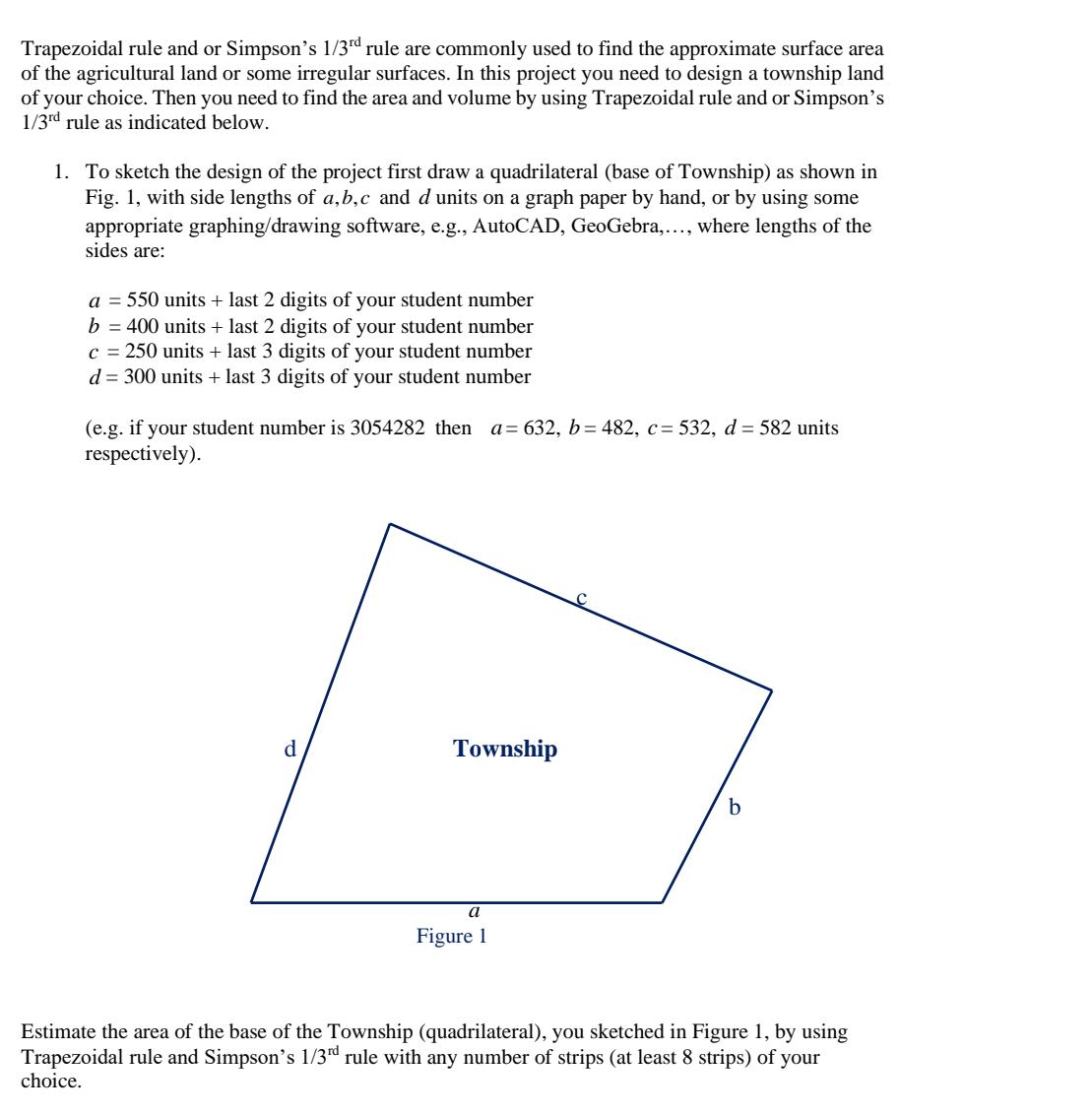
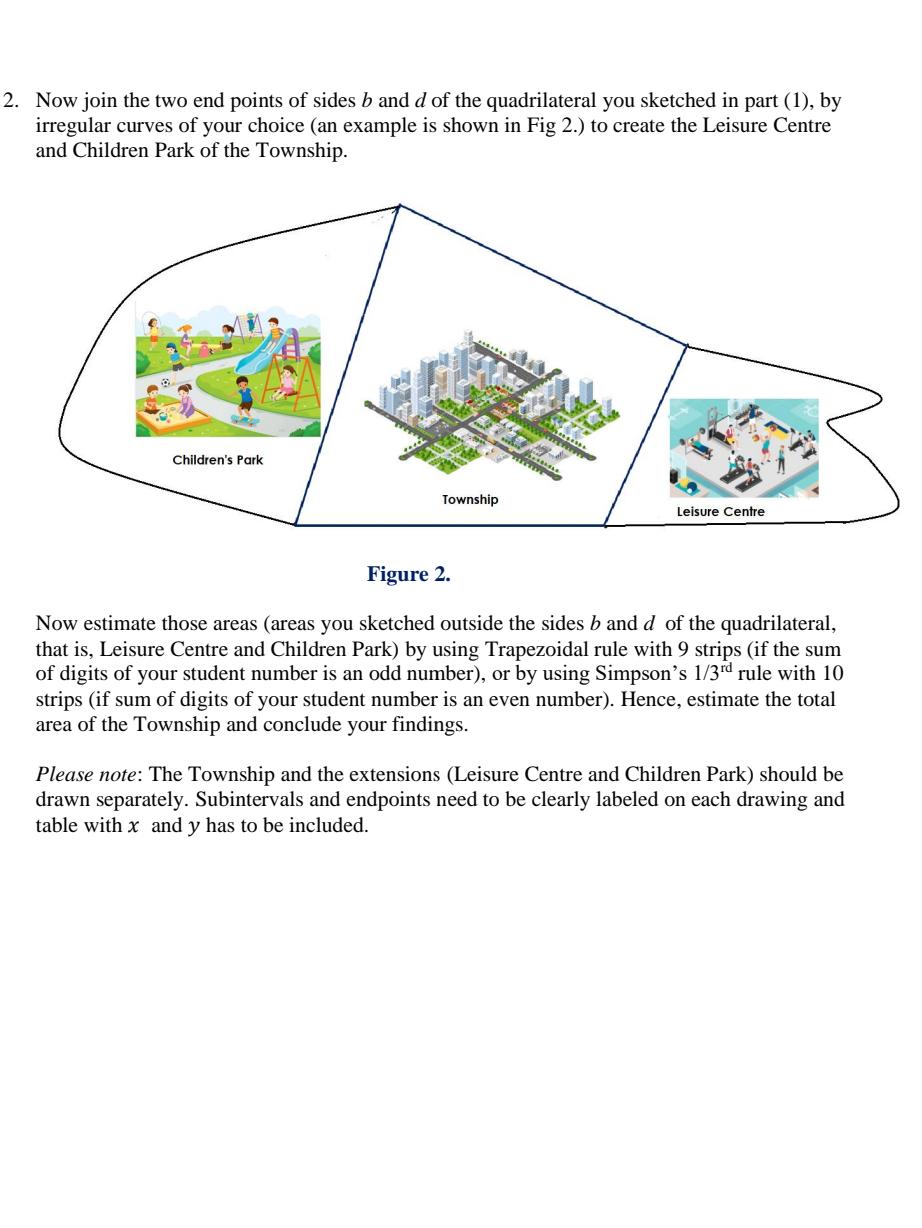
Trapezoidal rule and or Simpson's 1/3rd rule are commonly used to find the approximate surface area of the agricultural land or some irregular surfaces. In this project you need to design a township land of your choice. Then you need to find the area and volume by using Trapezoidal rule and or Simpson's 1/3rd rule as indicated below. 1. To sketch the design of the project first draw a quadrilateral (base of Township) as shown in Fig. 1, with side lengths of a,b,c and d units on a graph paper by hand, or by using some appropriate graphing/drawing software, e.g., AutoCAD, GeoGebra,..., where lengths of the sides are: a = 550 units + last 2 digits of your student number b = 400 units + last 2 digits of your student number c = 250 units + last 3 digits of your student number d = 300 units + last 3 digits of your student number (e.g. if your student number is 3054282 then a= 632, b= 482, c= 532, d= 582 units respectively). d. Township b a Figure 1 Estimate the area of the base of the Township (quadrilateral), you sketched in Figure 1, by using Trapezoidal rule and Simpson's 1/3d rule with any number of strips (at least 8 strips) of your choice. 2. Now join the two end points of sides b and d of the quadrilateral you sketched in part (1), by irregular curves of your choice (an example is shown in Fig 2.) to create the Leisure Centre and Children Park of the Township. Children's Park Township Leisure Centre Figure 2. Now estimate those areas (areas you sketched outside the sides b and d of the quadrilateral, that is, Leisure Centre and Children Park) by using Trapezoidal rule with 9 strips (if the sum of digits of your student number is an odd number), or by using Simpson's 1/3rd rule with 10 strips (if sum of digits of your student number is an even number). Hence, estimate the total area of the Township and conclude your findings. Please note: The Township and the extensions (Leisure Centre and Children Park) should be drawn separately. Subintervals and endpoints need to be clearly labeled on each drawing and table with x and y has to be included.
Step by Step Solution
3.48 Rating (158 Votes )
There are 3 Steps involved in it
To solve the given problem follow the structured steps below 1 Extracting Side Lengths From Student Number Assuming your student number is 3054282 exa... View full answer

Get step-by-step solutions from verified subject matter experts