







Question: TST102 Fundamentals of Test Evaluation Lesson 17 - Assignment Assignment 1: Developmental Test Planning You are designing a developmental test to verify that the
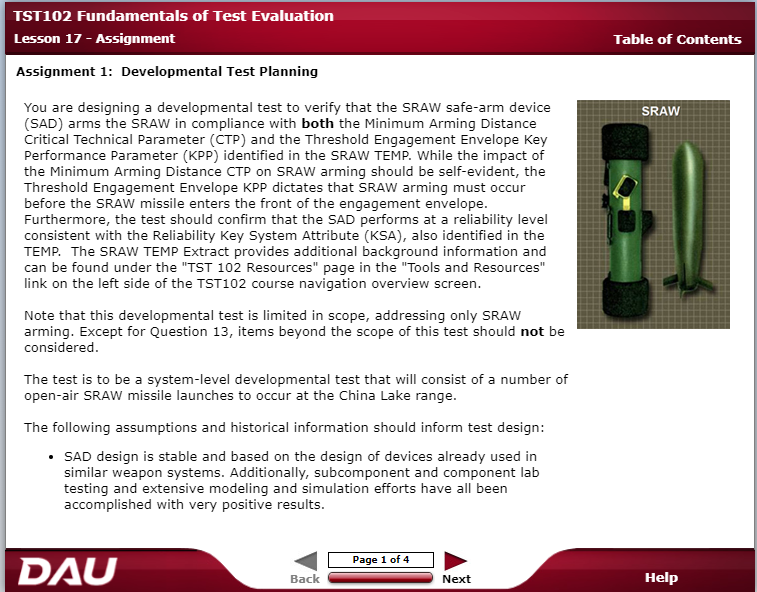
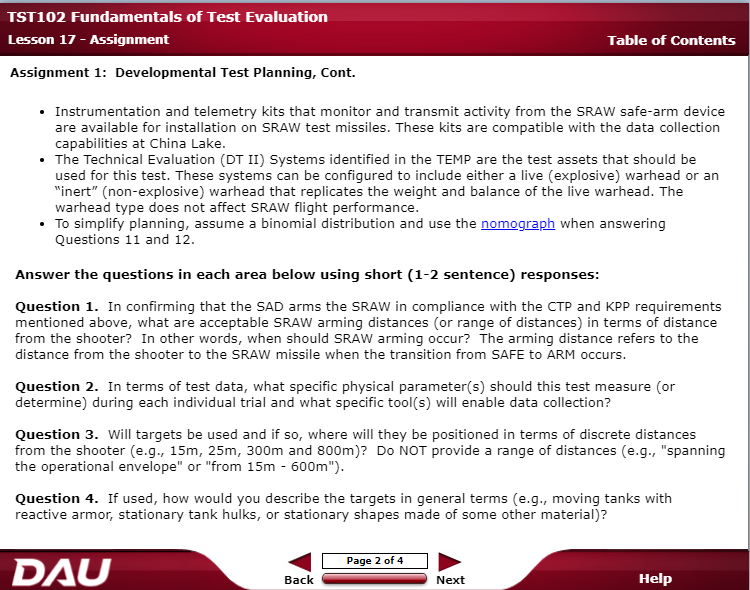
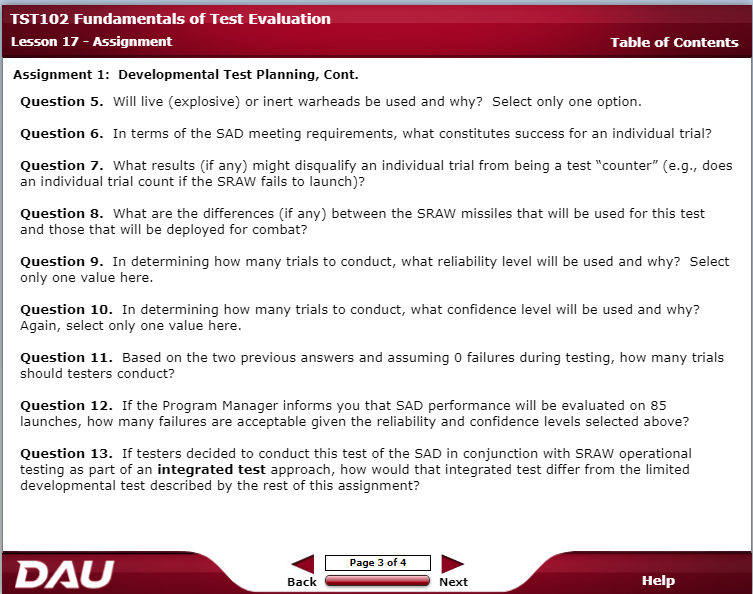
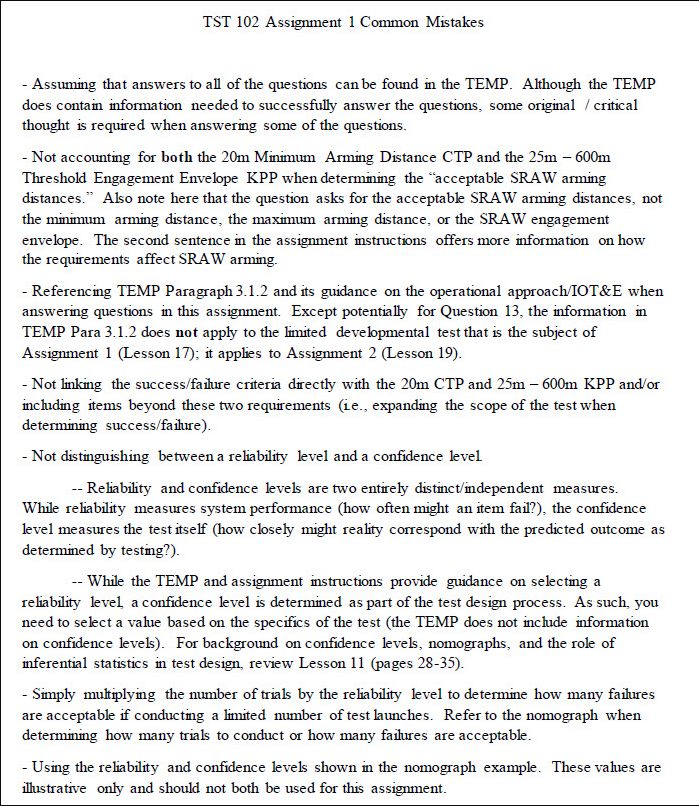
TST102 Fundamentals of Test Evaluation Lesson 17 - Assignment Assignment 1: Developmental Test Planning You are designing a developmental test to verify that the SRAW safe-arm device (SAD) arms the SRAW in compliance with both the Minimum Arming Distance Critical Technical Parameter (CTP) and the Threshold Engagement Envelope Key Performance Parameter (KPP) identified in the SRAW TEMP. While the impact of the Minimum Arming Distance CTP on SRAW arming should be self-evident, the Threshold Engagement Envelope KPP dictates that SRAW arming must occur before the SRAW missile enters the front of the engagement envelope. Furthermore, the test should confirm that the SAD performs at a reliability level consistent with the Reliability Key System Attribute (KSA), also identified in the TEMP. The SRAW TEMP Extract provides additional background information and can be found under the "TST 102 Resources" page in the "Tools and Resources" link on the left side of the TST102 course navigation overview screen. Note that this developmental test is limited in scope, addressing only SRAW arming. Except for Question 13, items beyond the scope of this test should not be considered. The test is to be a system-level developmental test that will consist of a number of open-air SRAW missile launches to occur at the China Lake range. The following assumptions and historical information should inform test design: SAD design is stable and based on the design of devices already used in similar weapon systems. Additionally, subcomponent and component lab testing and extensive modeling and simulation efforts have all been accomplished with very positive results. Table of Contents SRAW DAU Page 1 of 4 Back Next Help TST102 Fundamentals of Test Evaluation Lesson 17 - Assignment Assignment 1: Developmental Test Planning, Cont. Table of Contents Instrumentation and telemetry kits that monitor and transmit activity from the SRAW safe-arm device are available for installation on SRAW test missiles. These kits are compatible with the data collection capabilities at China Lake. The Technical Evaluation (DT II) Systems identified in the TEMP are the test assets that should be used for this test. These systems can be configured to include either a live (explosive) warhead or an "inert" (non-explosive) warhead that replicates the weight and balance of the live warhead. The warhead type does not affect SRAW flight performance. To simplify planning, assume a binomial distribution and use the nomograph when answering Questions 11 and 12. Answer the questions in each area below using short (1-2 sentence) responses: Question 1. In confirming that the SAD arms the SRAW in compliance with the CTP and KPP requirements mentioned above, what are acceptable SRAW arming distances (or range of distances) in terms of distance from the shooter? In other words, when should SRAW arming occur? The arming distance refers to the distance from the shooter to the SRAW missile when the transition from SAFE to ARM occurs. Question 2. In terms of test data, what specific physical parameter(s) should this test measure (or determine) during each individual trial and what specific tool(s) will enable data collection? Question 3. Will targets be used and if so, where will they be positioned in terms of discrete distances from the shooter (e.g., 15m, 25m, 300m and 800m)? Do NOT provide a range of distances (e.g., "spanning the operational envelope" or "from 15m - 600m"). Question 4. If used, how would you describe the targets in general terms (e.g., moving tanks with reactive armor, stationary tank hulks, or stationary shapes made of some other material)? DAU Page 2 of 4 Back Next Help TST102 Fundamentals of Test Evaluation Lesson 17 - Assignment Assignment 1: Developmental Test Planning, Cont. Table of Contents Question 5. Will live (explosive) or inert warheads be used and why? Select only one option. Question 6. In terms of the SAD meeting requirements, what constitutes success for an individual trial? Question 7. What results (if any) might disqualify an individual trial from being a test "counter" (e.g., does an individual trial count if the SRAW fails to launch)? Question 8. What are the differences (if any) between the SRAW missiles that will be used for this test and those that will be deployed for combat? Question 9. In determining how many trials to conduct, what reliability level will be used and why? Select only one value here. Question 10. In determining how many trials to conduct, what confidence level will be used and why? Again, select only one value here. Question 11. Based on the two previous answers and assuming 0 failures during testing, how many trials should testers conduct? Question 12. If the Program Manager informs you that SAD performance will be evaluated on 85 launches, how many failures are acceptable given the reliability and confidence levels selected above? Question 13. If testers decided to conduct this test of the SAD in conjunction with SRAW operational testing as part of an integrated test approach, how would that integrated test differ from the limited developmental test described by the rest of this assignment? DAU Page 3 of 4 Back Next Help TST 102 Assignment 1 Common Mistakes - Assuming that answers to all of the questions can be found in the TEMP. Although the TEMP does contain information needed to successfully answer the questions, some original / critical thought is required when answering some of the questions. - Not accounting for both the 20m Minimum Arming Distance CTP and the 25m - 600m Threshold Engagement Envelope KPP when determining the "acceptable SRAW arming distances." Also note here that the question asks for the acceptable SRAW arming distances, not the minimum arming distance, the maximum arming distance, or the SRAW engagement envelope. The second sentence in the assignment instructions offers more information on how the requirements affect SRAW arming. -Referencing TEMP Paragraph 3.1.2 and its guidance on the operational approach/IOT&E when answering questions in this assignment. Except potentially for Question 13, the information in TEMP Para 3.1.2 does not apply to the limited developmental test that is the subject of Assignment 1 (Lesson 17); it applies to Assignment 2 (Lesson 19). - Not linking the success/failure criteria directly with the 20m CTP and 25m - 600m KPP and/or including items beyond these two requirements (ie., expanding the scope of the test when determining success/failure). - Not distinguishing between a reliability level and a confidence level -- Reliability and confidence levels are two entirely distinct/independent measures. While reliability measures system performance (how often might an item fail?), the confidence level measures the test itself (how closely might reality correspond with the predicted outcome as determined by testing?). -- While the TEMP and assignment instructions provide guidance on selecting a reliability level, a confidence level is determined as part of the test design process. As such, you need to select a value based on the specifics of the test (the TEMP does not include information on confidence levels). For background on confidence levels, nomographs, and the role of inferential statistics in test design, review Lesson 11 (pages 28-35). - Simply multiplying the number of trials by the reliability level to determine how many failures are acceptable if conducting a limited number of test launches. Refer to the nomograph when determining how many trials to conduct or how many failures are acceptable. - Using the reliability and confidence levels shown in the nomograph example. These values are illustrative only and should not both be used for this assignment.
Step by Step Solution
There are 3 Steps involved in it
It appears youre asking about a specific assignment related to the SRAW shoulderlaunched weapon system safearm device SAD test planning based on the content in the images youve uploaded Here are the q... View full answer

Get step-by-step solutions from verified subject matter experts
 Study Help