







Question: We consider a team of a > 1 engineers that may be allocated to n 1 projects (each engineer can work on at most
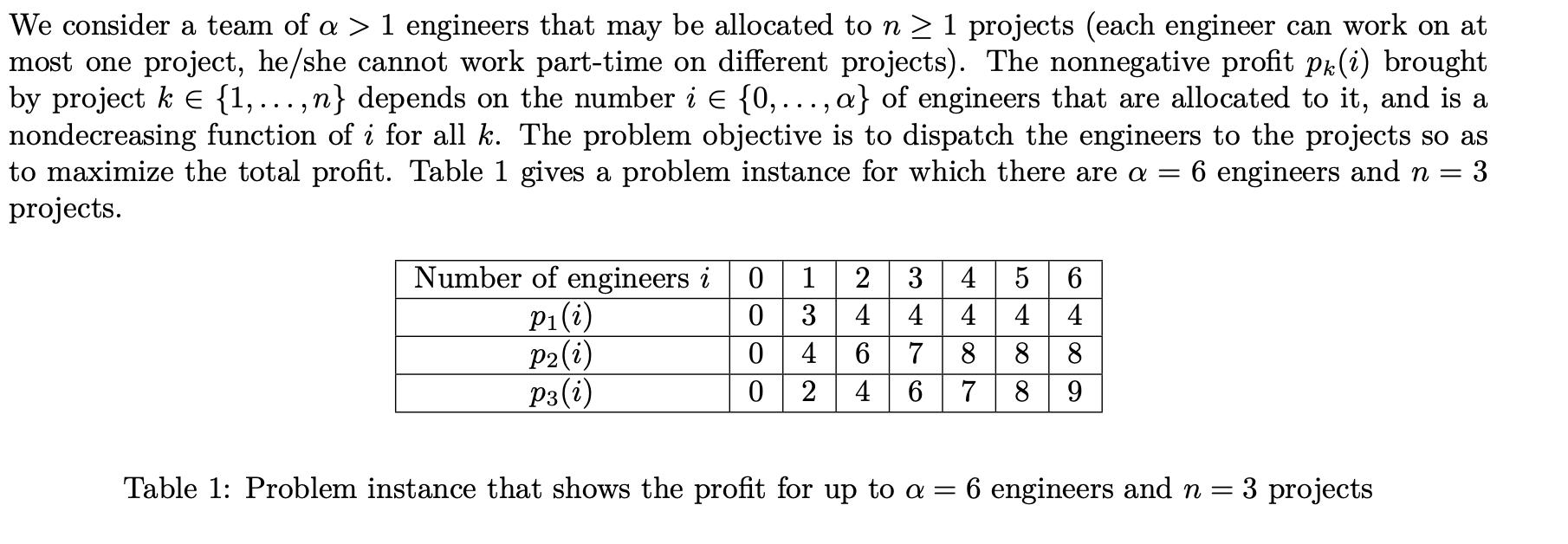
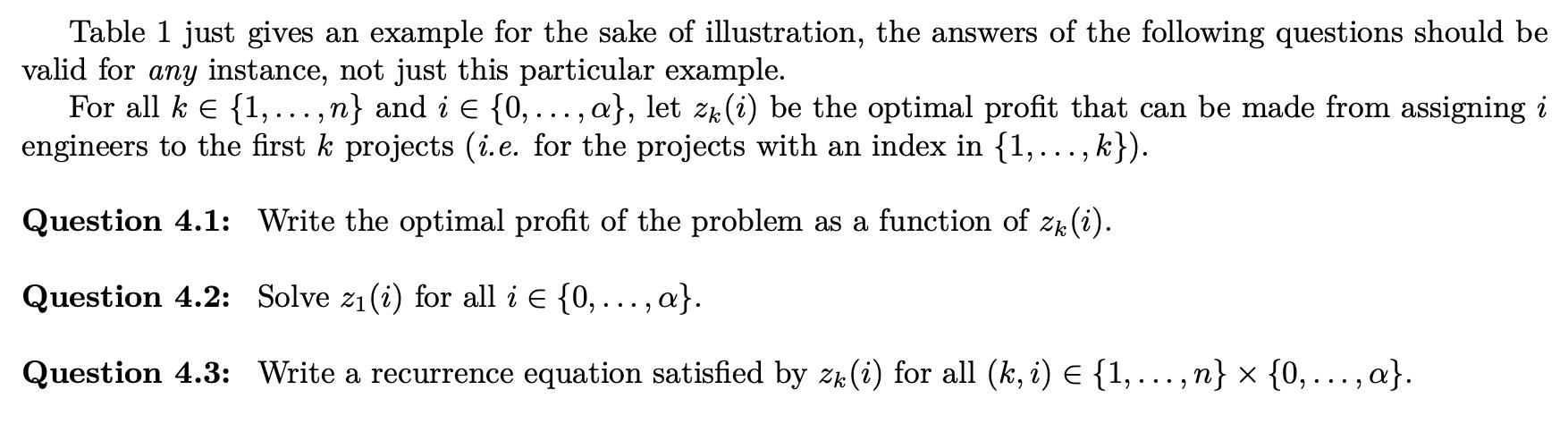
We consider a team of a > 1 engineers that may be allocated to n 1 projects (each engineer can work on at most one project, he/she cannot work part-time on different projects). The nonnegative profit pk(i) brought by project k {1,...,n} depends on the number i {0,..., a} of engineers that are allocated to it, and is a nondecreasing function of i for all k. The problem objective is to dispatch the engineers to the projects so as to maximize the total profit. Table 1 gives a problem instance for which there are a = 6 engineers and n = = 3 projects. Number of engineers i P(i) P2(i) P3 (i) 0 0 0 0 1 2 3 4 5 6 3 4 4 4 4 4 4 6 7 8 8 8 2 4 6 7 8 9 Table 1: Problem instance that shows the profit for up to a = 6 engineers and n = 3 projects Table 1 just gives an example for the sake of illustration, the answers of the following questions should be valid for any instance, not just this particular example. For all ke {1,. .. ,n} and i = {0,..., a}, let zk(i) be the optimal profit that can be made from assigning i engineers to the first k projects (i.e. for the projects with an index in {1, ..., k}). Question 4.1: Write the optimal profit of the problem as a function of zk(i). Question 4.2: Solve z (i) for all i = {0, ..., a}. Question 4.3: Write a recurrence equation satisfied by zk(i) for all (k, i) {1, ..., n} {0,..., a}.
Step by Step Solution
There are 3 Steps involved in it
We are given a profit table that shows the profit for assigning up to 6 engineers to n 3 projects an... View full answer

Get step-by-step solutions from verified subject matter experts
 Study Help