







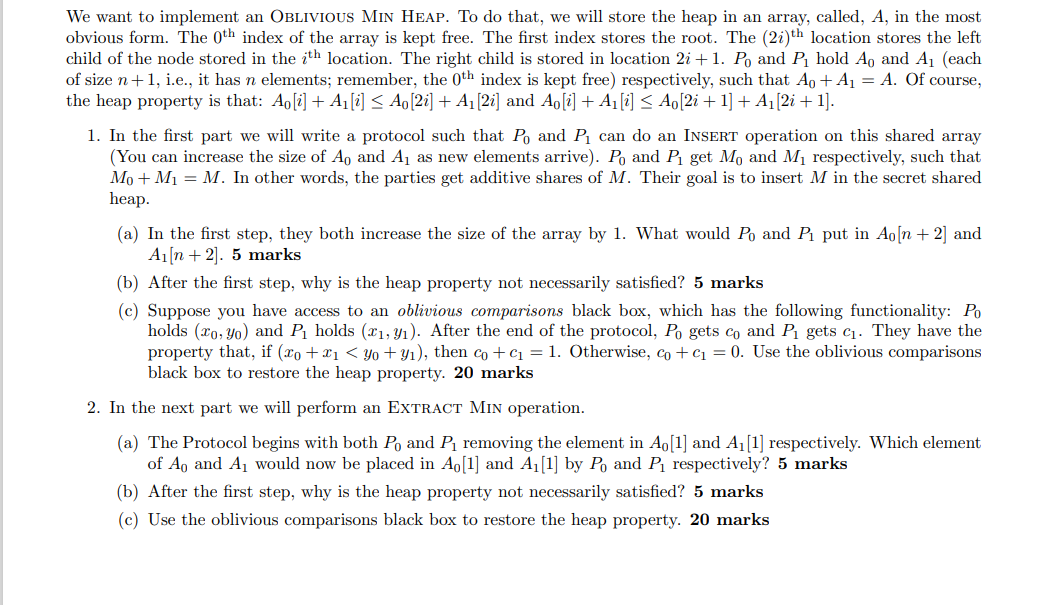
Question: We want to implement an Oblivious Min Heap. To do that, we will store the heap in an array, called, A , in the most
We want to implement an Oblivious Min Heap. To do that, we will store the heap in an array, called, in the most
obvious form. The index of the array is kept free. The first index stores the root. The location stores the left
child of the node stored in the location. The right child is stored in location and hold and each
of size ie it has elements; remember, the index is kept free respectively, such that Of course,
the heap property is that: and
In the first part we will write a protocol such that and can do an INSERT operation on this shared array
You can increase the size of and as new elements arrive and get and respectively, such that
In other words, the parties get additive shares of Their goal is to insert in the secret shared
heap.
a In the first step, they both increase the size of the array by What would and put in and
marks
b After the first step, why is the heap property not necessarily satisfied? marks
c Suppose you have access to an oblivious comparisons black box, which has the following functionality:
holds and holds After the end of the protocol, gets and gets They have the
property that, if
Step by Step Solution
There are 3 Steps involved in it
1 Expert Approved Answer
Step: 1 Unlock

Question Has Been Solved by an Expert!
Get step-by-step solutions from verified subject matter experts
Step: 2 Unlock
Step: 3 Unlock
 Study Help