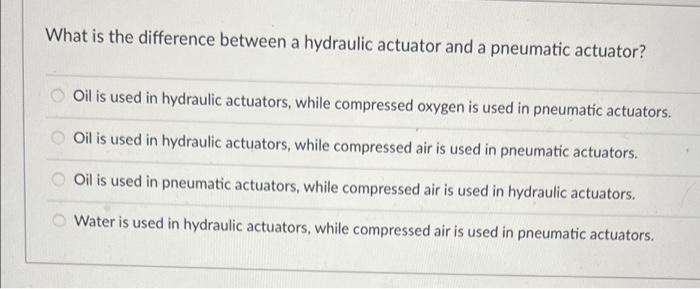
Question: What is the difference between a hydraulic actuator and a pneumatic actuator? Oil is used in hydraulic actuators, while compressed oxygen is used in pneumatic
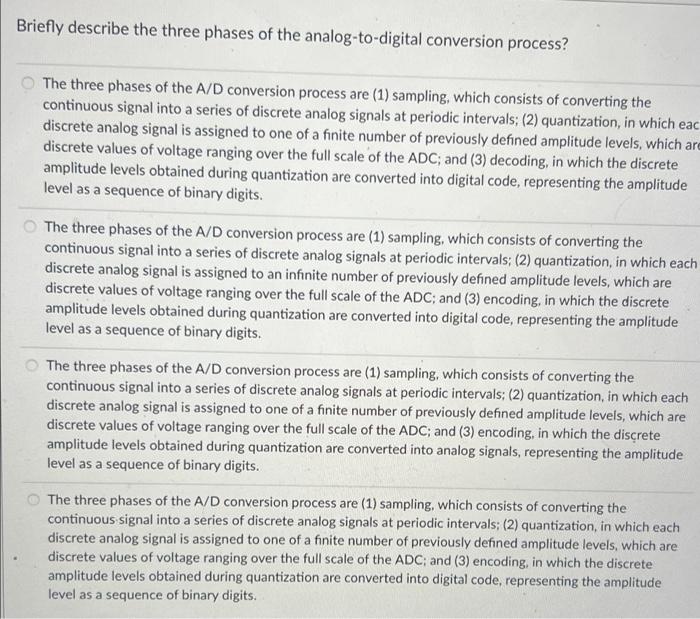
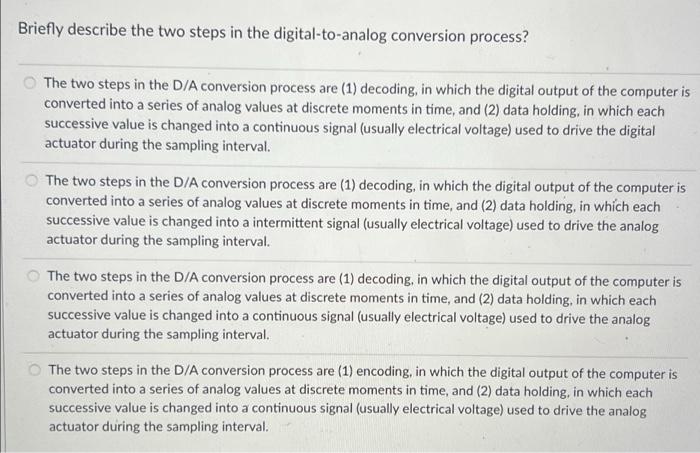
What is the difference between a hydraulic actuator and a pneumatic actuator? Oil is used in hydraulic actuators, while compressed oxygen is used in pneumatic actuators. Oil is used in hydraulic actuators, while compressed air is used in pneumatic actuators. Oil is used in pneumatic actuators, while compressed air is used in hydraulic actuators. Water is used in hydraulic actuators, while compressed air is used in pneumatic actuators. Briefly describe the three phases of the analog-to-digital conversion process? The three phases of the A/D conversion process are (1) sampling, which consists of converting the continuous signal into a series of discrete analog signals at periodic intervals; (2) quantization, in which eac discrete analog signal is assigned to one of a finite number of previously defined amplitude levels, which are discrete values of voltage ranging over the full scale of the ADC; and (3) decoding, in which the discrete amplitude levels obtained during quantization are converted into digital code, representing the amplitude level as a sequence of binary digits. The three phases of the A/D conversion process are (1) sampling, which consists of converting the continuous signal into a series of discrete analog signals at periodic intervals; (2) quantization, in which each discrete analog signal is assigned to an infinite number of previously defined amplitude levels, which are discrete values of voltage ranging over the full scale of the ADC; and (3) encoding, in which the discrete amplitude levels obtained during quantization are converted into digital code, representing the amplitude level as a sequence of binary digits. The three phases of the A/D conversion process are (1) sampling, which consists of converting the continuous signal into a series of discrete analog signals at periodic intervals; (2) quantization, in which each discrete analog signal is assigned to one of a finite number of previously defined amplitude levels, which are discrete values of voltage ranging over the full scale of the ADC; and (3) encoding, in which the discrete amplitude levels obtained during quantization are converted into analog signals, representing the amplitude level as a sequence of binary digits. The three phases of the A/D conversion process are (1) sampling, which consists of converting the continuous signal into a series of discrete analog signals at periodic intervals: (2) quantization, in which each discrete analog signal is assigned to one of a finite number of previously defined amplitude levels, which are discrete values of voltage ranging over the full scale of the ADC; and (3) encoding, in which the discrete amplitude levels obtained during quantization are converted into digital code, representing the amplitude level as a sequence of binary digits. a Briefly describe the two steps in the digital-to-analog conversion process? The two steps in the D/A conversion process are (1) decoding, in which the digital output of the computer is converted into a series of analog values at discrete moments in time, and (2) data holding, in which each successive value is changed into a continuous signal (usually electrical voltage) used to drive the digital actuator during the sampling interval. The two steps in the D/A conversion process are (1) decoding, in which the digital output of the computer is converted into a series of analog values at discrete moments in time, and (2) data holding, in which each successive value is changed into a intermittent signal (usually electrical voltage) used to drive the analog actuator during the sampling interval. The two steps in the D/A conversion process are (1) decoding, in which the digital output of the computer is converted into a series of analog values at discrete moments in time, and (2) data holding, in which each successive value is changed into a continuous signal (usually electrical voltage) used to drive the analog actuator during the sampling interval. The two steps in the D/A conversion process are (1) encoding, in which the digital output of the computer is converted into a series of analog values at discrete moments in time, and (2) data holding, in which each successive value is changed into a continuous signal (usually electrical voltage) used to drive the analog actuator during the sampling interval









 Study Help