







Question: You are asked to design a digital logic circuit that has three inputs A, B and C and two outputs X and Y. The
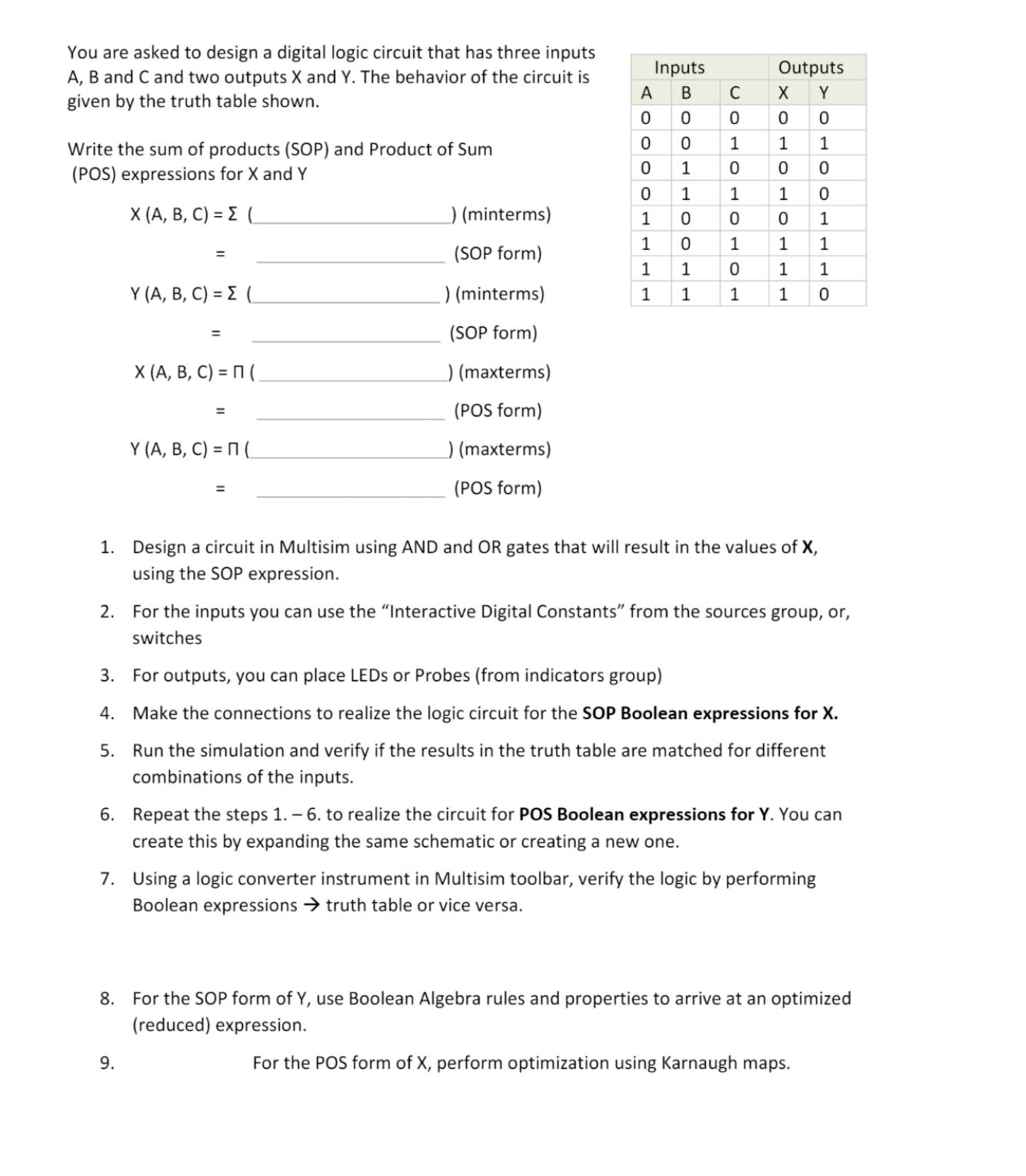
You are asked to design a digital logic circuit that has three inputs A, B and C and two outputs X and Y. The behavior of the circuit is given by the truth table shown. Write the sum of products (SOP) and Product of Sum (POS) expressions for X and Y X (A, B, C) = ( = Y (A, B, C) = ( X (A, B, C) = 1 ( = Y (A, B, C) = n( = 9. __) (minterms) (SOP form) _) (minterms) (SOP form) _) (maxterms) (POS form) ) (maxterms) (POS form) Inputs A B TATTOO O OD TTO OTTO OW 0 0 0 1 COLOHOOL 1 0 1 1 1 0 1 1 0 Outputs Y XOHO 1 1 0 1 1 CLLL 0 0 1 1 1. Design a circuit in Multisim using AND and OR gates that will result in the values of X, using the SOP expression. (1T0OOTOA 2. For the inputs you can use the "Interactive Digital Constants" from the sources group, or, switches 3. For outputs, you can place LEDs or Probes (from indicators group) 4. Make the connections to realize the logic circuit for the SOP Boolean expressions for X. 5. Run the simulation and verify if the results in the truth table are matched for different combinations of the inputs. 6. Repeat the steps 1.-6. to realize the circuit for POS Boolean expressions for Y. You can create this by expanding the same schematic or creating a new one. 7. Using a logic converter instrument in Multisim toolbar, verify the logic by performing Boolean expressions truth table or vice versa. 8. For the SOP form of Y, use Boolean Algebra rules and properties to arrive at an optimized (reduced) expression. For the POS form of X, perform optimization using Karnaugh maps.
Step by Step Solution
3.32 Rating (152 Votes )
There are 3 Steps involved in it
Solutions Step1 In given the question Three input ... View full answer

Get step-by-step solutions from verified subject matter experts
 Study Help