



Question: You have the following context-free gramma: S -> ABA A -> abA | baB | a B -> AB | ab Using the grammar
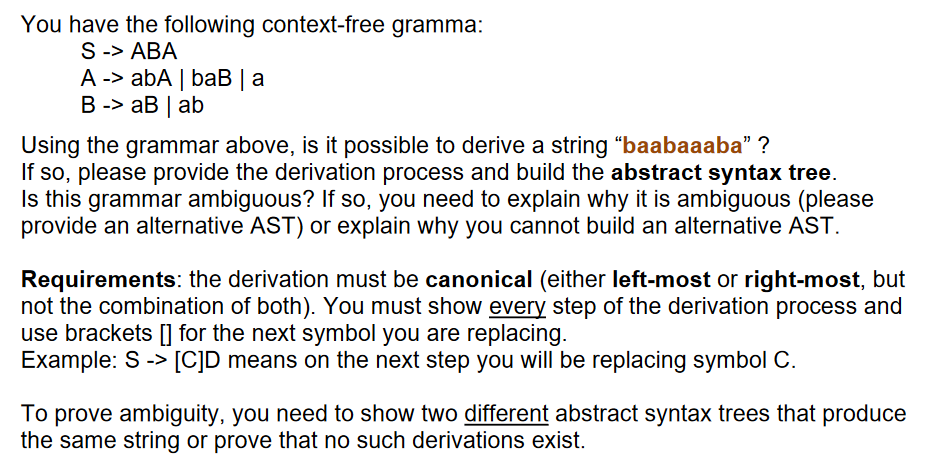
You have the following context-free gramma: S -> ABA A -> abA | baB | a B -> AB | ab Using the grammar above, is it possible to derive a string "baabaaaba"? If so, please provide the derivation process and build the abstract syntax tree. Is this grammar ambiguous? If so, you need to explain why it is ambiguous (please provide an alternative AST) or explain why you cannot build an alternative AST. Requirements: the derivation must be canonical (either left-most or right-most, but not the combination of both). You must show every step of the derivation process and use brackets [] for the next symbol you are replacing. Example: S -> [C]D means on the next step you will be replacing symbol C. To prove ambiguity, you need to show two different abstract syntax trees that produce the same string or prove that no such derivations exist.
Step by Step Solution
There are 3 Steps involved in it
Steps Step 1 of 2 It is possible to derive the string baabaaaba using the provided context... View full answer

Get step-by-step solutions from verified subject matter experts