







Question: Consider the triangular train of pulses x(t) in Figure 1.23. (a) Carefully plot the derivative of x(t), y(t) = dx(t)/dt. (b) Can you compute If
Consider the triangular train of pulses x(t) in Figure 1.23.
(a) Carefully plot the derivative of x(t), y(t) = dx(t)/dt.
(b) Can you compute
![| [(x(t) – 0.5]dt? z(t) =](https://dsd5zvtm8ll6.cloudfront.net/si.question.images/images/question_images/1544/8/8/9/2255c152389820221544871802415.jpg)
If so, what is it equal to? If not, explain why not.
(c) Is x(t) a finite energy signal? how about y(t)?
Figure 1.23:
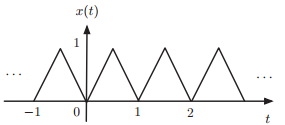
| [(x(t) – 0.5]dt? z(t) = x(t) -1 1
Step by Step Solution
★★★★★
3.31 Rating (166 Votes )
There are 3 Steps involved in it
1 Expert Approved Answer
Step: 1 Unlock

a The derivative signal yt dxtdt is a train of rectan... View full answer
Question Has Been Solved by an Expert!
Get step-by-step solutions from verified subject matter experts
Step: 2 Unlock
Step: 3 Unlock
 Study Help