







Question: The article referred to in Exercise 15 also presents measurements of Young??s modulus for side members of T-braced assemblies. The following table presents data in
The article referred to in Exercise 15 also presents measurements of Young??s modulus for side members of T-braced assemblies. The following table presents data in which the factors are the length of the side member and its method of attachment. There were 10 replications for each combination of factors. The data (in kN/mm2) are consistent with the means and standard deviations given in the article.
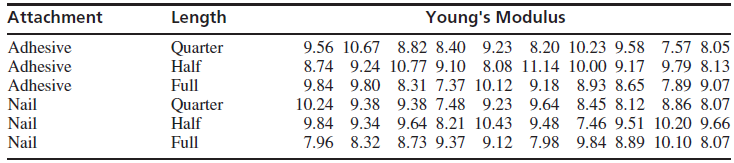
a. Compute all main effects and interactions.
b. Construct an ANOVA table. You may give ranges for the P-values.
c. Is the additive model plausible? Provide the value of a test statistic and the P-value.
d. Can the effect of attachment method (nail versus adhesive) on Young??s modulus be described by interpreting the main effects of attachment method? If so, interpret the main effects. If not, explain why not.
e. Can the effect of side member length on Young??s modulus be described by interpreting the main effects of side member length? If so, interpret the main effects, using multiple comparisons at the 5% level if necessary. If not, explain why not.
Referred to in Exercise 15
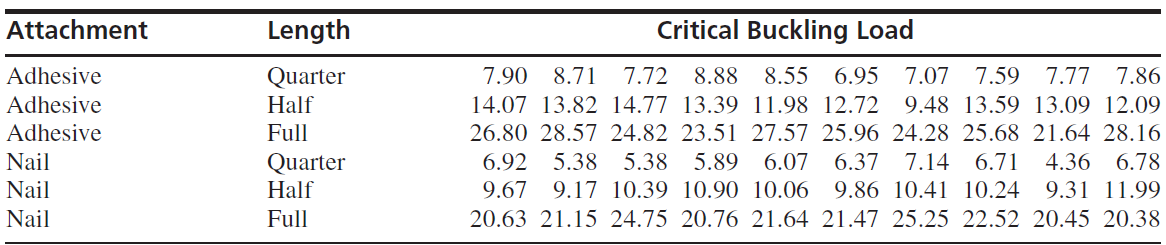
The article ??T-Bracing for Stability of Compression Webs in Wood Trusses?? (R. Leichti, I. Hofaker, et al., Journal of Structural Engineering, 2002:374??381) presents results of experiments in which critical buckling loads (in kN) for T-braced assemblies were estimated by a finite-element method. The following table presents data in which the factors are the length of the side member and its method of attachment. There were 10 replications for each combination of factors. The data are consistent with the means and standard deviations given in the article.
Attachment Length Young's Modulus Adhesive Adhesive Adhesive Quarter Half 9.56 10.67 8.82 8.40 9.23 8.20 10.23 9.58 7.57 8.05 8.74 9.24 10.77 9.10 8.08 11.14 10.00 9.17 9.79 8.13 Full 9.84 9.80 8.31 7.37 10.12 9.18 8.93 8.65 7.89 9.07 Nail Quarter Half 10.24 9.38 9.38 7.48 9.23 9.64 8.45 8.12 8.86 8.07 Nail 9.84 9.34 9.64 8.21 10.43 9.48 7.46 9.51 10.20 9.66 Nail Full 7.96 8.32 8.73 9.37 9.12 7.98 9.84 8.89 10.10 8.07
Step by Step Solution
3.58 Rating (166 Votes )
There are 3 Steps involved in it
a b c The additive model is quite plausible F 254 ... View full answer

Get step-by-step solutions from verified subject matter experts
 Study Help